Vehicle Driving Characteristics and Driver Assistance Systems (ABS, EDS, ASR, ESP)
Economical and Environmentally Friendly Driving
Fuel consumption, exhaust emissions, and wear of the engine, brakes and tires depend on various factors.
Driving style has a significant effect on fuel economy, exhaust emissions and noise level.
Do not warm up the engine at idle.
Warming up at idle takes a long time, and engine wear and exhaust emissions are especially high during warm-up. Therefore, as soon as the engine starts, begin driving, avoiding high engine speeds.
Avoid acceleration with the accelerator pedal fully depressed.
By metering accelerator pedal input precisely, you can significantly reduce fuel consumption, while also reducing exhaust emissions and wear of moving parts.
While driving, avoid unnecessarily high engine speeds. Shift up as early as possible, and shift down only when necessary to prevent the engine from running unevenly.
For example, fuel consumption in 2nd gear is more than twice as high as when driving in the highest gear. At the same time, lower engine speed reduces engine noise.
Whenever possible, do not drive at maximum speed.
As speed increases, fuel consumption, harmful emissions and noise level increase disproportionately.
Drive as smoothly as possible, anticipating road conditions.
Unnecessary maneuvering with acceleration and braking results in increased fuel consumption and environmental pollution.
Switch off the engine during stops caused by traffic conditions.
Specific operating conditions also affect fuel consumption.
The following situations, for example, are unfavorable for fuel consumption:
Heavy traffic, especially on city streets with numerous traffic lights.
Driving with frequent stops, with starting and warming up the engine before each new trip.
Driving in a traffic jam in low gears, with a relatively high engine speed per unit distance traveled.
When planning your trips in advance, avoid frequent stops, traffic jams and similar situations whenever possible.
Naturally, fuel consumption also depends on factors the driver cannot influence. It is normal, for example, for consumption to increase in winter or when operating under severe conditions (poor road surface, towing a trailer, etc.).
Technical data
Fuel economy and efficiency are built into the vehicle during its design and manufacture. Particular importance was given to reducing environmental pollution. To ensure optimal performance and preserve these qualities, observe the following recommendations:
Carry out scheduled maintenance according to the maintenance schedule.
Maintenance according to the schedule ensures not only constant readiness for operation, but also economy, reduced environmental pollution and durability.
Check the tire pressure every 4 weeks.
When the pressure drops below the specified value, rolling resistance increases. As a result, not only does fuel consumption increase, but tire wear is also accelerated. At the same time, the vehicle's handling characteristics deteriorate.
Do not carry unnecessary ballast in the luggage compartment.
Especially when driving in the city and when frequent stops are required, the vehicle's weight has a significant effect on fuel consumption.
Remove the roof rack immediately after use.
Fuel consumption increases, especially at high speed, due to increased aerodynamic drag.
Switch on electrical consumers only when absolutely necessary.
The rear window defroster, auxiliary lamps, heater blower and air conditioner* consume a considerable amount of power. The corresponding increase in alternator load increases fuel consumption.
Monitor fuel consumption regularly.
Check fuel consumption at every refueling. This allows you to detect faults leading to excessive fuel consumption in good time.
Check the oil level when refueling.
Oil consumption depends to a large extent on engine load and engine speed.
Oil consumption can be reliably assessed only after the first 5000 km.
The same applies to fuel consumption and engine output.
Normal operation of the catalytic converter is a decisive condition for vehicle operation.
Therefore, the following rules must be observed without exception:
Fill a vehicle equipped with a catalytic converter only with unleaded fuel.
Even a single refueling with leaded gasoline reduces the effectiveness of the converter.
If the vehicle has been operated on leaded fuel, the catalytic converter must be replaced.
Never run the fuel tank dry on a vehicle equipped with a catalytic converter.
A fuel supply disruption may cause ignition misfires. As a result, unburned fuel enters the exhaust system. This may lead to overheating and damage to the catalytic converter.
If ignition misfires, power loss or rough engine running occur while driving, the cause may be a malfunction in the ignition system. In this case, unburned fuel may enter the exhaust system and then the atmosphere. In addition, the catalytic converter may be damaged by overheating. Reduce speed immediately and have the fault rectified at the nearest authorized service center.
Do not overfill the engine with oil above the maximum mark.
Do not tow the vehicle for a distance of more than 50 m to start the engine.
When parking the vehicle, remember the following:
CAUTION
The catalytic converter heats up to a very high temperature. Do not park the vehicle on dry leaves or other flammable materials.Driving on poor roads
To prevent damage to your vehicle, observe the following:
When driving onto a ramp, over a curb, on poor roads, etc., make sure that components under the underbody, such as the spoiler and exhaust pipe, are not damaged.
This applies especially to vehicles with low suspension (sport version) and when the vehicle is fully loaded.
Braking
General information
New brake pads must bed in and therefore do not provide optimum braking during the first 400 km after replacement. The reduced braking effectiveness is compensated by applying greater force to the brake pedal. During the break-in period, avoid hard braking, especially at very high speed, as well as braking on steep ascents and descents (for example, mountain passes).
Under certain operating conditions, for example after driving through water, in heavy rain or after washing, braking effect may be reduced due to moisture, and in winter brake pads or discs may even freeze. In this case, dry the brakes by applying light braking. Reduced braking effect is also possible after a long period without using the brakes when driving on roads treated with salt. First, remove the salt layer from the brake discs and pads by light braking.
Corrosion of the brake discs and contamination of the brake pads are promoted by prolonged vehicle idling, low mileage and low brake system loads.
If the brake system is subjected to low loads for a long time, or if corrosion appears, clean the brake discs and pads to restore normal brake operation by applying the brakes firmly several times at a medium vehicle speed.
Perform this braking only in favorable road conditions and only if it does not present a hazard to other road users.
A sudden increase in brake pedal travel may indicate failure of one circuit of the dual-circuit brake system. In this case, drive slowly to the nearest Audi service station, taking into account the increased pedal effort and braking distance. Check the brake fluid level regularly.
A drop in fluid level below normal is indicated by the brake system warning lamp or the vehicle fault indication system* (refer to the subsection Instruments and Warning Systems. Warning and Diagnostic Systems).
Brake Booster
The brake booster operates only when vacuum is generated by the running engine. Therefore, never allow the vehicle to coast with the engine off.
When the brake booster does not operate, for example due to damage or when towing the vehicle, the pedal effort must be considerably greater to compensate for the missing booster effect.
Use of Additional Floor Mats for the Driver
Nothing must ever interfere with the operation of the pedals. Therefore, never place objects under the feet that could slide under the pedals.
In the event of brake system malfunction, increased pedal travel may be required to brake.
It must be possible to fully depress the clutch and accelerator pedals at all times.
All pedals must be able to return to their original positions without obstruction.
No floor mats or other additional items covering the floor may be placed in the pedal area.
Therefore, only floor mats that do not extend into the pedal area and that can be secured to prevent them from shifting are permitted.
CAUTION
Never place any objects in the footwell. During sudden maneuvers or braking, they may get under the pedals, and you will not be able to operate the brake, clutch or accelerator pedals!Anti-Lock Brake System (ABS)
ABS contributes significantly to improving vehicle safety. The decisive advantage of an ABS brake system over a conventional one is that the wheels do not lock even during emergency braking on slippery roads. As a result, steerability and stability of the vehicle are maintained to the greatest extent possible.
However, do not assume that ABS will shorten the braking distance under all circumstances. When driving on gravel or freshly fallen snow lying on top of a slippery road surface, where extreme caution and minimum speed are already required, the braking distance may even increase slightly.
ABS Operating Principle
When the vehicle reaches a speed of approximately 6 km/h, an automatic monitoring process begins. A pump noise may be heard.
When a wheel tends to lock, the brake pressure in that wheel's brake circuit is reduced. This control process is noticeable as pulsation of the brake pedal and is accompanied by characteristic noises. This serves as a warning to the driver that one or more wheels are operating close to a skid. To ensure optimum control effect of ABS in this mode, keep the brake pedal fully depressed and never pump the brakes!
CAUTION
ABS cannot overcome the limits of physics. Keep this in mind, especially on slippery or wet roads. At the first sign of wheel slip, reduce speed immediately to suit the traffic and road conditions.Increased safety must not encourage dangerous risk-taking.
A malfunction of the anti-lock brake system is indicated by the warning lamp. Refer to the subsection Instruments and Warning Systems. Warning and Diagnostic Systems.
Electronic Differential Lock (EDS)*
EDS works together with ABS. EDS operates automatically, i.e. without driver intervention.
Using the ABS sensors, the system monitors the rotational speed of the driven wheels up to a speed of approximately 40 km/h or 80 km/h.
ABS brakes spinning wheels (for example, on a slippery road surface), and higher torque is transmitted to the wheels with better road grip.
The following recommendations must be observed:
When starting off, depress the accelerator pedal according to road conditions. If a wheel spins (for example, one wheel on ice), depress the accelerator pedal so that the vehicle starts moving.
When accelerating on a road surface that is equally slippery across its full width, such as ice or snow, depress the accelerator pedal carefully. Especially on front-wheel-drive vehicles, the driven wheels may still spin despite EDS, which can compromise driving stability.
EDS is temporarily switched off to prevent overheating of the disc brake of the braking wheel under unusually high loads. The vehicle remains ready for operation and has the same dynamic characteristics as a vehicle without EDS.
CAUTION
Driving style must match road surface and traffic conditions. The increased driving safety provided by EDS must not encourage hazardous risk-taking!Anti-Slip Regulation (ASR)*
ASR prevents the driven wheels from spinning when starting off and accelerating by reducing engine torque. ASR works together with ABS across the entire speed range. If ABS malfunctions, ASR will also not operate.
ASR is switched on automatically when the engine is started. If necessary, it can be switched on and off by pressing the button in the switch row. Refer to the subsection Switches and Controls.
When the system is switched off, the ASR warning lamp illuminates. Refer to the subsection Instruments and Warning Systems. Warning and Diagnostic Systems. ASR should normally always be switched on. Only in specific exceptional cases, when wheel slip is required, should it be switched off, namely:
– when driving with the emergency spare wheel installed* – when driving with snow chains – when driving through deep snow or loose ground – when attempting to rock the vehicle free after getting stuck, and – when driving up inclines with extremely different traction between the drive wheels (for example, ice under the left wheel and dry asphalt under the right). Afterwards, switch the device back on.
CAUTION
Driving style must match road surface and traffic conditions. The increased driving safety provided by ASR must not encourage hazardous risk-taking! Trouble-free ASR operation requires the same tires on all four wheels. Using different tires may reduce engine power.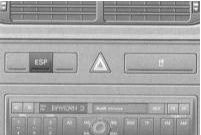
Electronic Stabilization Program (ESP)*
ESP improves the effectiveness of vehicle dynamics control in critical situations, for example during acceleration and cornering.
ESP extends the functions of ABS / ASR and reduces the risk of skidding under all driving conditions. This improves vehicle stability while driving.
ESP works together with ABS across the entire speed range. If ABS fails, ESP will not work either.
ESP switches on automatically when the engine is started and performs a self-diagnosis.
If necessary, ESP can be switched on and off by pressing the (ESP) button.
When ESP is switched off, its indicator lamp illuminates. Refer to the subsection Instrument and Warning Displays. Warning and Diagnostic Systems.
ESP should always be switched on. Only in certain exceptional cases, when wheel slip is required, should it be switched off, namely:
– when driving through deep snow or loose ground – when attempting to rock the vehicle free after getting stuck.
Afterwards, switch ESP back on.
When ESP is switched off, ABS and EDS remain operational.
Operating Principle
The Electronic Stabilization Program includes ABS, EDS and ASR. In addition to the data supplied by these systems, the ESP control unit requires further parameters, which are obtained by means of highly sensitive sensors. The rotation rate of the vehicle about its vertical axis, lateral acceleration, brake system pressure and steering wheel angle are measured.
The driver's intended direction of travel is determined from the steering angle and vehicle speed and is continuously compared with the actual vehicle behavior. If there are deviations, for example when the vehicle begins to skid, ESP automatically brakes the appropriate wheel.
Braking an individual wheel generates effective forces that stabilize the vehicle. When there is a tendency for the rear axle to skid, the braking force is applied mainly to the front wheel on the outside of the turn. When there is a tendency for the front of the vehicle to skid, the rear wheel closest to the center of the turn is braked. ESP operation is accompanied by noise.
CAUTION
ESP cannot overcome the limits of physics. Keep this in mind, especially on slippery or wet roads.Driving style must match road surface conditions and traffic situation. The increased safety provided by ESP must not encourage dangerous risk-taking!
Permanent All-Wheel Drive (quattro)*
The all-wheel drive system of your vehicle operates automatically.
Torque is distributed automatically, optimally matched to vehicle dynamics and the prevailing road conditions.
Thanks to its all-wheel drive layout, designed for high engine output, your Audi is an exceptionally capable vehicle with outstanding handling, both on normal road surfaces and in extreme conditions such as snow or ice.
Always observe the following safety rules:
CAUTION
Driving style must match the road surface and the specific traffic conditions. The increased safety provided by ABS and four-wheel drive models must not encourage hazardous risk-taking!Braking capability is limited by tire grip on the road and is no different from that of a two-wheel-drive vehicle.
For this reason, strong acceleration, which remains available even on slippery surfaces, must never encourage excessive speed.
When driving on wet roads, remember that at excessive speed the front wheels may lose contact with the road surface (hydroplane). Unlike front-wheel-drive vehicles, the onset of hydroplaning is not accompanied by a sudden increase in engine speed. Therefore avoid excessive speeds and adapt your speed to the prevailing road conditions.
Driving on Unpaved Roads
The Audi is not an off-road vehicle. Its ground clearance is too low for this.
Winter Tires
Even with standard tires, all-wheel-drive vehicles have good traction in winter conditions. However, to improve handling and braking efficiency, fit winter tires or all-season tires on all four wheels. Also refer to the subsection Checking Tire Condition and Tire Pressure. Tire and Wheel Designation.
Using Snow Chains
Regulations requiring the use of snow chains also apply to all-wheel-drive vehicles. For more detailed information on using snow chains, refer to the subsection Wheel Rotation and Replacement. Snow Chains.
Test yourself
A quick Audi A3 quiz: every answer comes with an explanation and a link to the manual page.