Electric parking brake
In automatic operation, this system applies the parking brake when the engine is switched off and releases it as soon as the vehicle moves off.
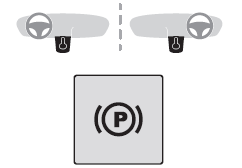
At any time, with the engine running: ► To apply the parking brake, briefly pull the control.
► To release it, briefly push the control while pressing the brake pedal.
Automatic operation is enabled by default.
Automatic operation can be disabled in certain situations.
Operating indicator light
 This indicator light comes on in both the instrument cluster and on the control to confirm that the parking brake is applied, together with the message “Parking brake applied”.
The indicator light goes out to confirm that the parking brake is released, together with the message “Parking brake released”.
The indicator light flashes when a manual apply or release request is made.
If the battery fails, the electric parking brake does not operate.
For safety, with a manual gearbox, if the parking brake is not applied, immobilize the vehicle by engaging a gear.
For safety, with an automatic gearbox, if the parking brake is not applied, immobilize the vehicle by placing the supplied wheel chocks against one of the wheels.
Contact a CITROËN dealer or a qualified workshop.
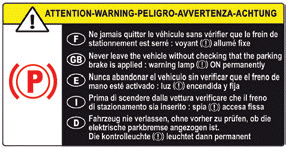
Before leaving the vehicle, check that the parking brake is applied: the parking brake indicator lights must be on steadily in the instrument cluster and on the control.
If the parking brake is not applied, a warning chime sounds and a message is displayed when the driver's door is opened.
Never leave a child alone inside the vehicle, as they could release the parking brake.
When parking: on a steep slope, with a heavily loaded vehicle, or while towing
With a manual gearbox, turn the wheels towards the kerb and engage a gear.
With an automatic gearbox, turn the wheels towards the kerb and select P mode.
When towing, the vehicle is approved for parking on slopes of less than 12%.
Manual operation
Manual releasing
Ignition on or engine running:
► Press the brake pedal.
► While holding the brake pedal pressed, briefly push the control.
If you push the control without pressing the brake pedal, the parking brake will not release and a message is displayed.
Manual applying
Vehicle stationary:
► Briefly pull the control.
The apply request is confirmed by the indicator light on the control flashing.
Automatic operation
Automatic releasing
First make sure that the engine is running and that the driver's door is properly closed.
The parking brake releases automatically and progressively as the vehicle moves off.
With a manual gearbox
► Fully depress the clutch pedal and engage first gear or reverse.
► Press the accelerator pedal and release the clutch pedal.
With an automatic gearbox
► Press the brake pedal.
► Select D, M or R mode.
► Release the brake pedal and press the accelerator pedal.
With an automatic gearbox, if the parking brake does not release automatically, check that the front doors are properly closed.
When stationary with the engine running, do not press the accelerator unnecessarily. Risk of releasing the parking brake.
Automatic applying
When the vehicle is stationary, the parking brake applies automatically when the engine is switched off.
If the engine stalls or Stop & Start switches to STOP mode, automatic application does not take place.
In automatic operation, the parking brake can be manually applied or released at any time using the control.
Special cases
Immobilising the vehicle, engine running
To immobilize the vehicle with the engine running, briefly pull the control.
Parking the vehicle with the parking brake released
In severe cold (frost), it is recommended not to apply the parking brake.
To immobilize the vehicle, engage a gear or place the wheel chocks against one of the wheels.
With an automatic gearbox, P mode engages automatically when the ignition is switched off. The wheels are locked.
For more information on Putting the Vehicle in Neutral, refer to the corresponding section.
With an automatic gearbox, with N mode engaged, opening the driver's door triggers a warning chime. Closing the driver's door stops it.
Disabling automatic operation
In certain situations, such as severe cold or towing (caravan, breakdown recovery), it may be necessary to disable the system's automatic operation.
► Start the engine.
► Using the control, apply the parking brake if it is released.
► Fully release the brake pedal.
► Hold the control pushed in the release direction for 10 to 15 seconds maximum.
► Release the control.
► Press and hold the brake pedal.
► Pull the control in the apply direction for 2 seconds.
 Disabling the automatic functions is confirmed by this indicator light coming on in the instrument cluster.
► Release the control and the brake pedal.
From then on, only the manual functions, using the control, can apply and release the parking brake.
► Repeat this procedure to re-enable automatic operation (confirmed by the indicator light in the instrument cluster going out).
Emergency braking
If the foot brake fails or in an exceptional situation (e.g. driver illness, during accompanied driving), holding the electric parking brake control pulled provides braking to stop the vehicle. Braking remains active as long as the control is held pulled; it stops as soon as the control is released.
The ABS and CDS systems maintain vehicle stability during emergency braking.
If the emergency braking fails, the message “Parking brake fault” is displayed in the instrument cluster.
 If the ABS and CDS systems fail, indicated by one or both warning lights coming on in the instrument cluster, vehicle stability is no longer guaranteed.
► In this case, maintain stability by repeatedly pulling and releasing the electric parking brake control until the vehicle is stationary.
Test yourself
A quick Citroen C5 Aircross quiz: every answer comes with an explanation and a link to the manual page.