Automatic transmission
With petrol / diesel engines
6- or 8-speed automatic gearbox with push-button selector. It also offers a manual mode, with gear changes made using the paddle controls located behind the steering wheel.
With plug-in hybrid engine
8-speed automatic gearbox with push-button selector and regenerative braking function.
Apart from manual mode and the regenerative braking function, its operation is identical to that of the other EAT8 gearboxes.
Push-button selector
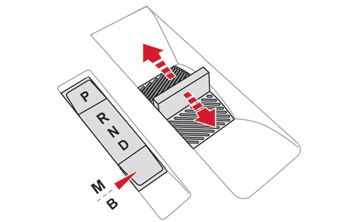
P. Auto Park
Press this button to select Park mode.
To park the vehicle: the front wheels are locked.
R. Reverse
N. Neutral
To put the vehicle in freewheel mode and move it, ignition off.
For more information on freewheeling the vehicle, refer to the corresponding section.
D. Automatic driving mode
The gearbox manages gear changes according to driving style, road profile and vehicle load.
M. Manual driving mode (Petrol / Diesel)
Press this button to select manual mode.
The driver changes gears using the controls on the steering wheel.
B. Automatic driving mode with regenerative braking function (Plug-in hybrid)
Press this button to activate the regenerative braking function.
The gearbox also manages braking when the accelerator pedal is released.
► In N mode, with your foot on the brake pedal, give a short push without going past the resistance point:
- Forward: R mode is selected.
- Backward: D mode is selected.
Release the selector completely after each push; it then returns to its initial position.
Special cases
To avoid N mode (rapid change from D to R and vice versa):
► In R mode, give a push backward past the resistance point; D mode is selected.
► In D mode, give a push forward past the resistance point; R mode is selected.
► To return to N mode, give a short push without going past the resistance point.
Steering wheel controls
(Depending on equipment)
In M and D modes, the steering wheel paddle controls allow manual gear changes.
They do not allow selection of neutral, nor engagement or disengagement of reverse.
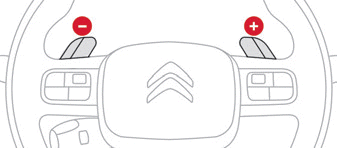
► Pull the "+" or "-" paddle towards you with a short push to engage the next higher or lower gear respectively.
Instrument cluster displays
As soon as the ignition is switched on, the gearbox status is shown in the instrument cluster:
P Park
R Reverse
N Neutral
D1...6 / 8 Automatic forward gear
B1...8 Automatic forward gear with regenerative braking function activated
M1...6 / 8 Manual forward gear
When driving in all-electric mode, the gear engaged is not displayed.
When the ignition is switched off, the gearbox status remains displayed in the instrument cluster for a few seconds.
Operation
Only valid mode change requests are taken into account.
With the engine running, if pressing the brake pedal is required to change mode, a warning message is displayed in the instrument cluster.
With the engine running and the brakes released, if R, D or M is selected, the vehicle moves even without pressing the accelerator pedal.
Never press the accelerator and brake pedals at the same time - risk of damage to the gearbox! With N mode engaged, opening the driver's door triggers an audible signal and engagement of P mode. The audible signal stops when the driver's door is closed.
Speed below 5 km/h, opening the driver's door triggers engagement of P mode - risk of sudden braking! In the event of a battery failure, you must place the wheel chock(s) supplied with the on-board tools against one of the wheels to immobilise the vehicle.
Specific features of automatic mode
The gearbox selects the gear providing optimum performance according to ambient temperature, road profile, vehicle load and driving style.
For maximum acceleration, press the accelerator pedal fully down (kickdown). The gearbox automatically downshifts or holds the selected gear up to the engine's maximum speed.
The steering wheel controls allow temporary gear selection if vehicle speed and engine speed conditions permit.
Specific features of manual mode
Changing from one gear to another is only carried out if vehicle speed and engine speed conditions permit.
Regenerative braking (Brake function)
Regenerative braking acts as engine braking, decelerating the vehicle without pressing the brake pedal.
When the driver releases the accelerator pedal, the vehicle slows down more noticeably.
The energy recovered when lifting off the accelerator is then used to partially recharge the traction battery.
This partial recharge does not change the state of charge indicator.
Deceleration of the vehicle does not turn on the brake lights.
► From D mode, press button B to activate / deactivate the function.
D is replaced by B in the instrument cluster.
The status of the function is stored when the ignition is switched off.
In certain situations (e.g. battery fully charged, extreme temperatures), the level of regenerative braking may be temporarily limited and the deceleration less pronounced.
The driver must remain attentive to traffic conditions and always be ready to use the brake pedal.
Regenerative braking via the brake pedal
Pressing the brake pedal also recovers energy to partially recharge the traction battery, without changing the state of charge indicator.
Starting the vehicle
► Press the brake pedal fully.
► Start the engine.
► Keeping your foot on the brake pedal, tap the lever once or twice towards you to select automatic D mode, or push it forward to select reverse R.
► Release the brake pedal.
► Gently accelerate to release the electric parking brake automatically.
The vehicle moves off immediately.
Automatic transmission
Never attempt to start the engine by pushing the vehicle.
Stopping the vehicle
Whatever the state of the gearbox when the ignition is switched off, P mode engages automatically and immediately.
However, in N mode, P mode will engage after a delay of 5 seconds (to allow the vehicle to be put into freewheel mode).
Check that P mode is engaged and that the electric parking brake has applied automatically; if not, apply it manually.
 The corresponding indicator lights on the gear selector and the electric parking brake control must be on, as well as the warning lights in the instrument cluster.
Gearbox malfunction
 This warning light comes on, together with a message and an audible signal, as soon as the ignition is switched on.
Go to a CITROËN dealer or a qualified workshop.
Do not drive faster than 100 km/h, within local regulations.
Gearbox switched to fail-safe mode
D mode is stuck in third gear.
The steering wheel paddles are inoperative and M mode is no longer accessible.
A noticeable jolt may be felt when engaging reverse. It is harmless for the gearbox.
Gear selector malfunction
Minor fault
 This warning light comes on, together with a message and an audible signal.
Drive carefully.
Go to a CITROËN dealer or a qualified workshop.
In some cases, the gear selector indicator lights no longer come on, but the gearbox status remains displayed in the instrument cluster.
Serious fault
 This warning light comes on, together with a message.
Stop the vehicle immediately.
Park in the safest possible conditions and switch off the ignition.
Contact a CITROËN dealer or a qualified workshop.
Progressive Hydraulic Cushions
This progressive hydraulic cushion suspension system improves ride comfort by filtering out road imperfections and shocks.
Each shock absorber is fitted with a compression hydraulic cushion (at the bottom) and a rebound hydraulic cushion (at the top).
Depending on the damping intensity, these cushions either give the vehicle greater suspension travel or gradually slow the movement to avoid abrupt stops at the end of travel.
Unlike a conventional suspension, which absorbs energy but gives back part of it, this active suspension absorbs and dissipates that energy, without any rebound effect.
Test yourself
A quick Citroen C5 Aircross quiz: every answer comes with an explanation and a link to the manual page.