engine control system
Bauteile und bauteile-Übersicht
COMPONENT LOCATION
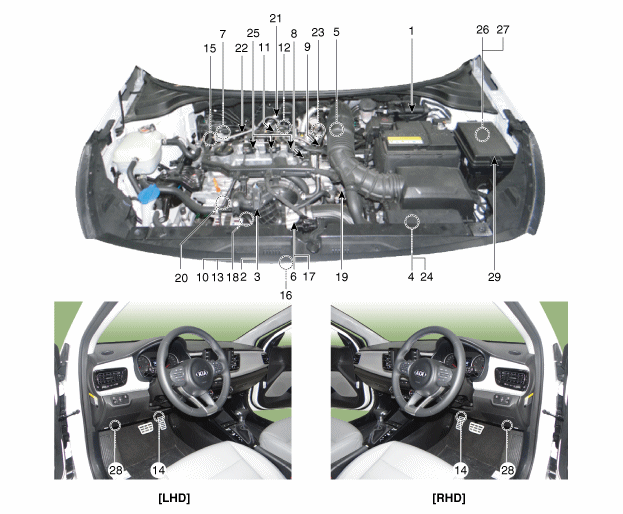
| 1. Engine Control Module (ECM) 2. Absolute Pressure Sensor (MAPS) 3. Intake Air Temperature Sensor (IATS) 4. Boost Pressure Sensor (BPS) 5. Engine Coolant Temperature Sensor (ECTS) 6. Throttle Position Sensor (TPS) [integrated in ETC module] 7. Crankshaft Position Sensor (CKPS) 8. Camshaft Position Sensor (CMPS) [Bank 1 / Intake] 9. Camshaft Position Sensor (CMPS) [Bank 1 / Exhaust] 10. Knock Sensor (KS) 11. Heated Oxygen Sensor (HO2S) [Bank 1 / Sensor 1] 12. Heated Oxygen Sensor (HO2S) [Bank 1 / Sensor 2] 13. Rail Pressure Sensor (RPS) 14. Accelerator Pedal Position Sensor (APS) |
15. A/C Pressure Transducer (APT) 16. Ambient Air Temperature Sensor (ATS) 17. ETC Motor [integrated in ETC module] 18. Injector 19. Purge Control Solenoid Valve (PCSV) 20. CVVT Oil Control Valve (OCV) [Bank 1 / Intake] 21. CVVT Oil Control Valve (OCV) [Bank 1 / Exhaust] 22. Fuel Pressure Control Valve (FPCV) 23. Electric Wastegate Actuator (EWGA) 24. RCV Control Solenoid Valve 25. Ignition Coil 26. Relay 27. Fuel Pump Relay 28. Diagnostic Link Connector (DLC) [16 Pin] 29. Multi-Purpose Check Connector [20 Pin] |
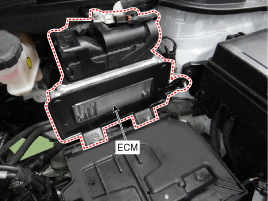
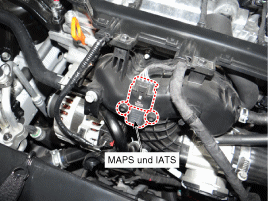
| 1. Motorsteuermodul (ECM) | 2. Absolute Pressure Sensor (MAPS) 3. Intake Air Temperature Sensor (IATS) |
 |
 |
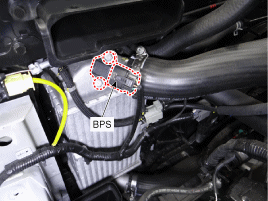
| 4. Boost Pressure Sensor (BPS) | Engine Coolant Temperature Sensor (ECTS) |
 |
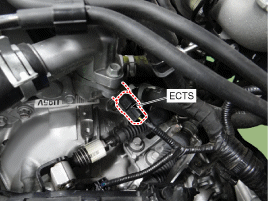 |
| 6. Throttle Position Sensor (TPS) [integrated in ETC module] 17. ETC Motor [integrated in ETC module] |
7. Crankshaft Position Sensor (CKPS) |
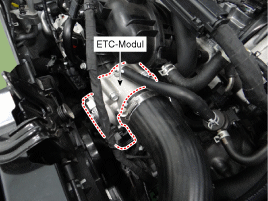 |
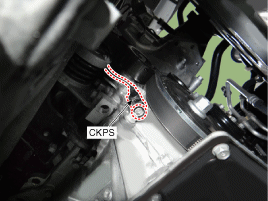 |
| 8. Camshaft Position Sensor (CMPS) [Bank 1 / Intake] | 9. Camshaft Position Sensor (CMPS) [Bank 1 / Exhaust] |
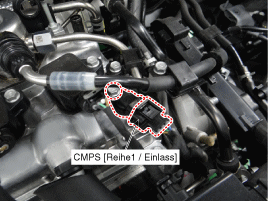 |
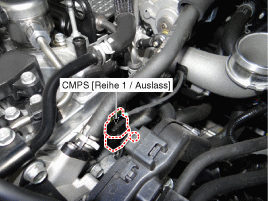 |
| 10. Knock Sensor (KS) | 11. Beheizte Lambdasonde (HO2S) [Reihe 1/Sensor 1] |
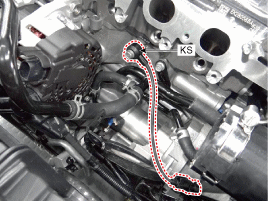 |
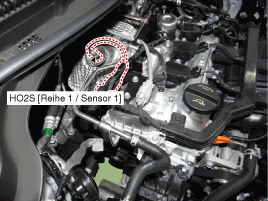 |
| 12. Beheizte Lambdasonde (HO2S) [Reihe 1/Sensor 2] | 13. Rail Pressure Sensor (RPS) 18. Injector |
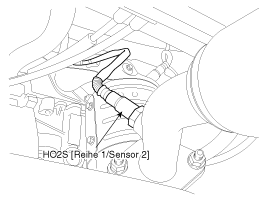 |
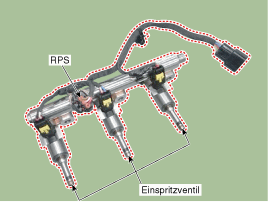 |
| 14. Accelerator Pedal Position Sensor (APS) |
15. A/C Pressure Transducer (APT) |
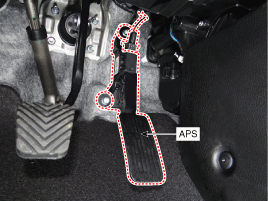 |
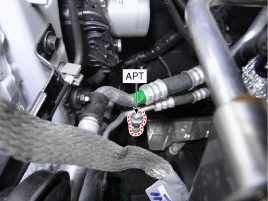 |
| 16. Ambient Air Temperature Sensor (ATS) | 19. Regenerierventil (PCSV) |
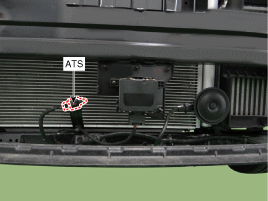 |
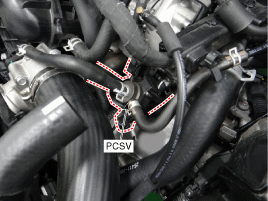 |
| 20. CVVT-Ölregelventil (OCV) [Reihe 1/Einlass] | 21. CVVT-Ölregelventil (OCV) [Reihe 1/Auslass] |
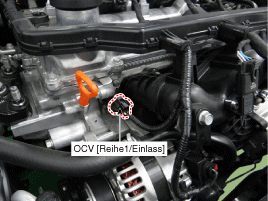 |
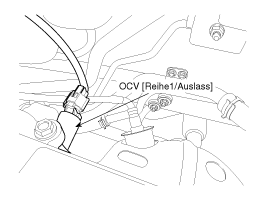 |
| 22. Kraftstoffdruckregelventil (FPCV) | 23. Elektrischer Bypassventil-Stellantrieb (EWGA) |
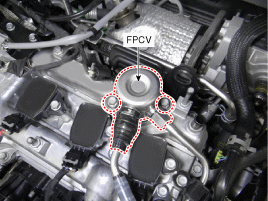 |
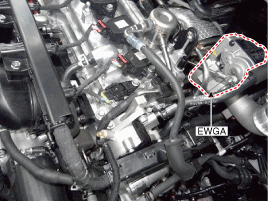 |
| 24. RCV-Steuermagnetventil | 25. Ignition Coil |
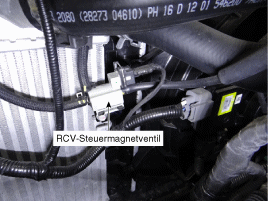 |
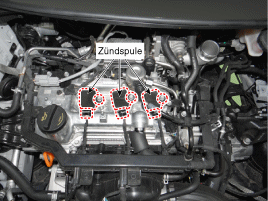 |
| 26. Main Relay [EMS Box] 27. Fuel Pump Relay [EMS Box] |
28. Diagnostic Link Connector (DLC) [16 Pin] |
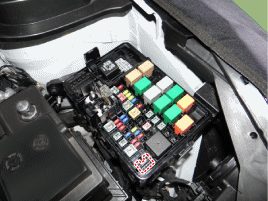 |
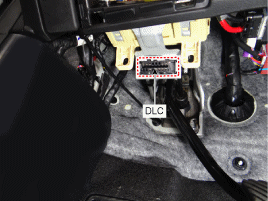 |
| 29. Multi-Purpose Diagnostic Connector (MPCC) [20-pin] | |
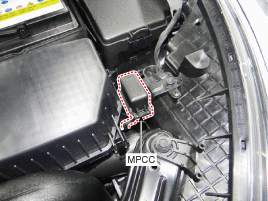 |
Beschreibung und bedienung
Beschreibung
Störungen an Componenten des Motorsteuerungssystems (Sensoren, ECM, Einspritzventile, usw) von benzingetriebenen Fahrzeugen führen zu unterbrochener oder den Betriebsbedingungen nicht entsprechender Kraftstoffzufuhr. Die folgenden Situationen können auftreten:
Engine cranks poorly or does not start.
Ungleichmäßiger Leerlauf
Poor Engine Running
If any of the above conditions occur, first perform routine diagnosis including basic engine functions (ignition system malfunction, incorrect engine adjustment, etc.). Then inspect the gasoline engine control system components using the KDS.
MALFUNCTION INDICATOR LAMP (MIL)
[OBD]
The MIL illuminates to alert the driver to a problem with the vehicle. The MIL automatically turns off if the malfunction has not recurred for 3 consecutive driving cycles. The MIL stays on continuously immediately after the ignition is turned on (ignition switch ON position). This indicates that the MIL is operating properly.
Die MIl leuchtet bei Fehlfunktionen folgender Systeme auf.
Catalyst
Abgasregelung & Kraftstoffsystem
ANSAUGKRÜMMER ABSOLUTDRUCKSENSOR (MAPS)
Intake Air Temperature Sensor
Engine Coolant Temperature Sensor
ETC Module (TPS + ETC Motor)
Beheizte (Vorkat)-Lambdasonde
Heated Oxygen Sensor (Front) Heater
Heated Oxygen Sensor (Rear)
Heated Oxygen Sensor (Rear) Heater
INJECTOR
Misfire (Knock)
Crankshaft Position Sensor
Camshaft Position Sensor
Evaporative Emission Control System
Vehicle Speed Sensor
Power Supply
PCM/PCM
MT Coding
Vertical Acceleration Sensor (CAS)
MIL-Einschaltsignal
PCM Driver Stage
[KEY - EOBD]
The MIL illuminates to alert the driver to a problem with the vehicle. The MIL automatically turns off if the malfunction has not recurred for 3 consecutive driving cycles. The MIL stays on continuously immediately after the ignition is turned on (ignition switch ON position). This indicates that the MIL is operating properly.
Die MIl leuchtet bei Fehlfunktionen folgender Systeme auf.
Heated Oxygen Sensor (HO2S)
ANSAUGKRÜMMER ABSOLUTDRUCKSENSOR (MAPS)
ENGINE COOLANT TEMPERATURE SENSOR (ECTS)
ETC Module (TPS + ETC Motor)
INJECTOR
ECM
[INJECTION]
Make sure the MIL illuminates for approximately 5 seconds after the ignition is turned on, and then turns off.
If the MIL does not illuminate, check for an open circuit in the wiring harness, a blown fuse, or a burned-out bulb.
Self-Diagnosis
The ECM monitors the input and output signals (some signals continuously and others under specific conditions). When the ECM detects an abnormality, it stores a DTC and outputs a signal to the diagnostic tester. The DTC can be read through the MIL or with the KDS. DTCs remain in the ECM memory as long as battery voltage is supplied. DTCs are erased when a battery cable or ECM connector is disconnected, or when they are cleared with the KDS.
ABHÄNGIGKEIT ZWISCHEN FEHLERCODES UND FAHRZYKLEN IM EOBD-SYSTEM
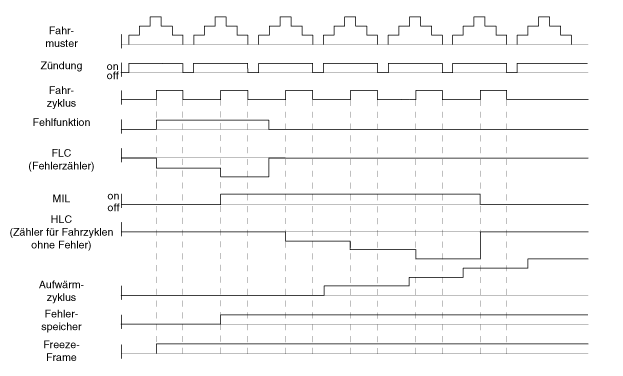
Die MIL-Kontrollleuchte schaltet sich ein, wenn die Fehfunktion länger als 2 aufeinanderfolgende Fahrzyklen anhält.
Die MIL (Störungsanzeigeleuchte) geht aus, wenn in 3 aufeinanderfolgende Fahrzyklen keine Störung mehr auftritt.
Ein Fehlercode (DTC) wird im ECM-Speicher abgelegt, wenn eine Störung bei zwei aufeinanderfolgenden Fahrzyklen erfasst wird. Die MIL leuchtet auf, wenn der Fehler im zweiten Fahrzyklus erkannt wird.
Wenn ein Zündaussetzer festgestellt wird, dann wird ein Fehlerdiagnosecode gespeichert, und die Störungsanzeigelampe leuchtet sofort nach dem ersten Feststellen der Störung auf.
A DTC is automatically erased from ECM memory if the same malfunction does not recur for 40 consecutive driving cycles.
Test yourself
A quick Kia Stonic quiz: every answer comes with an explanation and a link to the manual page.