Wheel Alignment Angles
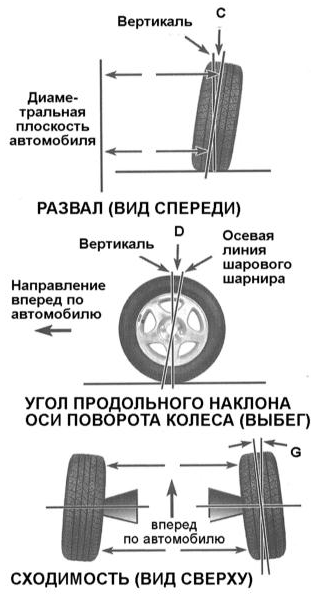
The front wheel alignment angles determine the position of the wheels relative to the suspension and the road surface. Incorrect alignment leads to reduced vehicle handling and faster tyre wear. The front wheel alignment angles to be checked include camber, caster (the angle of longitudinal inclination of the steering axis) and toe. Only one of the parameters — toe — can be adjusted, on both the front and rear wheels. The camber and caster of the front wheels should be checked regularly to assess the degree of wear of the suspension and steering components.
Wheel alignment is a procedure requiring particularly precise measurement; correct performance requires special, fairly bulky and expensive equipment. It is best to entrust this work to professional mechanics at a service centre. For general understanding, the definitions of each of the monitored wheel alignment angles are given below, knowledge of which will make it easier for the vehicle owner to communicate with service personnel.
Toe refers to the amount by which the front edges of the vehicle's wheels are turned towards each other. This misalignment of wheel parallelism minimises tyre tread wear caused by scrubbing during cornering. With zero toe, the distance between the front edges of the wheels equals the distance between their rear edges. Normal toe usually does not exceed a fraction of an inch (1 inch = 2.54 cm). Front wheel toe is adjusted by changing the length of the tie rods by altering the position of their ends. To adjust the rear wheel toe, a special eccentric adjusting bolt is provided, screwed into the inner end of the rear suspension control arm. Incorrect toe adjustment accelerates tyre tread wear due to the tyres slipping over the road surface.
Camber is the angle of inclination of the wheel plane relative to the vertical. If the wheels are tilted outward at the top, the camber is called positive, and vice versa. Camber is measured in degrees. Correct camber adjustment determines the size and position of the tyre contact patch with the road and allows compensation for changes in suspension geometry during cornering and when driving over uneven road surfaces. On the models considered, camber adjustment is not provided.
Caster is the angle of deviation from the vertical of the steering axis in the plane of the wheel. If the steering axis is tilted backwards, the caster is called positive, and vice versa. Front wheel caster is adjusted by selecting shims placed under the suspension control arms.
Test yourself
A quick Honda Accord quiz: every answer comes with an explanation and a link to the manual page.