Main and Connecting Rod Bearings
GENERAL INFORMATION
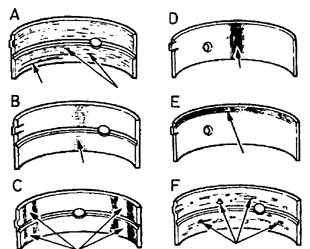
Types of Main and Connecting Rod Bearing Wear A. Scratches caused by dirt embedded in the bearing material B. Insufficient lubrication, localized wear of the bearing overlay C. Incorrect installation, shiny (polished) areas D. Journal taper, wear of the bearing overlay over the entire bearing surface along its length E. Formation of a shoulder at the bearing edge F. Fatigue wear, pitting or cavities
Inspection of Condition. Although main and connecting rod bearings must always be replaced during engine overhaul, used bearings should be kept in their installed locations for careful inspection, since wear marks on these parts help determine the overall condition of the engine. Bearing shells are divided into size groups by thickness; the size group of each shell is indicated by a color code marked on the shell.
Crankshaft bearing failure is caused by insufficient lubrication, the presence of dirt and foreign particles, engine overloading and corrosion. Regardless of the cause, it must be eliminated before final engine assembly to prevent repeated damage to these parts.
When inspecting bearings, remove them from the cylinder block, main bearing caps, connecting rod caps and connecting rods. Lay the bearing shells out on a clean surface in the same order in which they were installed in the engine. This allows identification of the crankshaft journal where the bearing has suffered excessive wear. During inspection, do not touch the working surface of the bearing shells with your fingers to avoid causing additional damage.
Dirt and foreign particles enter the engine for various reasons, including during assembly, through filters or the crankcase ventilation system. Contaminants may also enter the oil and then reach the bearings. Contamination often contains metal particles from machining of engine parts or from normal engine wear. Sometimes contamination contains abrasive residue left after lapping and grinding work, especially if the engine was not thoroughly washed and cleaned after such work. Regardless of origin, foreign contaminants usually become embedded in the soft bearing alloy and are easily identified. Large particles cannot embed in the bearing and cause scratches and scoring on both the bearing and the crankshaft journal surfaces. The best way to prevent such wear is to thoroughly wash parts and maintain strict cleanliness during engine assembly. To prevent premature wear, it is also recommended to change oil and filters more frequently.
Insufficient engine lubrication ("oil starvation") may be caused by a number of interrelated factors. These include engine overheating (which thins the oil), overloading (which squeezes oil out from the bearing surfaces), and a drop in oil pressure due to oil leakage (discharge) (caused by increased bearing clearances, wear of the oil pump, or high crankshaft speed). Accelerated crankshaft bearing wear is also caused by blockage of the oil passages, usually due to misalignment of the lubrication holes in the crankshaft bearings with the holes in the cylinder block and connecting rods, which causes insufficient lubrication and bearing failure. When insufficient lubrication is the cause of failure, the bearing overlay material is wiped or squeezed off the steel backing. The temperature rises to such a level that overheating causes the steel backing of the bearing to break away, which takes on a bluish tint.
The service life of the crankshaft bearings also depends significantly on driving habits. Bearings are subjected to increased loads when driving with the throttle fully open, or at low speed in a high gear (under heavy engine operating conditions). Under high loads, the oil film is squeezed out. Bearings experience bending deformation, which forms microcracks (fatigue wear). As a rule, the bearing overlay separates from the steel backing in the form of small particles.
Short trips may cause corrosion wear of the bearings, since the engine does not warm up enough to evaporate condensed moisture and gases that cause corrosion. These components accumulate in the oil, forming acids and insoluble deposits. As the oil reaches the bearings, acid corrosion occurs, causing the bearings to break down and fail.
Incorrect bearing installation during assembly also leads to premature wear. If the bearing clearance is less than specified, lubrication becomes difficult, which causes wear just as in "oil starvation". Dirt or small particles getting under the bearing shell cause local lifting of the shell and accelerated wear in that area.
During assembly, do not touch the bearing shell surfaces with your fingers, otherwise you may scratch the surface or get dirt particles on the shell.
As noted above, during engine overhaul the main and connecting rod bearing shells must always be replaced. Ignoring this rule and saving money on repairs leads to highly undesirable consequences.
Test yourself
A quick Nissan Sunny quiz: every answer comes with an explanation and a link to the manual page.