Cooling System Service
GENERAL INFORMATION
Warning
Do not allow antifreeze to contact skin or painted body surfaces. If antifreeze contacts skin or eyes, rinse immediately with plenty of cold water. Antifreeze is highly toxic and dangerous if swallowed. Do not leave antifreeze in an open container or spilled on the floor in puddles. Children and animals may be attracted by its sweet smell and drink or lick it. Consult local authorities regarding disposal of used antifreeze. Many communities have collection points where this fluid can be disposed of safely.
The cooling system should be flushed periodically and the coolant replaced. This is necessary to prevent corrosion and scale buildup, which reduce cooling efficiency and increase engine wear. When servicing the cooling system, check and, if necessary, replace all hoses and the radiator filler cap.
Draining the Coolant
PROCEDURE
1. Apply the parking brake and chock the wheels. If the engine is hot, wait several hours for the engine to cool completely.
2. With the engine cold, remove the radiator filler cap.
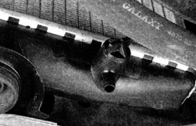
3. On almost all vehicles, the cover must be removed to access the radiator drain cock located at the bottom of the radiator. Place a container of suitable capacity under the radiator drain opening to collect the drained coolant.
4. Attach a hose with an inside diameter of 9.5 mm to the drain fitting to direct the coolant flow into the container (on some vehicles such a hose is provided by the design), then open the drain cock (pliers may be used for this).

5. After all the coolant has drained from the radiator, move the container under the cylinder block drain plug. Remove the plug (indicated by the arrow) and drain the coolant from the cylinder block.
6. While the coolant is draining, check the condition of the radiator and heater hoses and clamps (if necessary, see subsection 2.6.5).
7. Replace all damaged hoses and clamps.
Flushing the Cooling System
PROCEDURE
1. After draining the coolant, flush the radiator with running water using a garden hose until clean water flows from the lower hose. Water flushing removes deposits from the radiator but does not remove rust and scale deposits from the engine and cooling system piping.
2. These deposits can be removed with a chemical cleaner. Use the cleaner in accordance with the manufacturer's instructions. If the radiator is heavily contaminated, mechanically damaged or leaking, remove the radiator (see subsection 4.9) and take it for repair.
3. Disconnect the hose from the coolant reservoir. Drain the fluid from the reservoir and flush it with clean water, then reconnect the hose.
Filling the Cooling System
PROCEDURE
1. Install and tighten the plug on the cylinder block, and securely close the radiator drain cock.
2. Move the heater control lever to the extreme position corresponding to the fully open heater valve.
3. Slowly pour in fresh coolant consisting of water and antifreeze (50/50 ratio) until the radiator is full. Add coolant to the reservoir so that the level is above the lower mark.
4. Remove the radiator cap and start the engine (in a well-ventilated area). Warm up the engine until the thermostat opens (coolant begins to circulate through the radiator and the upper hose becomes hot).
5. Stop the engine and let it cool. Top up the coolant to the lower edge of the radiator filler neck.
6. Squeeze the upper hose to expel air, and top up the coolant if necessary. Install the radiator cap.
7. Start the engine, warm it up and check for leaks.
Test yourself
A quick Toyota Corolla quiz: every answer comes with an explanation and a link to the manual page.