Tire Condition and Tire Pressure Check
Typical Tread Wear Patterns from Abnormal Tire Wear
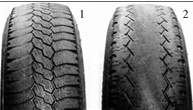
1. Edge Tread Wear
Insufficient tire pressure (wear on both edges of the tread)
Check the pressure and correct it to the specified value.
Incorrect front wheel alignment (wear on one edge of the tread)
Repair or replace suspension parts.
Severe angular tread wear
Drive at moderate speeds!
2. Center Tread Wear
Excessive tire pressure
Check the pressure and correct it to the specified value. If you had to inflate the tires to the maximum pressure in connection with upcoming high-speed driving or carrying a heavy load, be sure to reduce the pressure to the specified value afterward.
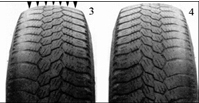
3. One-Sided Diagonal Wear
Incorrect wheel toe-in
Adjust wheel toe-in.
4. Uneven Wear
Incorrect front wheel alignment angles, wheels do not return well to straight-ahead position after turning
Repair or replace suspension parts.
Abnormal front suspension operation
Repair or replace suspension parts.
Excessive wheel imbalance
Balance the wheels.
Out-of-round wheel disc or brake drum
Turn or replace the drum; repair or replace the wheel disc.
* One-sided diagonal tread wear, which indicates incorrect wheel alignment, is best detected by touch.
PROCEDURE
1. Periodic tire inspection will save you unnecessary expenses associated with tire replacement due to premature wear. The condition of the tires can provide very important information about the condition of the suspension and steering before serious damage becomes apparent.
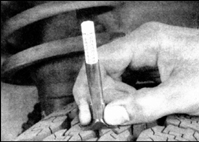
2. Tire wear can be checked with a simple and inexpensive tread depth indicator. When the tread depth reaches the minimum permissible value, replace the tire (or tires).
3. Monitor the tire tread pattern. Deviations of tire tread wear from normal are illustrated in the figures (see figure Typical Tread Wear Patterns from Abnormal Tire Wear). The visible signs of uneven tread wear shown in the figures indicate the need to adjust wheel alignment angles or balance the wheels. If tire wear deviates from normal, take the vehicle to a workshop or service station and correct the fault.

4. Regularly inspect the tires for damage such as cuts or bulges, and remove any stones or sharp objects lodged in the tread.
5. If a tire has been punctured, it may hold pressure for some time, or a slight pressure loss may be observed, because the puncture may be blocked by a lodged sharp object. If a slow loss of tire pressure is observed, check the valve core for leaks (a special valve core tool is required, which is widely available).
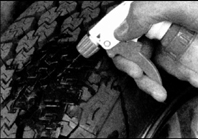
6. Check the tread for lodged objects that could cause a puncture.
7. If a tire puncture is suspected, check the possible puncture location with a soapy solution. If the valve is sealed, raise the vehicle on the side of the flat tire, and while rotating the wheel, apply the soapy solution to it.
8. Air bubbles will appear at the puncture location. If there is a leak, bubbles will form. If the damage to the tire is minor, the tire can be repaired at a tire repair shop or in garage conditions.
9. Carefully inspect the inner sidewalls of the tires for traces of brake fluid leakage. If any are found, immediately check the condition of the brakes.
10. Maintaining correct tire pressure extends tire service life and improves driving safety. Tire pressure cannot be accurately judged by visual inspection alone, especially for radial tires. Tire pressure must be checked with a pressure gauge. Always keep a pressure gauge in the glove box. Gauges at service stations mounted on air line hoses usually give inaccurate readings.
11. Check the pressure on cold tires. The term "cold" means that the vehicle has not been driven more than 1.5 km within the last three hours before measuring tire pressure. On warm tires, pressure may increase by 0.25–0.6 atm.
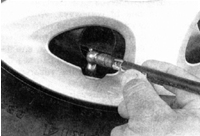
12. To extend tire service life, check the tire pressure regularly (weekly) with a verified pressure gauge (be sure to check the spare tire pressure as well). Remove the valve cap (located on the tire or under the wheel cover) and press the gauge firmly onto the valve. Read the gauge and compare with the specified values (see subsection 2.1).
13. Be sure to reinstall the valve cap. Check the pressure in all wheels and, if necessary, adjust to the specified pressure.
Test yourself
A quick Toyota Corolla quiz: every answer comes with an explanation and a link to the manual page.