Removing and installing brake line/brake hose
Steel brake lines are used for the brake line system, which together with the pressure-resistant brake hoses for the wheels connects the master cylinder to the four wheel brakes.
The line connections to the wheel cylinders and distribution blocks are designed as so-called cone-type couplings.
The pipe ends are flared at the front and then have a conical sealing surface for the threaded holes with a conical seat in the wheel cylinders or distribution blocks. Before the pipe ends are flared, a union nut is slipped onto the pipe. After screwing in, the nut presses the conical sealing surface of the pipe against the conical seat of the threaded hole, creating a reliable seal.
The brake hoses provide the flexible connections between rigid and moving vehicle components. Brake hoses must not show any chafing points.
RemovalJacking up the vehicle
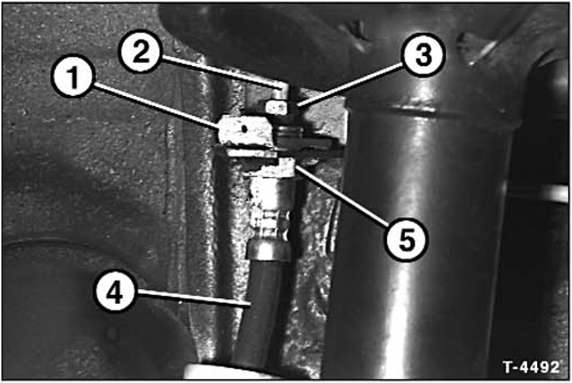
Pull off retaining clip - 1 - with pliers.
Loosen and remove brake line - 2 - at union nut - 3. While doing so, counter-hold brake hose - 4 - with open-end wrench on hex - 5.
Plug the line connection toward the master cylinder with a suitable plug.
Route the new brake line in the same position as the old one, where possible.
Install the new brake hose so that it hangs without twist, and tighten it to 15 N·m at the brake caliper.
When connecting the brake line, wet the conical sealing surface with a few drops of brake fluid and tighten to 5 N·m.
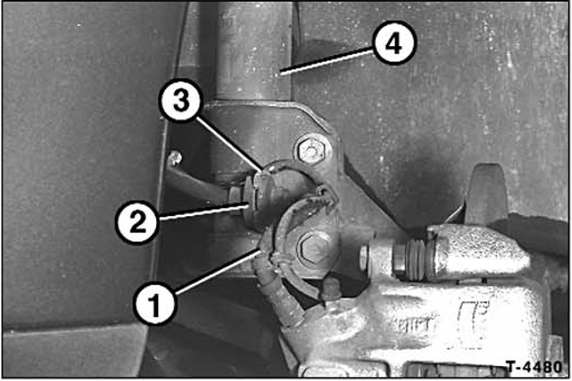
Insert front brake hose - 1 - with rubber holder - 2 - into bracket - 3 - on strut - 4.
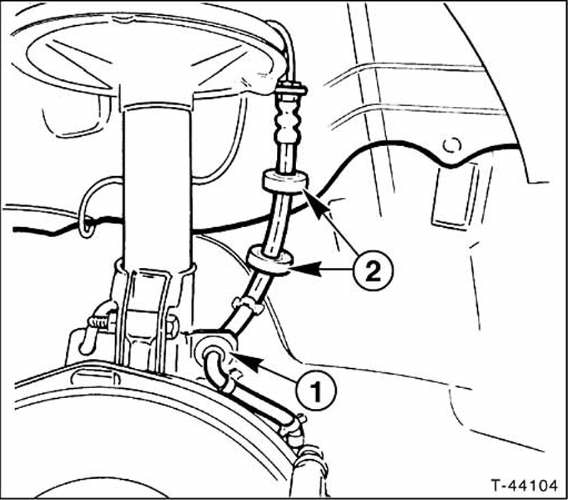
After installation, check that rubber grommet - 1 - is seated securely in the mount. Spacer rings - 2 - must be positioned as shown in the illustration so that the brake hose cannot be pressed against the wheel housing or other parts when the wheels are turned.
After installation, with the wheel unloaded (vehicle raised), check that the hose follows all wheel movements without chafing anywhere.
Bleed brake system.
Lower the vehicle.
With the vehicle standing on the ground, turn the wheels fully left and right to the stop, and check that the hose follows all wheel movements without chafing anywhere.
Are the brake hose connections tightened?
- Is the brake hose seated in the bracket?
- Are the bleed screws tightened?
- Is there enough brake fluid in the system?
With the engine running, carry out a leak check.
To do this, press the brake pedal with 200 to 300 N (equivalent to 20 to 30 kg) for about 10 seconds. The brake pedal must not sink. Check all connections for leaks.Then carry out several braking tests on a road with light traffic.
Test yourself
A quick Fiat Bravo quiz: every answer comes with an explanation and a link to the manual page.