Overhauling wheel brake cylinder
If the wheel cylinder is not to be replaced, it can also be disassembled while installed. However, the brake shoes must be removed beforehand.
The wheel cylinder must be replaced at the latest whenever brake fluid leaks past the seals.
When replacing brake pads, always pull the dust caps off the wheel cylinder and check inside the cylinder. If there is moisture behind the dust caps or the entire wheel cylinder is coated with brake fluid, replace the cylinder. Replacement is also necessary if the pistons in the wheel cylinder no longer slide freely back and forth, or show grooves or corrosion. In such a case the wheel either does not brake or brakes constantly.
RemovalRemove the brake shoes.
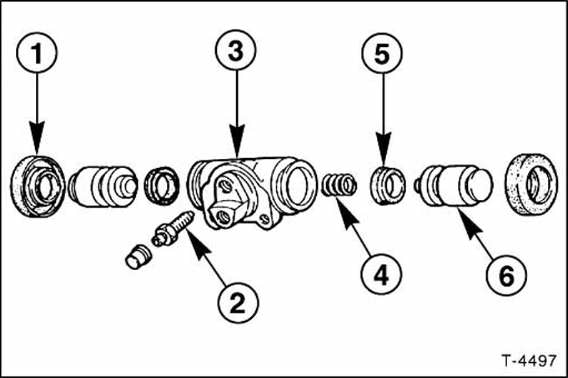
Use a screwdriver to lift off the dust caps - 1 -. Caution: do not damage the caps.
Pull out both pistons - 6 - with the seals - 5 -.
Caution: some brake fluid may leak out during this step, so place a rag underneath.
Remove spring - 4 - from wheel cylinder - 3 -.
Additionally shown part: 2 - bleed screw.
Pull the seals off the pistons, taking care not to damage the pistons.
Wipe the inside of the wheel cylinder with a lint-free cloth.
There must be no grooves or rust pits on the running surface. If necessary, replace the wheel cylinder.
Clean all parts with alcohol (methylated spirit) or brake fluid. Observe the brake fluid notes. Caution: do not use mineral oil-based fluids such as petrol or kerosene, otherwise brake faults may occur later. The specialist workshop uses the cleaning fluid "fiat-ldc".
Make sure the bleeder screw turns freely; replace if necessary.
Before assembly, dip all internal parts in clean brake fluid. Always use the complete repair kit.
Fit the boots onto the pistons so that the sealing lips point against the direction of hydraulic fluid pressure, i.e. inward.
Insert the left piston into the wheel brake cylinder.
Insert the spring from the right, open the bleeder screw, push in the piston. After completing, close the bleeder screw. Caution: do not overtighten. Maximum torque 5 N·m.
Fit the protective caps.
Install the brake shoes and brake drum.
Bleed the brake system. As a rule, it is sufficient to bleed only the wheel brake cylinder whose line was opened. If the brake pressure feels spongy after bleeding, bleed the entire brake system.
Press the foot brake firmly several times. This adjusts the rear wheel brake.
Are the brake lines tightened?
Is the brake line in the bracket?
Are the bleeder screws tightened?
Is there enough brake fluid in the reservoir?
With the engine running, carry out a leak check.
To do this, press the brake pedal with 200 to 300 N (equivalent to 20 to 30 kg) for about 10 seconds. The brake pedal must not sink. Check all connections for leaks.
Then carry out several braking tests on a road with light traffic.
Test yourself
A quick Fiat Bravo quiz: every answer comes with an explanation and a link to the manual page.