Remove and install brake disc
Mark the position of the wheels relative to the wheel hub with paint.
This allows the balanced wheel to be refitted in the same position. Loosen the wheel bolts. The vehicle must be standing on the ground.
Raise the front of the vehicle and remove the wheels.
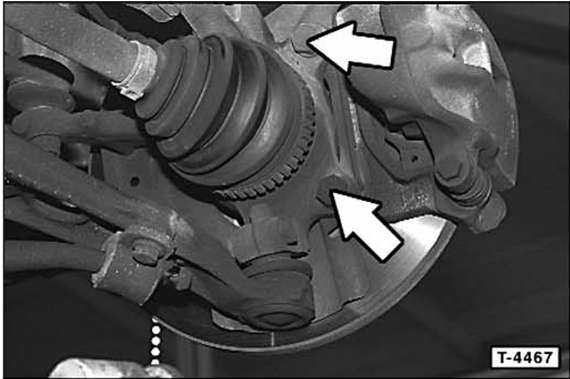
Unbolt the brake carrier from the steering knuckle, remove it together with the brake pads and hang it from the strut with a wire hook. Do not twist or stress the brake hose in tension.

Unbolt and remove the brake disc.
To ensure even braking on both sides, both brake discs must have the same surface condition in terms of grinding pattern and surface roughness. Therefore, always replace both brake discs or have both resurfaced.
Measure brake disc thickness.
If present, remove rust from the brake disc flange and the front wheel hub with a soft wire brush.
Clean the protective coating off new brake discs with nitro thinner.
Place the brake disc on the wheel hub and bolt it on with 10 N·m.
Position the brake carrier with the brake pads and bolt it to the steering knuckle with 55 N·m.
Position the wheels so that the alignment marks made during removal match. Before this, lightly grease the centering seat of the rim on the wheel hub and the tapered seat face of the wheel bolts with rolling bearing grease. Do not grease or oil the threads of the wheel bolts. Tighten the wheel bolts.
Lower the vehicle and tighten the wheel bolts crosswise to 90 N·m.
Adjust the parking brake if necessary.
Check the brake fluid in the reservoir and top up to the MAX mark if necessary.
Are the brake hose connections tightened?
Is the brake hose seated in the bracket?
Are the bleeder screws tightened?
Is there enough brake fluid in the reservoir?
With the engine running, carry out a leak check.
To do this, press the brake pedal with 200 to 300 N (equivalent to 20 to 30 kg) for about 10 seconds. The brake pedal must not sink. Check all connections for leaks.
Bed in new brake pads carefully: on a quiet road, brake several times from approx. 80 km/h to 40 km/h with light pedal pressure.
Let the brakes cool down somewhat between applications.
Note: brake pads must be disposed of as hazardous waste.
Local authorities can advise whether disposal with commercial waste similar to household waste is permitted.
Test yourself
A quick Fiat Bravo quiz: every answer comes with an explanation and a link to the manual page.