Removing and installing wheel brake cylinder
Remove the brake drum.
Pull the upper brake shoes apart far enough that the wheel cylinder is free and the automatic adjuster locks the shoes in this position.
Loosen the union nut of the brake line, do not unscrew it.
Clean the line connection beforehand.
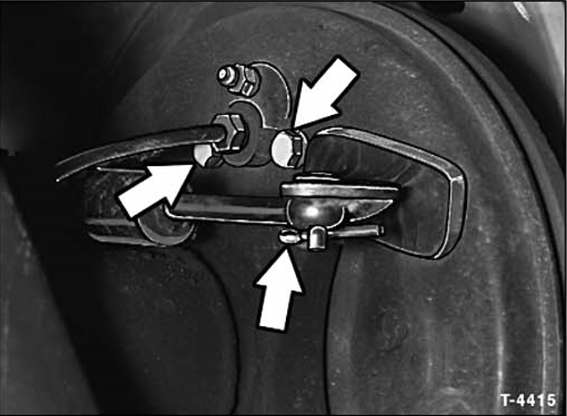
Unscrew the 2 mounting bolts for the rear wheel cylinder from the backing plate - upper arrows -.
Place a rag under the backing plate.
Unscrew the brake line nut and immediately screw it hand-tight into the new wheel cylinder. This ensures that only a small amount of brake fluid escapes.
Screw in the bolts for the wheel cylinder and tighten them to 10 N·m.
Tighten the brake line union nut to 15 N·m, that is, not too tight.
Reset the brake shoes and install the brake drum.
Bleed the brake system. As a rule, it is sufficient to bleed only the wheel cylinder whose line was opened. If the brake pressure feels spongy after bleeding, bleed the entire brake system.
Press the foot brake firmly several times. This adjusts the rear wheel brake.
Are the brake lines tightened?
Is the brake line in the bracket?
Are the bleeder screws tightened?
Is there enough brake fluid in the reservoir?
With the engine running, carry out a leak check.
To do this, press the brake pedal with 200 to 300 N (equivalent to 20 to 30 kg) for about 10 seconds. The brake pedal must not sink. Check all connections for leaks.
Then carry out several braking tests on a road with light traffic.
Note: Brake fluid must be disposed of as hazardous waste.
Test yourself
A quick Fiat Bravo quiz: every answer comes with an explanation and a link to the manual page.