Check brake disc thickness
Mark the position of the wheels relative to the wheel hub with paint.
This allows the balanced wheel to be refitted in the same position. Loosen the wheel bolts. The vehicle must be standing on the ground.
Raise the front of the vehicle and remove the wheels.
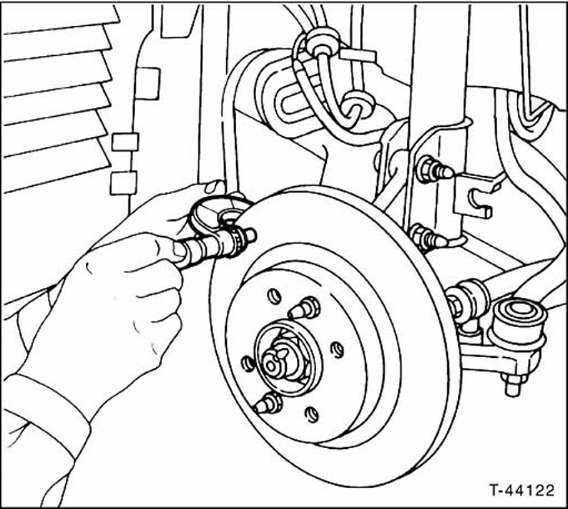
Measure the brake disc thickness. Workshops use a special vernier caliper or a micrometer, as wear on the brake disc forms a lip.
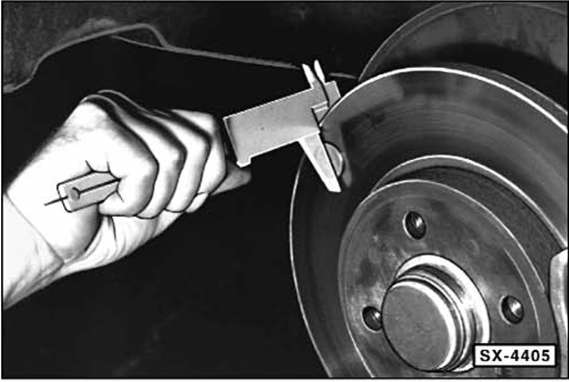
The brake disc thickness can also be measured with a standard vernier caliper, but then a suitably thick spacer must be placed on each side of the brake disc (for example, two 10-pfennig coins). To determine the exact dimension of the brake disc, subtract the thickness of the 10-pfennig coins or spacers from the measured value. Caution: measure at several points on the brake disc.
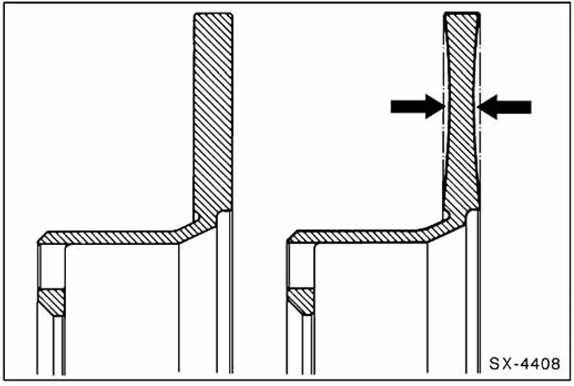
Caution: always measure the brake disc thickness at the thinnest point (arrows).
For brake disc dimensions, see page 170.
If the wear limit is reached, replace the brake disc.
Replace the brake disc if there are large cracks or grooves deeper than 0.5 mm.
Note: the workshop can check the brake disc for runout. Lateral runout must not exceed 0.15 mm.
Measure 2 mm from the outer edge of the braking surface.
Position the wheels so that the alignment marks made during removal match. Before this, lightly grease the centering seat of the rim on the wheel hub and the tapered seat face of the wheel bolts with rolling bearing grease. Do not grease or oil the threads of the wheel bolts. Tighten the wheel bolts.
Lower the vehicle and tighten the wheel bolts crosswise to 90 N·m.
Test yourself
A quick Fiat Bravo quiz: every answer comes with an explanation and a link to the manual page.