Hydraulic tappets
The petrol engines are fitted with hydraulic tappets. The 1.4 L engine also has hydraulic valve lash adjusters for the rocker arms, which work in a similar way to the tappets. As a result, valve clearance no longer needs to be adjusted during routine maintenance, and valve train noise is reduced.
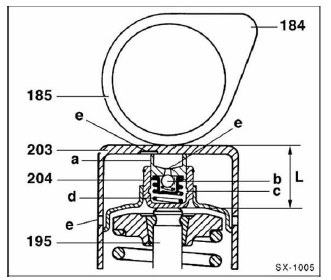
With the engine running, tappet -203- is unloaded when cam -184- of camshaft -185- points upward.
Spring - d - then pushes the compensating element -204- apart so that it rests against the valve stem -195- at the bottom, while plunger - a - at the top presses tappet -203- against the camshaft. In this position, engine oil can flow into or out of working chamber - c - through small holes - e -. As soon as the tappet is loaded again by the cam of the rotating camshaft, ball valve - b - closes and the trapped oil acts like a solid body, since it cannot be compressed. Length - l - is therefore adjusted with each camshaft revolution to match the corresponding dimensional changes of the valve train components.
The external identification of hydraulic tappets is a circumferential oil groove and the absence of adjusting shims.
Hydraulic tappets cannot be repaired.
Caution: valve train noises when starting the engine are normal. When the engine is stopped, more or less oil is forced out of each valve tappet depending on the position of the cam. This causes noise until the hydraulic tappets are refilled with engine oil with the engine running. This process may take until the engine reaches operating temperature.
To ensure correct operation of the hydraulic tappets, the cylinder head contains a check valve that prevents the oil passages in the cylinder head from draining completely when the engine is off. Do not place the tappets upside down when the engine is removed, otherwise the oil fill will slowly drain out, causing malfunctions.
Test yourself
A quick Fiat Bravo quiz: every answer comes with an explanation and a link to the manual page.