Check compression
The compression test allows conclusions about the condition of the engine. The test shows whether the valves or the pistons (piston rings) are in good condition or worn. In addition, the test values indicate whether the engine is ready for replacement or needs a complete overhaul. A compression tester is required for the test; for gasoline engines, one is available at specialist shops at a fairly low price.
Caution: a compression tester with a larger measuring range is required for the diesel engine.The pressure difference between individual cylinders must not exceed 3.0 bar (diesel 5.0 bar). If one or more cylinders show a pressure difference of more than 3.0 bar (diesel 5.0 bar) compared with the others, this indicates defective valves, worn piston rings or worn cylinder bores. If the wear limit has been reached, the engine must be overhauled or replaced.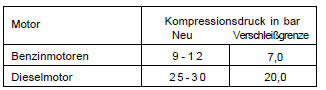
The engine should be at operating temperature for the compression test. However, the engine oil temperature must be at least +30 °C.
Switch off the ignition.
Remove spark plugs, see page 298.
Crank the engine with the starter a few times to blow out deposits and soot. Caution: transmission in neutral and parking brake applied.
Press or screw the compression tester into the spark plug opening according to the manufacturer's instructions.
Have an assistant fully depress the accelerator pedal and hold it down with their foot throughout the test.
Crank the engine approx. 8 revolutions until the gauge shows no further pressure increase.
Test all cylinders one after another and compare with the nominal value.
Then install the spark plugs, see page 298.
Reinstall the fuel pump fuse.
Disconnect the electrical lead from the shut-off solenoid on the injection pump, see page 115.
Clean the injection lines with cold cleaner and remove them.
Remove the injectors, see page 115.
Screw the compression tester in place of the injectors. Insert the old heat shield gasket between the tester and the cylinder head.
After measuring, screw in the injectors with 70 N·m.
Caution: always replace the heat shield gasket between cylinder head and injector.
Tighten the injection lines with 25 N·m.
Push the line onto the shut-off solenoid.
Test yourself
A quick Fiat Bravo quiz: every answer comes with an explanation and a link to the manual page.