General Transmission Description
GENERAL INFORMATION
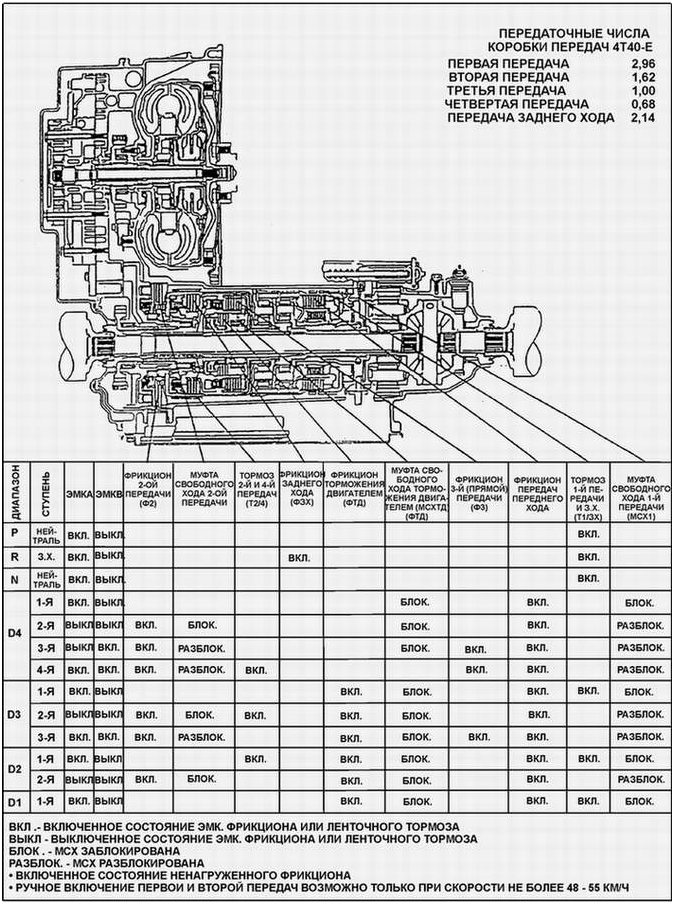
Transmission control element application chart
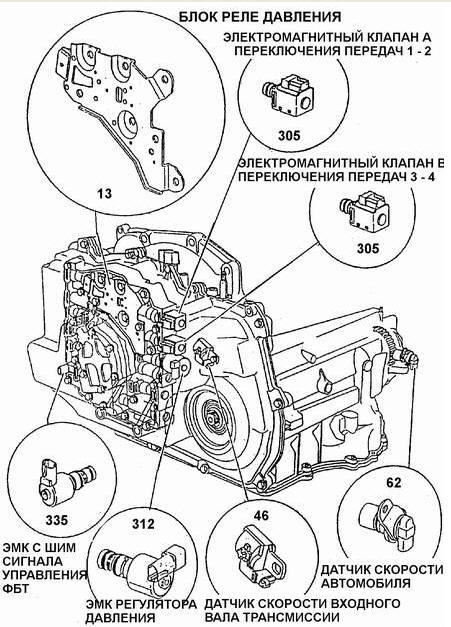
Location of transmission electromechanical and electronic components
The 4T40-E unit is designed for front-wheel-drive vehicles and is an automatic transaxle with electronic-hydraulic control.
The transaxle has a four-speed forward gear set (one of which is an overdrive) and one reverse gear. The gears are shifted by the electronic TCM using two shift solenoid valves. The transaxle hydraulic system is supplied by a vane-type pump. Line pressure is regulated by the TCM through the pressure regulator solenoid valve (PRV).
The transaxle has a four-speed forward gear set (one of which is an overdrive) and one reverse gear. The gears are shifted by the electronic TCM using two shift solenoid valves. The transaxle hydraulic system is supplied by a vane-type pump. Line pressure is regulated by the TCM through the pressure regulator solenoid valve (PRV).
The automatic transmission can operate in one of the following positions:
P (Park) – Mechanical lock of the transmission output shaft,
which prevents the vehicle from moving unintentionally. For greater
safety, the P range is selected when parked together with the parking brake.
brake of the vehicle.
R (Reverse) – Engages the reverse gear.
N (Neutral) – The neutral position is used when starting and running the engine with the vehicle stationary. This range is also selected if it is necessary to start a stalled engine while the vehicle is moving.
D (Drive) – This range is used in all normal driving conditions.
The range provides automatic shifting of all forward gears and control of the torque converter clutch.
For confident and safe passing, a downshift is performed by fully depressing the accelerator pedal.
For confident and safe passing, a downshift is performed by fully depressing the accelerator pedal.
3 – This range is used when driving in the city, driving in hilly terrain, or towing a trailer.
The range provides automatic shifting of 1st, 2nd and 3rd gears. 4th gear cannot be engaged.
Forced downshifting is performed in the same way as in range D when the accelerator pedal is fully depressed.
Forced downshifting is performed in the same way as in range D when the accelerator pedal is fully depressed.
Forced downshifting is performed in the same way as in range D when the accelerator pedal is fully depressed.
2 – This range provides automatic shifting of 1st and 2nd gears.
It is used for vigorous acceleration and strong braking. Range 2 can be selected at any vehicle speed.
It is used for vigorous acceleration and strong braking. Range 2 can be selected at any vehicle speed.
1 – 1st gear engagement. Range 1 is used when intensive
The transaxle can be placed in range 1 at any vehicle speed, but 1st gear will engage only after the vehicle speed decreases to 48–56 km/h.
The 4T40-E automatic transaxle consists of the following main components.
Mechanical components of the transaxle
– torque converter with lock-up clutch.
– chain drive.
– five multi-plate clutches (2nd gear clutch C2, reverse gear clutch CR, 3rd gear clutch C3, overrun clutch COR and forward gear clutch CFG).
– two band brakes (2nd and 4th gear B2/1, 1st gear and reverse B1/R).
– three one-way clutches: two roller one-way clutches (1st and 2nd gear) and one sprag one-way clutch.
– three one-way clutches: two roller one-way clutches (1st and 2nd gear) and one sprag one-way clutch.
– three one-way clutches: two roller one-way clutches (1st and 2nd gear) and one sprag one-way clutch.
– two-row planetary gear set.
– final drive with differential.
– control valve assembly. Vane-type pump.
Electromechanical components and electronic devices
– pressure regulator solenoid valve (PRV).
– two transaxle shift solenoid valves (SSV).
– PWM-controlled torque converter clutch solenoid valve (TCC).
– transaxle input shaft speed sensor (ISS).
– vehicle speed sensor (VSS).
– transaxle temperature sensor (TFT).
– pressure switch assembly (PSA).
– electrical wiring.
Test yourself
A quick Daewoo Nexia quiz: every answer comes with an explanation and a link to the manual page.