Measuring instruments
For measuring the vehicle electrics, multimeters are available from retailers. They combine in one unit a voltmeter for measuring voltage, an ammeter for measuring current and an ohmmeter for measuring resistance. Measuring instruments on the market differ mainly in measuring range and measuring accuracy. The measuring range determines the range within which voltages or resistances must lie in order to be detected by the instrument at all.

For the home mechanic there are multimeters specially matched for work on cars. With such an instrument, engine speed, dwell angle and voltages up to 20 volts can be measured. For resistance measurements, the instrument is usually limited to the kilo-ohm range, i.e. approx. 1–1000 kΩ.
In addition, measuring instruments are offered for checking electrical and electronic components. They allow comprehensive measurement from small resistances in ohms (Ω) up to large resistances in the mega-ohm range (MΩ). Voltages (in volts) can be measured very accurately, which is especially necessary for electronic components.
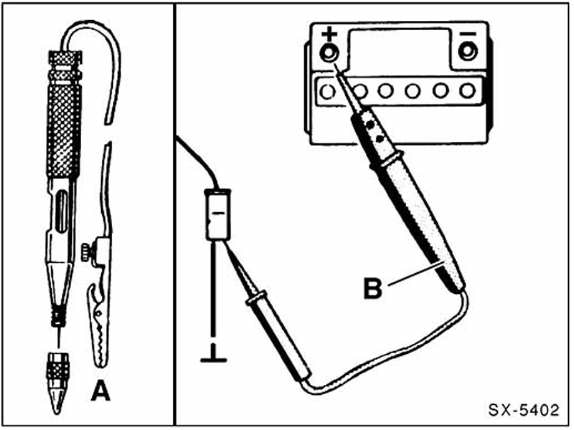
If you only need to check whether voltage (V) is present at all, a simple test lamp - A - is suitable. However, this only applies to circuits that contain no electronic components, as electronic parts react extremely sensitively to excessive currents. Under some circumstances they can be destroyed just by connecting a test lamp. Caution: when testing electronic components (transistors, diodes and control units), a high-impedance voltage tester - B - is required. It works like a test lamp but without damaging electronic components, and is suitable for all testing work.
Test yourself
A quick Fiat Bravo quiz: every answer comes with an explanation and a link to the manual page.