Retrofitting electrical accessories
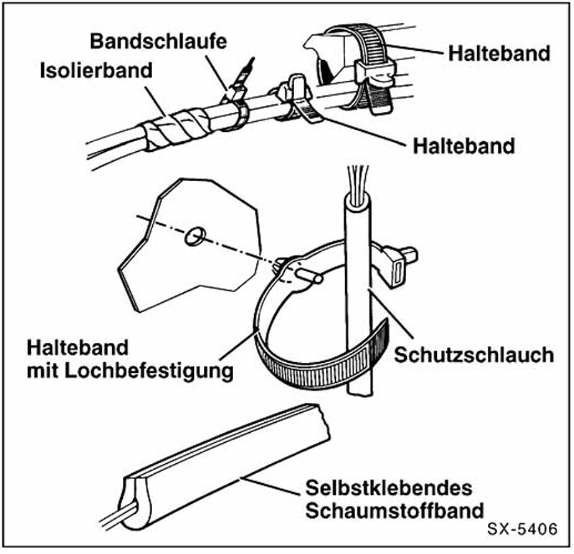
Wires that must be routed in the vehicle in addition to the factory-installed wiring harness when installing accessories should, wherever possible, always be routed along the existing wiring harnesses, using the existing cable clips and rubber grommets.
If necessary, secure the newly routed wires additionally with insulating tape, plastic compound, cable ties and the like to prevent noises while driving and to avoid chafing of the wires.
Take particular care to maintain a minimum distance of 10 mm between the brake lines and the fixed wiring, and a minimum distance of 25 mm between the brake lines and wiring that moves with the engine or other vehicle parts.
After drilling holes in the bodywork, the hole edges must be deburred, primed and painted.
Metal chips produced during drilling must be completely removed from the bodywork.
For all installation work that affects the electrical wiring system, to prevent the risk of short circuits in the electrical wiring system, always disconnect the ground cable (-) from the vehicle battery and secure it aside.
Caution: disconnecting the battery may erase the fault memory of the engine and transmission control, the anti-lock braking system, and other electrical devices such as the radio and clock, or delete stored values. Special notes on this topic are in the section "Battery removal".
If additional electrical consumers are installed, always check whether the increased load can still be handled by the existing alternator. If necessary, a higher-output alternator should be fitted.
Test yourself
A quick Fiat Bravo quiz: every answer comes with an explanation and a link to the manual page.