Brake System Bleeding
GENERAL INFORMATION.
Brake system bleeding must be performed in all cases of
air entering the hydraulic drive. If the brake fluid level drops in the reservoir and air enters the system through the master cylinder, or when disconnecting the
brake lines from the master cylinder, bleed air from all circuits and lines.
hydraulic drive. If only one caliper or wheel cylinder was disconnected, bleeding is required only from those chambers and the corresponding lines. After removing any line and then installing it, bleed air from the
circuit and cylinder served by that line.
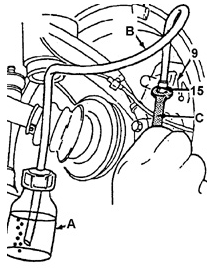
MANUAL BRAKE SYSTEM BLEEDING A. RESERVOIR.
B. HOSE.
C. WRENCH.
9. SUPPORT.
15. BLEEDER VALVE
Before starting the procedure, deplete the vacuum booster reserve by pressing and releasing the brake pedal several times.
The engine must be switched off.
PROCEDURE.
1. Fill the reservoir with brake fluid. During the procedure, make sure the fluid level does not drop below half of the full level.
2. If air is known to be in the master cylinder, first bleed the master cylinder chamber as follows.
2a. Disconnect the front brake lines from the master cylinder.
2b. Wait until the fluid fills the master brake cylinder and begins to flow out
of the fitting.
2c. Connect the front brake lines to the master cylinder. Tighten the fittings.
2d. Slowly press the brake pedal once and hold it depressed.
Loosen the front brake line fitting at the master cylinder and release air from the cylinder. Tighten the fitting, then slowly release the brake pedal. Wait 15 seconds. Repeat the same actions, including the 15-second pause, several times until all air has left the master cylinder.
Do not allow brake fluid to contact painted body surfaces.
2e. After bleeding air from the master cylinder through the front line fittings, repeat the same operations to bleed air through the rear lines (see step 2d).
2f. If air is known to be absent from the front caliper cylinders or rear wheel cylinders, bleeding of the corresponding circuits can be omitted.
3. Bleed air from the front and rear wheel cylinders only after bleeding the master brake cylinder.
3a. Place the wrench on the bleeder valve. Attach the hose to the valve nipple.
Submerge the other end of the hose in a container of brake fluid.
3b. Slowly press the brake pedal once and hold it depressed.
Loosen the valve slightly and release air from the cylinder. Tighten
the valve, then slowly release the brake pedal. Wait 15 seconds.
Repeat the same actions, including the 15-second pause, several times until
all air has left the wheel cylinder. It may be necessary to repeat this procedure 10 or more times to fully remove air. Rapid pedal presses cause the secondary piston to move to the end of the master
cylinder, which makes air removal from the system difficult.
4. Bleeding sequence.
– Right rear wheel cylinder.
– Left front wheel cylinder.
– Left rear wheel cylinder.
– Right front wheel cylinder.
5. Drain the coolant (disconnect the lower radiator hose)..
POWER BRAKE SYSTEM BLEEDING
Required tools:
– hydraulic system bleeder device.
– adapter.
Only diaphragm-type bleeder devices are permitted, which have a diaphragm separating the air and brake fluid and preventing water, dirt, oil, etc. from entering the brake hydraulic drive.
Installation
PROCEDURE.
1. Install the adapter on the master cylinder.
2. Charge the device reservoir to 140–172 kPa.
3. Connect the hose to the adapter and open the hose valve.
4. Raise the vehicle and secure it properly.
5. Place the hose on the bleeder valve and lower the other end of the hose into
a container partially filled with clean brake fluid.
6. Open the bleeder valve 1/2–3/4 turn and drain fluid until no air bubbles come out with the fluid.
7. Bleeding sequence.
– Right rear wheel cylinder.
– Left front wheel cylinder.
– Left rear wheel cylinder.
– Right front wheel cylinder.
8. Check the brake pedal for firmness. If the brake pedal is noticeably spongy, repeat the air bleeding operations.
Test yourself
A quick Daewoo Nexia quiz: every answer comes with an explanation and a link to the manual page.