General Description
GENERAL INFORMATION
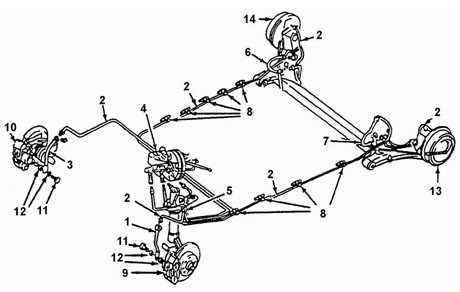
Brake system
1. BRAKE HOSE LH.
2. BRAKE LINE.
3. BRAKE HOSE RH.
4. MASTER CYLINDER.
5. BRAKE LINE BRACKET.
6. BRAKE HOSE RH.
7. BRAKE HOSE LH.
8. BRAKE LINE CLIP.
9. CALIPER LH.
10. CALIPER RH.
11. BANJO BOLT.
12. GASKET.
13. BRAKE DRUM LH.
14. BRAKE DRUM RH.
The master cylinder is designed for a dual-circuit brake system with a diagonal circuit split. The dual-section master cylinder.
is additionally equipped with a brake fluid level sensor in the reservoir and.
brake force regulators (proportioning valves).
brake force regulators (proportioning valves)..
When the brake pedal is pressed, the brake fluid pressure acts simultaneously on the piston and on the sliding caliper of the disc brake. Under the force of the fluid pressure, the piston presses the inner pad against one side of the brake disc. The same force acts on the sliding caliper, in whose cylinder the piston is installed. The caliper, moving along the guide pins, presses the outer brake pad against the other side of the disc.
Increasing the force on the brake pedal increases the pressure in the brake hydraulic system and the corresponding brake torque at the wheels, which provides deceleration and stopping of the vehicle. When the brake pedal is released, the pressure in the brake hydraulic system drops to zero. Due to the elasticity of the seals,
the piston and the caliper move slightly away from the brake disc, releasing the pads. In the released state there are small clearances between the friction surfaces of the pads and the disc.
This caliper design provides automatic compensation for pad wear and maintains a stable clearance between the disc and the
pads during operation.
The vehicle is fitted with rear drum brake assemblies with a leading and a trailing shoe. In the released state, the upper ends of the shoes are pressed by springs against the pistons, and the lower ends against the abutment located on the backing plate.
When the brake pedal is pressed, the pistons press the shoes against the
inner friction surface of the drum. The leading shoe is additionally pressed against the drum by the friction torque, which provides self-energizing or servo action. The force pressing the trailing shoe against the drum, on the contrary,
is reduced by the friction torque. When the vehicle moves in reverse,
the rear shoe becomes the leading shoe and the front shoe becomes the trailing shoe.
The rear brake pressure regulators limit the rate of pressure increase in the hydraulic system of the rear wheels after the pressure in the master cylinder reaches a
certain value. This limits the brake torque of the rear wheels and the risk of their locking during intensive braking. Such brake force regulators are usually used on vehicles equipped with
front disc and rear drum brake assemblies.
The master cylinder is equipped with a brake fluid level sensor. When the fluid level drops below normal, the sensor turns on the BRAKE warning indicator (Brake system). After topping up the brake fluid and restoring the normal level, the indicator turns off.
Brake system technical condition check
Brake system technical condition check
Brake system technical condition check
Brake system technical condition check
Brake system technical condition check
Brake system technical condition check
Brake system technical condition check
Brake system technical condition check
Test yourself
A quick Daewoo Nexia quiz: every answer comes with an explanation and a link to the manual page.