Emergency Equipment. Accident Notification System. Transporting the Vehicle. Towing Points
Whether in an accident or a breakdown, this section explains how the automatic notification system in the Ford Mustang works and which measures are required in an emergency. It also explains how a Mustang is correctly transported and towed. The information on towing points and the use of towing hooks is particularly helpful. With clear illustrations and practical tips, this guide is essential reading for all drivers who want to be prepared for emergencies. It ensures that the vehicle is handled properly to avoid damage and maintain safety.
Accident Notification System
The system flashes the turn signals when a severe collision deploys an airbag (front, side or head airbags) or the seat belt pretensioners.
Switch off the ignition.
- The hazard warning switch has been pressed.
- Press the panic button (if equipped) on the remote control.
- The vehicle is no longer supplied with power.
Transporting the Vehicle
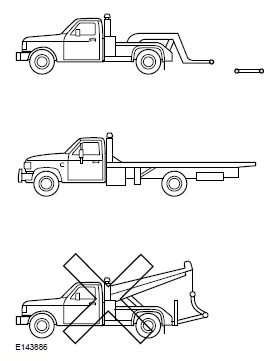
If your vehicle needs to be towed, contact a professional towing service or the roadside assistance of an automobile club if you are a member of one.
For towing your vehicle, we recommend using a tow bar and dolly or a flatbed tow truck. Do not tow your vehicle with a sling strap. Ford Motor Company has not approved towing with a sling strap. Improper or otherwise incorrect towing may damage the vehicle.
Ford Motor Company has produced a towing guide for all authorized towing service operators. Make sure the towing service operator consults this guide so that your vehicle is correctly attached and towed.
A front-wheel-drive vehicle may be towed from the front if the front wheels are lifted off the ground using a suitable tow bar. When towing in this way, the rear wheels may remain on the ground.
On front-wheel-drive vehicles, when towing from the rear with a tow bar, the front wheels must be placed on a dolly. This prevents damage to the transmission.
When towing a vehicle with automatic or part-time all-wheel drive, no wheel may have ground contact. For this reason, a tow bar and dolly or a flatbed tow truck must be used. This prevents damage to the transmission, the automatic or part-time all-wheel-drive system and the vehicle.
Tow Points
Due to different requirements in each country, some vehicles may be equipped with a tow hook.
Installation Position of the Tow Hook
If the vehicle has a screw-in tow hook, it is located in the spare wheel kit.
Installing the Tow Hook
A tow hook mount is located behind the bumper trim.
Note: The screw-in tow hook has a left-hand thread. To install, turn clockwise. Make sure the tow hook is tightened securely.
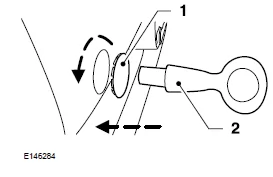
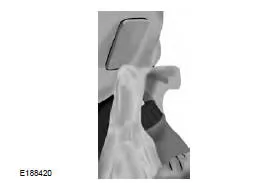
Pry off the tow hook cover with a screwdriver or similar tool.
Note: Wrap the lever tool with a soft cloth. This reduces the risk of scratching the vehicle paint.
The emergency equipment and crash signaling system of the Ford Mustang (6th gen, 2014–2023) are designed for maximum safety. When an airbag or seat belt pretensioner is deployed, the hazard warning lights switch on automatically to alert other road users immediately to a crash. Here the Ford Mustang 2014–2023 demonstrates its engineering maturity and responsibility on the road.
The Ford Mustang 6th generation also relies on professional solutions when transporting and towing the vehicle, in order to prevent damage to the vehicle. The clear instructions on using tow hooks and on correct securing protect the vehicle and its occupants.
These systems underline the claim of the Ford Mustang (6th gen, 2014–2023) to be not only sporty but also responsible and safe on the road.
Test yourself
A quick Ford Mustang quiz: every answer comes with an explanation and a link to the manual page.