Fuel and Refueling. Catalytic Converter. Refueling. Fuel Consumption
This chapter focuses on the catalytic converter, refueling, and fuel consumption of the Ford Mustang (VI Gen). In addition to safety information, it explains how driving behavior and refueling habits affect efficiency. Detailed step-by-step instructions for the correct refueling procedure help prevent misfueling and fuel loss. Notes on CO₂ values and long-term consumption are also included. If you want to drive your Mustang economically and safely, you will find valuable information and practical tips here.
Catalytic Converter
WARNING
Do not park your vehicle on dry leaves, dry grass, or other flammable material, and do not let the engine idle in areas with such material.
While the engine is running, and even after it is switched off, the exhaust system still radiates considerable heat. This creates a fire hazard.
Driving with a Catalytic Converter
WARNINGS
Avoid running on an extremely low fuel level.
Avoid unnecessarily long starting attempts.
Do not run the engine with a spark plug connector disconnected.
Do not start the engine by pushing or towing. Use jumper cables. See Jump Starting the Vehicle.
Never switch off the ignition while driving.
Refueling
WARNINGS
Always turn off the engine when refueling. Never bring sparks or open flames near the fuel filler neck valve.
Never smoke or use a cell phone while refueling. Fuel vapor is extremely dangerous under certain conditions. Avoid inhaling fuel vapors.
The fuel system may be under pressure. If a whistling noise occurs near the fuel filler door, wait until the noise stops before refueling.
Otherwise, fuel could spray out and cause serious injury.
Never remove the fuel nozzle from the inserted position while refueling.
Never overfill the fuel tank. Pressure in an overfilled tank can cause leaks and result in fuel spray and fire.
Stop refueling when the fuel nozzle shuts off for the first time. If this is ignored, fuel will flow into the expansion space in the fuel tank and could leak out.
Wait at least 10 seconds before removing the fuel nozzle so that any residual fuel can flow into the fuel tank.
Never open or force the capless fuel system with foreign objects. This could damage the fuel system and seal and cause injury to you or bystanders.
Note: Your vehicle does not have a fuel filler cap.

A Left-hand: To open the fuel filler door, press the center of the rear edge of the fuel filler door, then release it.
B Right-hand: To open the fuel filler door, press the center of the rear edge of the fuel filler door, then release it.
C Left-hand: To open, pull the rear of the fuel filler door.
D Right-hand: To open, pull the rear of the fuel filler door.
- Fully open the fuel filler door until it latches.
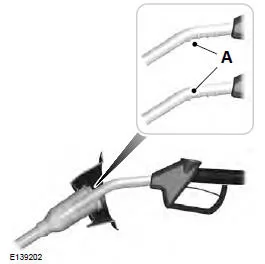
Note: When a fuel nozzle of the correct diameter is inserted, a spring-loaded latch opens.
2. Insert the fuel nozzle until it reaches the first detent at nozzle position A. Keep it supported on the fuel filler neck cover.
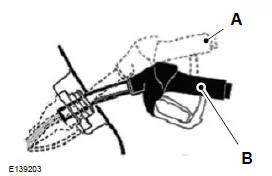
3. Hold the fuel nozzle in position B while refueling. Holding the fuel nozzle in position A may restrict fuel flow and cause the nozzle to shut off before the fuel tank is full.

4. Hold the fuel nozzle within the area shown.

5. Lift the fuel nozzle slightly, then slowly pull it out.
6. Close the fuel filler door fully.
Note: If the wrong fuel has been added, do not attempt to start the engine. Incorrect fuel can cause damage that is not covered by the vehicle warranty. Have your vehicle checked immediately.
System Warnings
If the fuel filler cap is not fully closed, a warning message appears in the information display.
Stop the vehicle as soon as traffic conditions allow, and shift the transmission into Park (P) or Neutral (N).
Apply the parking brake and switch off the ignition.
Fully open the fuel filler door until it latches.
Check the fuel filler neck and its immediate surroundings for objects or dirt that may prevent its movement.
Insert a fuel nozzle or the fuel funnel supplied with the vehicle into the opening of the fuel filler neck. This dislodges any debris that may prevent the fuel filler cap from closing fully.
Note: Even if this procedure resolves the problem, the message will not reset immediately. If the message continues to display and the "Engine Service Soon" warning lamp appears in the information display, have the vehicle inspected as soon as possible.
Fuel Consumption
The CO2 emission and energy consumption values are determined by us using laboratory tests in accordance with Regulation (EC) 715/2007 or Regulation (EC) 692/2008 and subsequent amendments. They were determined by starting from a standstill in second gear on a level surface.
The values determined in this way are used to compare manufacturers and vehicle models. These values are not intended to indicate the actual fuel consumption during everyday use of your vehicle.
Actual fuel consumption depends on factors such as driving style, high-speed driving, frequency of stopping and starting, air conditioning use, installed accessories, payload, and trailer towing.
The stated tank capacity is the maximum amount of fuel that can be added to the fuel tank when the fuel gauge indicates an empty tank. In addition, the fuel tank contains a reserve quantity. The reserve quantity is an imprecisely defined fuel volume that remains in the fuel tank when the fuel gauge first indicates "empty".
Note: The fuel quantity in the reserve range varies, so it should not be counted on to extend driving range.
Refueling
For optimal refueling:
- Switch off the ignition.
- When refueling, let the fuel nozzle shut off automatically only once.
Optimal results can be achieved by using a consistent refueling procedure every time.
Calculating Fuel Consumption
Do not measure fuel consumption during the first 1,600 km (this is the engine break-in period). A more accurate measurement is obtained after 3,200–4,800 km.
- Fill the tank completely and record the odometer reading as the initial odometer reading.
- Record the amount of fuel added at each refueling.
- After at least three refuelings, fill the tank completely again and record the current odometer reading.
- Subtract the initial odometer reading from the current odometer reading.
To calculate fuel consumption in liters per 100 km (l/100 km), multiply the amount of fuel used in liters by 100, then divide by the number of kilometers driven. To calculate fuel consumption in MPG (miles per gallon), divide the miles driven by the number of gallons used.
It is recommended to keep records for at least one month and note the driving conditions (city or highway). This gives you an accurate estimate of consumption under your current driving conditions.
Keeping separate consumption records for summer and winter shows how temperatures affect fuel consumption.
Fuel receipts, refueling frequency, and fuel gauge readings are not accurate methods for determining fuel consumption.
The catalytic converter of the Ford Mustang (6th generation, 2014–2023) helps reduce emissions and protects the environment. The 2014–2023 Ford Mustang combines sporty performance with advanced exhaust technology and a strong commitment to sustainability.
The safe refueling and fuel quality information helps prevent damage to the catalytic converter and maintain the full performance of the vehicle. The sixth-generation Ford Mustang demonstrates its engineering maturity and sense of responsibility here.
This section highlights the Ford Mustang (VI Gen, 2014–2023) as a high-performance sports car that also meets modern environmental requirements.
Test yourself
A quick Ford Mustang quiz: every answer comes with an explanation and a link to the manual page.