Emergency equipment. Jump-starting the vehicle
These instructions describe safe jump-starting of the Ford Mustang (VI Gen, 2014–2023). In addition to warnings about the battery and jump-starting, they provide clear step-by-step instructions for connecting the jumper cables. Removing the cables and recommended engine run times are also explained in detail, for safe assistance in an emergency.
WARNINGS
Batteries can produce explosive gases that can cause injury. Therefore, keep sparks, flames and open lights away from the battery.
When working near the battery, always cover your face and protect your eyes. Always ensure proper ventilation.
Keep batteries out of reach of children. Batteries contain sulfuric acid. Avoid contact with skin, eyes or clothing.
When working near the battery, protect your eyes from battery acid spray. If acid gets on your skin or in your eyes, flush the affected area immediately with water for at least 15 minutes and seek medical attention without delay. If acid is swallowed, seek medical attention immediately.
Use only correctly sized cables with insulated clamps.
Preparing the Vehicle
Note: Do not attempt to push-start a vehicle with an automatic transmission. Attempting to start a vehicle with an automatic transmission by pushing it can damage the transmission.
Note: Use only 12-volt power sources to start the vehicle.
Note: Do not disconnect the battery of the disabled vehicle, as this could damage the vehicle's electrical system.
Position the helping vehicle near the hood of the disabled vehicle without the vehicles touching. Switch off all electrical accessories.
Connecting the Jumper Cables
WARNING
Do not connect the cables to fuel lines, rocker covers, the intake manifold or electrical components as ground points. Keep away from moving parts. To avoid reverse-polarity connections, correctly identify the positive (+) and negative (-) terminals on the disabled vehicle and the helping vehicle before connecting the cables.
Note: In the illustration, the lower vehicle is the helping vehicle.
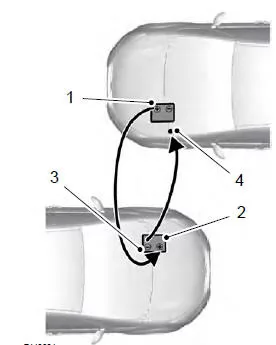
- Connect the positive (+) jumper cable clamp to the positive (+) terminal of the discharged battery.
- Connect the other end of the positive (+) cable to the positive (+) terminal of the helping vehicle's battery.
- Connect the negative (-) cable to the negative (-) terminal of the helping vehicle's battery.
- Finally, connect the negative (-) cable to a bare metal part of the engine in the disabled vehicle (not to the battery or the fuel injection system) or, if provided, to a ground point.
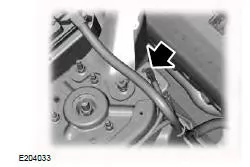
Note: The ground connection of your vehicle can also be made via the optional connection point shown above.
WARNING
Do not connect the end of the second cable to the negative (-) terminal of the battery that is to receive the jump start. A spark can cause the gases around the battery to explode.
Jump-starting
- Start the engine of the helping vehicle and moderately increase engine speed or press the accelerator pedal to maintain an engine speed between 2000 and 3000 rpm, while monitoring the tachometer.
- Start the engine of the disabled vehicle.
- After starting the disabled vehicle, let both engines run for another three minutes before disconnecting the jumper cables.
Removing the Jumper Cables
Disconnect the jumper cables in the reverse order.
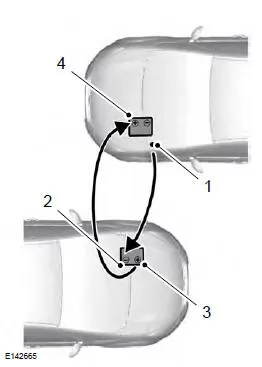
- Disconnect the jumper cable from the bare metal surface or ground point used for grounding (if provided).
- Disconnect the negative (-) jumper cable from the disabled vehicle.
- Disconnect the jumper cable from the negative (-) battery terminal of the helping vehicle.
- Disconnect the jumper cable from the positive (+) battery terminal of the helping vehicle.
- Disconnect the jumper cable from the positive (+) terminal of the disabled vehicle's battery.
Let the engine idle for at least one minute.
The jump-starting system of the Ford Mustang (6th generation, 2014–2023) is designed for maximum safety and ease of use. With clear instructions for connecting and removing jumper cables, the risk of damage to the electronics or the powertrain is minimized. The 2014–2023 Ford Mustang combines technical precision with practical everyday usability.
The warnings on the correct handling of the battery and jumper cables are especially important. They help prevent injury and property damage and ensure that the system functions properly. The sixth-generation Ford Mustang demonstrates its high standards of quality and safety here.
This equipment highlights how the Ford Mustang (6th generation, 2014–2023) combines sporty performance with modern safety and comfort technology, even in emergency situations.
Test yourself
A quick Ford Mustang quiz: every answer comes with an explanation and a link to the manual page.