Transmission
This chapter covers the manual and automatic transmission of the Ford Mustang (VI Gen, 2014–2023). It explains the gear positions, Sport mode and the SelectShift system for manual gear selection. Drivers also learn how to use the adaptive learning function and how to operate the transmission correctly in snow or mud. Detailed warnings and recommendations for securing the transmission make this chapter especially useful, and it is ideal for anyone who wants maximum control while driving.
Manual Transmission
Shifting into Reverse
Never shift into reverse while the vehicle is moving. This can cause transmission damage.
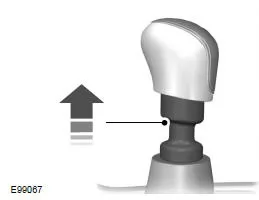
When shifting into reverse, lift the ring.
Automatic transmission
WARNINGS
When parking the vehicle, always fully apply the parking brake and be sure to move the shift lever to Park (P).
Switch off the ignition and take the key with you when you leave the vehicle.
Never press the brake and accelerator pedals at the same time. If both pedals are applied simultaneously for more than three seconds, engine speed is limited, which may prevent you from maintaining speed in traffic and could result in serious injury.
Your Automatic Transmission Positions
Selecting a gear:
- Fully depress the brake pedal.
- Press and hold the button on top of the shift lever.
- Move the shift lever to the position for the desired gear.
- Release the button. The transmission remains in the selected gear.
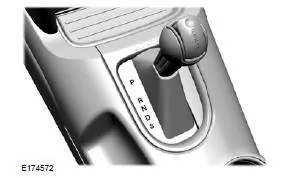
Park (P)
In this position the transmission is locked, which prevents the rear wheels from turning. Only shift into or out of Park (P) once the vehicle has come to a complete stop.
Reverse (R)
When the selector lever is in Reverse (R), the vehicle moves backward. Only shift into or out of Reverse (R) once the vehicle has come to a complete stop.
Neutral (N)
When the selector lever is in Neutral (N), the engine can be started and the vehicle can roll. In this position, always press the brake pedal firmly.
Drive (D)
Drive (D) is the normal driving position for optimal fuel economy. Overdrive allows automatic upshifting and downshifting through all gears.
Sport (S)
Switching to Sport mode (S):
- Provides additional engine braking and holds lower gears longer to improve performance when climbing hills, driving on hilly terrain or in the mountains. When engine braking is used, engine speed increases.
- Provides additional operation in lower gears through the automatic transmission's shift strategy.
- Allows faster gear selection and shifts at higher engine speeds.
SelectShift Automatic™ Transmission
This feature allows you to shift to a higher or lower gear.
Downshifting is possible as long as engine speed is below the maximum permitted limit. SelectShift downshifts automatically at low engine speeds to prevent the engine from stalling.
Note: The engine may be damaged if it is over-revved for an extended period without shifting.
As long as the accelerator pedal is not fully depressed, SelectShift does not upshift automatically, even when the engine speed limit is reached.
Observe the
shift indicator light, which indicates the most favorable shift point for efficient, fuel-saving driving.
SelectShift can be activated by pulling the shift paddle (+) on the steering wheel.
- To upshift, pull the right shift paddle (+).
- To downshift, pull the left shift paddle (–).

SelectShift in Drive (D) mode:
Provides a temporary manual mode for maneuvers with higher power demand that require additional control over gear selection (e.g., when towing or passing).
In this mode, the selected gear is held for a certain period depending on driver inputs (e.g., steering or accelerator pedal).
SelectShift in Sport (S) mode:
Allows permanent manual gear selection when full control over gear selection is needed.
To exit SelectShift mode, shift the transmission into another gear (e.g., Drive [D]).
The currently selected gear is shown in the instrument cluster. If a gear is requested that is not possible due to the driving situation (low speed, engine speed too high for the requested gear), the display of the current gear flashes three times.
Note: When the accelerator pedal is fully depressed, the transmission downshifts automatically to ensure maximum performance.
Shift Lock
WARNINGS
Only drive off after confirming that the brake lights are working.
To perform this procedure, the transmission must be taken out of Park (P), allowing the vehicle to roll freely. To avoid unintended vehicle movement, always apply the parking brake before this step. Use wheel chocks if necessary.
If the brake system warning lamp remains on with the parking brake fully released, the brakes may not be functioning properly. Have the vehicle inspected as soon as possible.
Note: After using this emergency procedure, visit an authorized dealer as soon as possible.
Note: This function is disabled in some markets.
In the event of an electrical malfunction or a discharged vehicle battery, the vehicle can be released from Park (P) using the shift lock.
Apply the parking brake and switch off the ignition before performing this procedure.
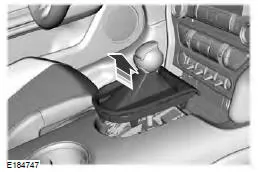
Using a flat-blade screwdriver or similar tool, remove the chrome trim and the shift plate at the base of the shift lever.
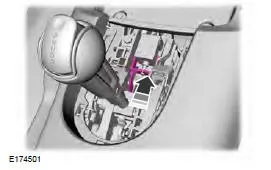
2. Using a suitable tool, push the white release lever forward while moving the shift lever from Park (P) to Neutral (N).
3. Reinstall the console.
4. Start the vehicle and release the parking brake.
Adaptive Learning – Automatic Transmission
This feature is designed to extend service life and ensure consistent shift comfort over the life of the vehicle. A new vehicle or
a new transmission may shift harder or softer. This behavior is normal, and it does not affect the function or service life of the transmission. Over time, the adaptive learning process fully adjusts transmission operation. In addition, the system must relearn its strategy after the battery is disconnected or a new battery is installed.
Freeing the Vehicle from Mud or Snow
Note: Never attempt to free the vehicle by alternately shifting between Drive and Reverse until the engine has reached normal operating temperature, as this can damage the transmission!
Note: Never attempt to free the vehicle by alternately shifting between Drive and Reverse for more than one minute, as this can cause engine overheating and damage to the transmission and tires.
If the vehicle is stuck in mud or snow, try to rock it free by repeatedly shifting between Drive and Reverse. With the gear engaged, apply light pressure to the accelerator pedal each time.
The transmission options of the Ford Mustang (VI Gen, 2014–2023) offer sporty performance and high comfort. Whether a precise manual transmission or a modern automatic with SelectShift, the Ford Mustang 2014–2023 meets the demands of performance and everyday usability.
Special features such as Sport mode, the shift lock, and the adaptive learning program underline the premium character of the Ford Mustang VI Gen. These systems provide an individual driving experience with maximum safety.
Frequently Asked Questions
When should reverse gear be engaged in the Ford Mustang (VI Gen, 2014–2023)?
Only when the vehicle is completely stopped, to avoid transmission damage.
How do I activate SelectShift using the steering wheel?
Pull the right shift paddle (+) to activate SelectShift mode and shift manually.
Test yourself
A quick Ford Mustang quiz: every answer comes with an explanation and a link to the manual page.