Stability Control
This chapter covers Stability Control on the Ford Mustang (6th Gen, 2014–2023). It describes how electronic systems such as ESC and Traction Control help maintain traction and vehicle control. Especially at the limit of handling, the system supports the driver with targeted braking and engine power regulation, which can help prevent spinning and sliding.
Function Description
WARNINGS
Changes to the vehicle affecting the brake system, aftermarket roof racks, suspension, steering system, tire construction, and wheel and tire size can alter handling and negatively affect the performance of the Electronic Stability Control system. Installing stereo speakers can also interfere with the Electronic Stability Control system and have negative effects.
When installing aftermarket stereo speakers, mount them as far as possible from the front center console, the tunnel, and the front seats to minimize the risk of interfering with the Stability Control sensors.
If the effectiveness of the Electronic Stability Control system is impaired, there is a higher risk of losing control of the vehicle, which may result in a rollover and serious or fatal injury.
Even the most advanced technology is subject to the laws of physics.
There is always the possibility that the driver may lose control of the vehicle through incorrect driving.
Aggressive driving can lead to loss of vehicle control under any driving conditions, increasing the risk of injury and property damage. When Electronic Stability Control activates, it indicates that at least some tires have lost grip; the driver may lose control of the vehicle, which may result in a rollover and serious or fatal injury. When Electronic Stability Control activates, REDUCE SPEED.
The system turns on automatically each time the ignition is switched on.
If a malfunction occurs in the stability control or traction control systems, the following conditions are possible:
- The stability control and traction control warning light stays on continuously.
- The stability control and traction control systems do not improve the traction of the vehicle's wheels.
If one of the stability control or traction control systems intervenes due to driving conditions, the following conditions are possible:
- The stability control and traction control indicator light flashes.
- The vehicle speed is reduced.
- Reduced engine power.
- Vibration in the brake pedal.
- The brake pedal must be pressed harder than normal.
- If your foot is not on the brake in a critical driving situation, the brake pedal may move while the system applies higher braking force.
The Electronic Stability Control system supports you with several integrated functions to help you keep control of the vehicle:
Electronic stability control
The system improves your vehicle's ability to prevent skidding and sideways sliding by applying the brakes individually at one or more wheels and, if necessary, reducing engine power.
Traction Control
The system improves the vehicle's ability to stay on track by detecting and controlling wheel speed.
See Using the Traction Control.
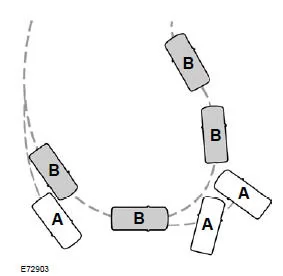
A Vehicle without stability control skidding out of control.
B Vehicle with stability control remaining under control on a slippery road surface.
Using the Stability Control
Electronic Stability Control
The system turns on automatically each time the ignition is switched on.
The electronic stability control of the system is deactivated when reverse (R) is selected or (on some models) when the vehicle is stationary, the brake is applied and the ESC button is pressed and held for more than five seconds. The traction control of the system can be switched off independently.
See Using the Traction Control.
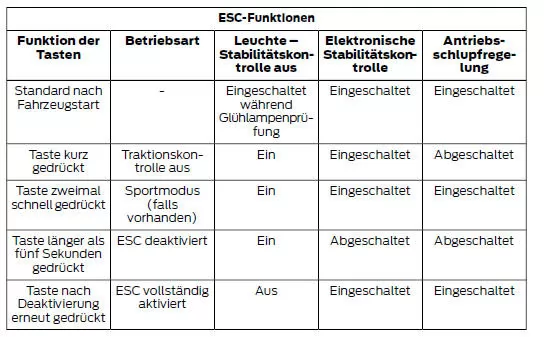
Note: Sport mode must not be used on public roads.
Some models have a Sport mode, which allows the driver to limit the intervention of the normal stability control for a sportier driving style. To switch to Sport mode, briefly press the stability control button twice. A message is shown in the information display confirming that the system is now in Sport mode.
On vehicles equipped with selectable drive modes, the electronic stability control Sport mode is not available. Selecting Track mode switches to a performance-oriented electronic stability control mode. In this mode, the intervention of the electronic stability control is limited and optimized for racetracks; this mode must not be used on public roads. In all selectable drive modes, traction control and electronic stability control can be deactivated with the electronic stability control switch.
Front wheel lock
The front wheel lock is intended exclusively for use on racetracks and must not be used on public roads. Using this function causes significantly greater wear on the rear tires.
This allows the rear tires to be conditioned for maximum traction when driving on a racetrack. With front wheel lock, the rear wheels can spin freely while the front wheels are braked, so the vehicle moves only minimally.
This function is accessible through the "Track Apps" menu. The settings can be selected using the five-way button on the information display and the "OK" button on the steering wheel.
Using the front wheel lock
The front wheel lock has three phases:
- Prepared
- Activated
- Off
Preparing the front wheel lock
In the preparation phase, the system checks whether the vehicle is ready to use the front wheel lock and confirms that the driver has made this selection intentionally. Follow the prompts in the information display to prepare the front wheel lock.
The following conditions must be met to prepare the front wheel lock:
- The vehicle is on level ground.
- The engine is running.
- The vehicle speed is less than 40 km/h.
- Wet mode (if equipped) is not selected as the selectable drive mode.
- There are no electronic stability control faults.
To cancel the front wheel lock after preparation, press the left button on the information display. After preparation, the front wheel lock is ready to be activated; the preparation is maintained up to a speed of 40 km/h. If the vehicle speed exceeds 40 km/h, the front wheel lock switches off automatically.
Activating the front wheel lock
Follow the prompts in the information display to activate the front wheel lock after preparation. To activate, press the brake pedal fully. Then press the "OK" button. After the function is activated, release the brake pedal. The front brakes remain applied and the rear brakes are released. At this point, the activation timer starts and is shown to the driver in the information display.
The following conditions must be met to activate the front wheel lock:
- The vehicle is on level ground.
- The engine is running.
- The vehicle is stationary.
- The parking brake is not applied.
- The driver's door is closed.
- A forward gear is selected.
- Wet mode (if equipped) is not selected as the selectable drive mode.
- There are no electronic stability control faults.
- The steering wheel must be in the straight-ahead position.
Releasing the front wheel lock
While the front wheel lock is active, you can cancel (release) the function with the "OK" button. Pressing the "OK" button releases the front wheel lock immediately and restores normal vehicle operation. While the front wheel lock is active, a countdown timer shows the time remaining until the front wheel lock is released automatically. If the time limit is exceeded or another vehicle condition requires the front wheel lock to be released, the system deactivates the function safely and normal vehicle operation resumes.
Note: If the brake pedal is pressed while the front wheel lock is on, the front wheel lock is automatically canceled and normal braking function is restored.
The stability control system of the Ford Mustang (VI Gen, 2014–2023) provides advanced safety technology that supports the driver in critical driving situations. By applying targeted braking to individual wheels and, if necessary, reducing engine power, the system helps prevent skidding and lateral slides. The 2014–2023 Ford Mustang combines sporty dynamics with technical precision.
Special features such as Sport mode or Track mode give the driver additional options for a performance-oriented driving experience. Clear user guidance and safety warnings underline the high standard of responsibility and control that the Ford Mustang VI Generation demands.
With this stability control system, the Ford Mustang (VI Gen, 2014–2023) shows how impressive performance and a high level of safety can be combined perfectly.
Test yourself
A quick Ford Mustang quiz: every answer comes with an explanation and a link to the manual page.