Tire Condition and Inflation Pressure Check
(every 400 km [250 miles] of driving or weekly)

INSUFFICIENT TIRE INFLATION PRESSURE
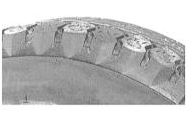
CUPPED WEAR
Possible causes of cupped wear:
- Tires are underinflated, or there is a mechanical irregularity (wheel imbalance or wheel rim deformation).
- Steering tie rod or steering idler arm attachments are loose, or the listed components are worn.
- Front suspension components are damaged or worn, or their attachments are loose.

EXCESSIVE TIRE INFLATION PRESSURE
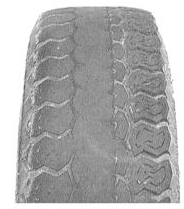
INCORRECT WHEEL ALIGNMENT, OR EXCESSIVE WHEEL CAMBER
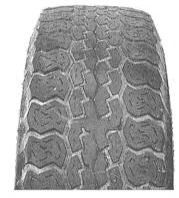
FEATHERED TREAD WEAR CAUSED BY INCORRECT WHEEL ANGLES
Performing regular tire condition checks allows the driver to avoid inconvenient delays caused by a wheel failure while driving. In addition, the tread wear pattern can be used to detect developing defects in suspension and steering components in advance.
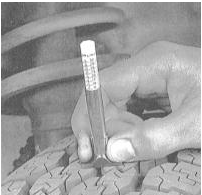
The minimum permissible tread depth is 1.6 mm. The degree of tread wear can be measured with a special inexpensive gauge, available at automotive accessory stores.
Pay attention to any signs of uneven tread wear. Local defects such as cupping, flat spots and similar are usually caused by incorrect front wheel alignment or wheel balance. To identify and correct the faults, take the vehicle to a specialized automotive service workshop or service station.
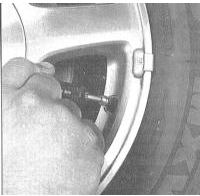
Carefully inspect the tires on all wheels for cuts, punctures and foreign objects lodged in the tread grooves. Sometimes a punctured tire continues to hold air for some time because the object that punctured the tire remains lodged in it. A slow leak may be caused by a defective tire valve core; check the condition of the valve core.
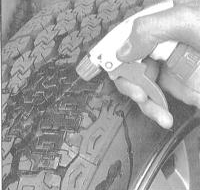
Carefully inspect the tread for embedded objects or for leaks at the repair plugs used to fix small punctures. To check for a puncture, wet the suspected area of the tire surface with soapy water. If there is a puncture, bubbles will form. Small punctures can be easily repaired at a tire service shop.
Carefully inspect the inner walls of all four tires for brake fluid stains. If any are found, immediately check the condition of the corresponding brake assemblies and the hydraulic lines connected to them.
Maintaining the specified tire inflation pressure will significantly extend tire life, provide maximum ride comfort, and prevent loss of vehicle handling. Remember that it is practically impossible to judge tire pressure by eye, especially for radial tires. Always keep a suitable tire pressure gauge on hand. Do not rely on the gauges of inflation compressors at gas stations and service stations.
Check tire inflation pressure when the tires are cold, meaning the vehicle has been driven no more than 1 mile (1.6 km) in the last three hours. Remember that a pressure increase of 0.3 to 0.6 kgf/cm² (4 to 9 psi) due to tire heating is normal.
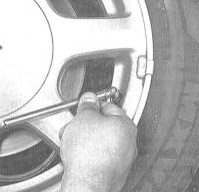
Remove the protective cap from the tire valve and press the gauge fitting firmly onto the valve outlet, depressing the valve core. Read the gauge and compare the reading with the specified values. If necessary, adjust the pressure.
Be sure to reinstall the valve protective cap to prevent moisture and dirt from entering the valve. Check the pressure in all tires, including the spare.
The inflation pressure of a compact spare tire is usually noticeably higher than that of regular tires.
Test yourself
A quick Honda Accord quiz: every answer comes with an explanation and a link to the manual page.