Inspection, Belt Tension Adjustment and Replacement of Drive Belts
(every 12,000 km [7500 miles] or every 6 months)
INSPECTION
PROCEDURE
1. Drive belts, also known as V-belts, are located at the front of the engine and play an important role in the operation of the engine and many other vehicle systems. Over time, belts wear out and must be inspected regularly according to the maintenance schedule to avoid serious engine failures, the repair of which can be very costly for the vehicle owner.
The V-belt family also includes multi-rib (serpentine) belts.
2. The number of drive belts used on the engine depends on vehicle equipment. Belts drive auxiliary components such as the generator, power steering pump, water pump, air conditioning compressor, etc. Depending on the pulley layout, one belt may drive more than one component.
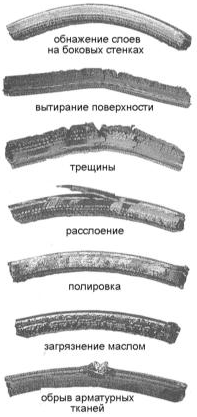
3. Turn off the engine, open the hood and locate the drive belts at the front of the engine. Using a flashlight, run your fingers along the full length of each belt and check for cracks and delamination. Glazed, shiny areas, abrasions and other obvious defects are not acceptable. Inspect both sides of the belts by twisting them.

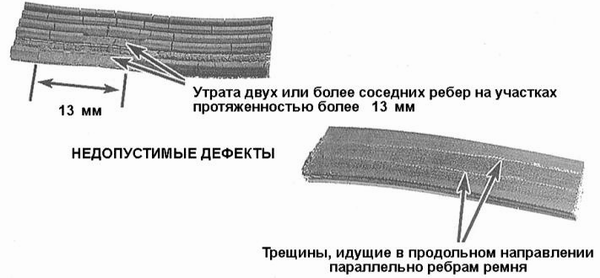
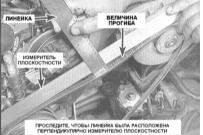
4. To check belt tension, press the belt with your thumb at a point midway between two adjacent pulleys. The pressure should be firm. The parameter characterizing belt tension is the amount of deflection when pressed. As a rule, if the pulleys are spaced 180 to 280 mm apart, the deflection should be 6.4 mm; a pulley spacing of 305 ÷ 405 mm corresponds to a deflection of 12.5 mm for V-belts and 6.4 mm for multi-rib belts.
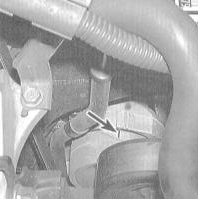
5. On V6 models, the generator/air conditioning compressor drive belt is equipped with an automatic tensioner, and no provision is made for adjusting its tension. The automatic tensioner includes a belt wear indicator (based on belt stretch).
ADJUSTMENT
PROCEDURE
1. On V6 models, the generator/air conditioning compressor belt is equipped with an automatic tensioner. Adjust the tension of all other belts manually by moving the driven components in the appropriate direction.
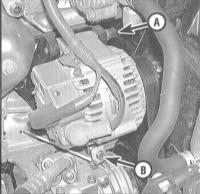
2. To adjust the generator belt on 4-cylinder models, or the power steering pump belt on V6 models, loosen the mounting bolts of the respective components and turn the adjusting bolt in the required direction (clockwise to tighten the belt, counterclockwise to loosen it).
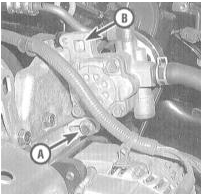
3. The power steering pump belt on 4-cylinder models is adjusted by loosening the mounting bolts and moving the component using a 1/2-inch square-drive socket wrench.
4. After adjustment, verify that the belt tension is correct. If necessary, repeat the adjustment procedure.
REPLACEMENT
PROCEDURE
1. On V6 models, fit a long wrench of the correct size onto the center bolt of the tensioner pulley and, turning the tensioner counterclockwise, remove the generator belt. On all other models, release the belt tension as described above to remove the generator belt from its pulleys. It is advisable to replace all drive belts at the same time. Before completely removing the belt from the vehicle, mark the direction of belt rotation and the routing through the pulley grooves.
2. When purchasing new belts, take the old ones with you as samples. Replacement belts must exactly match the original belts in size.
3. After replacement is complete, adjust the tension of the new belts.
Test yourself
A quick Honda Accord quiz: every answer comes with an explanation and a link to the manual page.