Battery Inspection, Maintenance and Charging
(every 12,000 km [7500 miles] or every 6 months)
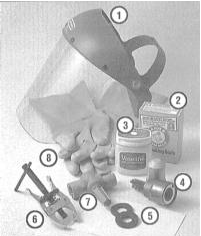
Tools and Materials Required for Battery Maintenance
1 — Face shield/safety glasses — when removing corrosion with a wire brush, crystallized acid particles can easily get into the eyes.
2 — Baking soda — a water solution of baking soda is used to neutralize corrosion.
3 — Acid-free petroleum jelly — lubricating the battery terminals helps prevent corrosion in the future.
4 — Battery terminal/cable end cleaning tool — specially shaped wire brush attachments help effectively clean battery posts and terminal clamps.
5 — Treated felt washers — installing such a washer directly under the terminal clamp helps prevent corrosion.
6 — Puller — sometimes cable clamps are fitted very tightly onto the posts and cannot be removed even after the fastener is fully loosened.
7 — Battery terminal/cable end cleaning tool — although of a different design than item 4, it performs the same tasks.
8 — Rubber gloves — do not underestimate this protective item. Remember that the battery contains sulfuric acid!
Battery inspection and maintenance require certain special precautions. Remember that hydrogen gas released by the electrolyte is highly explosive. Do not smoke, and keep open flames and lit cigarettes away from the work area! Remember that the electrolyte is dilute sulfuric acid, which can cause severe chemical burns if it contacts the eyes or exposed skin. Electrolyte can also easily damage clothing fabric and body paint!
When disconnecting the battery, always disconnect the negative cable first. Connect it last!
Preparation
Conscientious performance of routine battery maintenance procedures is the only guarantee of quick and reliable engine starting. Before servicing the battery, make sure you have all necessary materials and tools at hand to ensure safe work.
There are also a number of additional precautions that must be observed when servicing the battery. Before starting work, be sure to stop the engine and switch off all electrical consumers. Disconnect the negative cable from the battery.
Remember that hydrogen gas is released from the battery cells. Hydrogen is not only highly flammable but also explosive. Never approach the work area with an open flame or a lit cigarette. Use only non-sparking tools whenever possible. Charge the battery in a well-ventilated area.
Electrolyte is a sulfuric acid solution. Sulfuric acid is not only a toxic chemical compound but also an extremely chemically aggressive substance. Do not allow electrolyte to contact the eyes, exposed skin, or clothing. When servicing the battery, wear protective goggles and gloves, and do not allow children to approach the work area.
Inspect the external condition of the battery. If the positive battery terminal and its clamp are fitted with a rubber protective cover, make sure the cover is not damaged. The cover must completely cover the metal components of the terminal connection. Check the condition and security of the terminal connections, and inspect the battery case and cover for cracks and other mechanical damage. Make sure the clamp bolts are securely tightened. Check the condition of the battery cable insulation along its entire length.
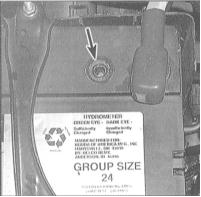
Some models are equipped with sealed-type batteries fitted with a charge level indicator. Compare the color of the indicator dot in the viewing window with the indicator status chart printed on the label affixed to the battery case. Check the battery condition regularly and charge it promptly when necessary.
Service PROCEDURE

1. If white powdery deposits (corrosion) are found on the battery surface, especially near the terminals, remove the battery from the vehicle for thorough external cleaning.
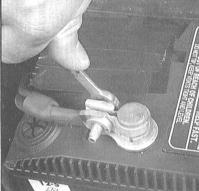
2. Loosen the terminal clamp bolts with a wrench (negative first!) and carefully disconnect the cables from the battery. Remove the hold-down clamp fasteners, lift the clamp, and remove the battery from the engine compartment.
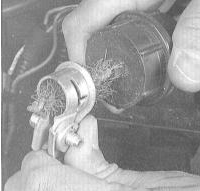
3. Thoroughly clean the contact surfaces of the cable clamps and battery terminal posts with special brushes using a baking soda solution. Clean the battery terminals with the same solution and rinse the battery cover surface. Take care that the solution does not get inside the cells. Perform cleaning while wearing a protective mask or goggles and rubber gloves to prevent acid particles from getting into your eyes or onto your hands. Also wear suitable clothing that you do not mind discarding afterward. When cleaning is complete, rinse the treated surfaces with clean water.
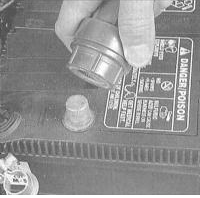
4. Check the condition of the battery tray and the hold-down clamp studs. Rinse the tray with baking soda solution. Treat areas damaged by corrosion with zinc-based primer.
5. Before installing the battery, make sure no tools or materials have been left in the tray. Do not overtighten the hold-down clamp fasteners.
6. To protect terminal connections from corrosion, install specially treated felt washers on the battery terminal posts. After connecting the cables, coat the terminal assemblies with acid-free petroleum jelly. Remember that the negative cable is always connected last!
7. Make sure the clamp fasteners are tightened securely.
Charging
During charging, highly flammable and explosive hydrogen gas is released from the battery cells! Do not smoke or approach the charging area with an open flame. When approaching the battery, wear protective goggles. Before connecting or disconnecting the battery to or from the charger, make sure the charger is disconnected from the power supply.
The authors of this manual recommend charging the battery outside the vehicle, since the gas released during the procedure is chemically aggressive toward paint finishes. Remember that performing a quick charge without disconnecting the cables from the battery may damage the vehicle's electrical components.
The best way to restore the charge of a battery that has been discharged to the point where it can no longer start the engine is slow charging. This charging method is also the most suitable for batteries of vehicles used mainly for short trips. Maintaining the battery charge is especially important in winter, when the battery is under the most unfavorable conditions, as well as during difficult engine starts and periods of increased electrical load.
It is best to use a trickle charger with a continuous low charging current (1 ÷ 2 A), sometimes also called a maintainer. Chargers of this type provide the most favorable charging mode with minimum stress on the battery. To charge the battery faster, a power source with a higher current output can be used; however, remember that the maximum permissible charging current must not exceed 1/10 of the battery capacity (its ampere-hour rating). Fast charging, which some users claim restores the charge in one to two hours, places so much stress on the battery that it often fails irreversibly. Avoid this method and use it only in genuine emergencies.
The average charging time should be specified in the instructions supplied with the charger. It is usually from 12 to 16 hours.
Remove the filler caps from all battery cells (if provided) and plug the openings with clean cloth to prevent electrolyte from splashing out. Disconnect the negative cable from the battery and, observing polarity, connect the charger clamps to the battery terminals (positive to positive, negative to negative). Plug the charger into the mains. If the charger has a selector switch, make sure it is set to 12 V.
When using a power source with a charging current above two amperes, check the battery regularly to make sure it does not overheat. During slow charging, after the initial two-hour check, the battery can safely be left to charge unattended overnight.
If the battery cells have filler openings with removable caps, check the electrolyte specific gravity every hour during the first few hours of charging. Many manufacturers produce inexpensive instruments called hydrometers for this purpose, which can be purchased at almost any automotive accessory store. When using a hydrometer, follow the manufacturer's instructions. Continue charging the battery until the electrolyte specific gravity no longer changes over the last two hourly readings and the electrolyte is gently gassing (bubbling) in all cells. Note that in a serviceable battery the difference in specific gravity between the cells must be very small.
Some batteries are sealed and have a built-in hydrometer (charge indicator), which allows the state of charge to be checked visually by the color of the indicator dot in the sight window of the case. Generally, a bright color of the indicator dot indicates a high state of charge; a darkening of the dot indicates that the battery needs to be recharged.
On sealed batteries without a built-in hydrometer (charge indicator), the state of charge can be checked by connecting a voltmeter to the battery terminals. The output voltage of a fully charged battery must be at least 12.6 V after the surface charge has been removed.
Test yourself
A quick Honda Accord quiz: every answer comes with an explanation and a link to the manual page.