General Information. Opening and Closing the Hood. Engine Compartment - Overview - 2.3L EcoBoost™, Left-Hand Drive. Engine Compartment - Overview - 2.3L EcoBoost™, Right-Hand Drive
This chapter provides basic maintenance recommendations for the Ford Mustang (VI generation, 2014–2023), as well as instructions for safely opening and closing the hood. It contains an overview of all important maintenance points in the engine compartment for left-hand and right-hand drive versions. The recommendations for regular visual and functional checks are especially helpful. The clear structure and detailed descriptions keep the Mustang in proper technical condition, ensuring reliable performance and preserving its value.
General Information
WARNINGS
Switch off the ignition and apply the parking brake.
Never touch components of the electronic ignition system when the ignition is switched on or while the engine is running. The system operates at high voltage.
Failure to heed this warning may result in serious or fatal injury.
Keep hands and clothing away from the radiator cooling fan.
Under certain operating conditions, the radiator cooling fan may continue to run for several minutes after the vehicle has been switched off.
Make sure that you have correctly reinstalled the filler caps after maintenance and inspection.
Have your vehicle serviced regularly to ensure roadworthiness and resale value. A comprehensive network of Ford dealers provides professional maintenance services.
Authorized dealerships provide the expert knowledge and qualifications, as well as the necessary special tools, required for correct maintenance of your vehicle.
In addition to regular maintenance, we recommend carrying out the following additional checks:
Check daily
- Exterior lights
- Interior Lamps
- Warning and indicator lights
Checks when refueling
- Brake fluid level. See Checking the Brake Fluid.
- Washer fluid level. See Checking the Washer Fluid.
- Tire pressure. See Technical Specifications.
- Tire condition. See Wheels and Tires.
Check monthly
- Engine oil level. See Checking the Engine Oil.
- Engine coolant level. See Checking the Coolant.
- Lines, hoses and reservoirs for leaks.
- Air conditioning operation
- Parking brake operation
- Horn operation
- Wheel nuts tight. See Technical Specifications.
Opening and Closing the Hood
Opening the bonnet
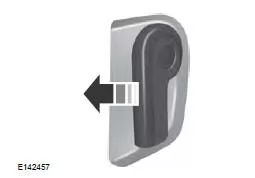
- Inside the vehicle, pull the hood release cable on the left under the instrument panel.
- Lift the hood slightly.
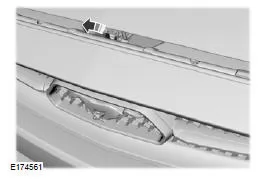
3. Release the hood latch by pushing the second release lever to the left, as seen from your position.
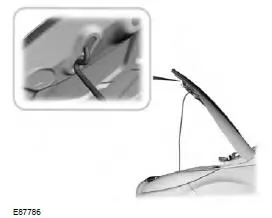
4. Open the hood. Support the hood with the prop rod.
Closing the Hood
- Release the hood prop rod from its holder and secure it correctly after use.
- Lower the hood and let it fall under its own weight from a height of 20–30 cm (8–12 in) to close it.
Note: Make sure the hood is properly latched.
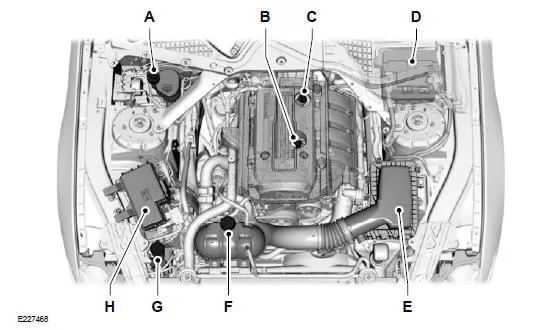
Engine Compartment - Overview - 2.3L EcoBoost™, Left-Hand Drive
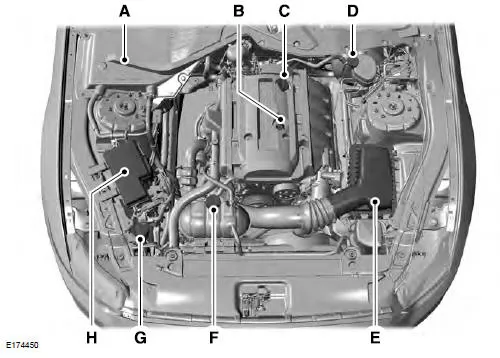
A Battery. See Replacing the 12 V Battery.
B Engine oil dipstick. See Engine Oil Dipstick.
C Engine oil filler cap. See Checking the Engine Oil.
D Brake fluid reservoir. See Checking the Brake Fluid.
E Air filter.
F Coolant expansion tank. See Checking the Coolant.
G Front windshield washer fluid reservoir. See Checking the Washer Fluid.
H Engine compartment fuse box. See Fuses.
Engine Compartment - Overview - 2.3L EcoBoost™, Right-Hand Drive
A Brake fluid reservoir. See Checking the Brake Fluid.
B Engine oil dipstick. See Engine Oil Dipstick.
C Engine oil filler cap. See Checking the Engine Oil.
D Battery. See Replacing the 12 V Battery.
E Air filter.
F Coolant expansion tank. See Checking the Coolant.
G Washer fluid reservoir. See Checking the Washer Fluid.
H Engine compartment fuse box. See Fuse Table.
The general maintenance information and engine compartment overviews for the Ford Mustang (VI generation, 2014–2023) give the driver clear guidance for daily and regular checks. With easily accessible components, the Ford Mustang 2014–2023 makes inspection tasks simple to carry out, helping to maintain vehicle safety and value.
The precise layout of components such as the oil dipstick, brake fluid reservoir and washer fluid reservoir reflects the high standard of user-friendliness and maintenance convenience of the Ford Mustang VI generation. All important check and filling points are clearly marked.
With these details, the Ford Mustang (VI generation, 2014–2023) shows that sporty design and practical everyday usability work together perfectly, giving the driver optimal support in caring for the vehicle.
Test yourself
A quick Ford Mustang quiz: every answer comes with an explanation and a link to the manual page.