Information on wheels with different specifications. Tire change procedure
This section explains when and how a spare wheel with different specifications may be used on the Ford Mustang. Differences in size or construction can affect handling and are subject to strict restrictions. The second part provides step-by-step instructions for changing a tire safely, including blocking the wheels, correct use of the jack, and the correct tightening torque. Diagrams help you locate the lift points. Especially in an emergency, this section serves as a structured guide for every driver. The information supports a safe and effective approach when dealing with tire damage.
Information on Spare Wheels with Different Specifications
WARNING
Failure to follow these guidelines increases the risk of losing control of the vehicle, as well as the risk of injury up to and including death.
If a spare wheel with different specifications is fitted, it may only be used temporarily.
If you must use it, replace it as soon as possible with a wheel that matches the size and type of the wheels originally fitted by Ford. If the spare wheel with different specifications is damaged, do not repair it; replace it.
A spare wheel with different specifications is a spare wheel that differs from the road wheels in brand, size or appearance. The following three types are possible:
1. Temporary-use spare wheel type T: On this spare wheel, the first letter of the tire size is T. The sidewall may bear the marking "Temporary Use Only".
2. Full-size spare wheel with different specifications and label: On this spare wheel, the wheel carries a label with the following text: THIS WHEEL AND TIRE ASSEMBLY FOR TEMPORARY USE ONLY.
When driving with any of the spare wheels listed above, avoid the following:
- Do not exceed 80 km/h.
- Loading the vehicle beyond the maximum load capacity shown on the safety compliance certification label.
- Using snow chains on the end of the vehicle where the spare wheel with different specifications is fitted.
- Using several spare wheels with different specifications at the same time.
- Using commercial car washes.
- Attempting to repair the spare wheel with different specifications.
A spare wheel with different specifications of the types listed above, fitted in any position, may affect the following:
- Driving, stability and braking performance.
- Comfort and noise.
- Ground clearance and parking at curbs.
- Handling in winter weather conditions.
- Handling in wet weather conditions.
- Handling when using all-wheel drive.
3. Full-size spare wheel with different specifications without label
When driving with a full-size spare wheel with different specifications, avoid the following:
- Do not exceed 113 km/h.
- Using several spare wheels with different specifications at the same time.
- Using commercial car washes.
- Using snow chains on the end of the vehicle where the spare wheel with different specifications is fitted.
A full-size spare wheel with different specifications may affect the following:
- Driving, stability and braking performance.
- Comfort and noise.
- Ground clearance and parking at curbs.
- Handling in winter weather conditions.
- Handling in wet weather conditions.
- Handling when using all-wheel drive.
When driving with a full-size spare wheel with different specifications, take particular care with the following:
- Driving vehicles with a loaded roof rack.
If you use a full-size spare wheel with different specifications, drive carefully and have the vehicle checked by a workshop as soon as possible.
Procedure for Changing a Tire
WARNINGS
If one of the front wheels is raised off the ground, the transmission alone does not prevent the vehicle from moving or slipping off the jack, even if the transmission is in Park (P) or, for manual transmissions, in Reverse (R).
To prevent the vehicle from moving while changing a tire, place the transmission in Park (P) or, for manual transmissions, engage Reverse (R), apply the parking brake, and block the wheel diagonally opposite the tire being changed (at the other end of the vehicle, on the opposite side) in both directions.
Never work under a vehicle that is supported only by a jack. If the vehicle slips off the jack, you or others could suffer serious injury.
Never attempt to change a tire on the side of the vehicle facing traffic. Park the vehicle far enough from the roadway so there is no risk of being struck by another vehicle while operating the jack or changing the tire.
Always use the jack supplied with the vehicle as original equipment. If a jack other than the one supplied with the vehicle is used, make sure it is rated for the vehicle weight (including load and modifications).
Make sure the jack is not damaged or deformed and that the threads are lubricated and clean.
No passengers may remain in the vehicle when it is raised with a jack.
- Park the vehicle on level ground, apply the parking brake and switch on the hazard warning lights.
- Place the transmission in Park (P) and switch off the engine. On vehicles with a manual transmission, engage Reverse (R) after switching off the engine.
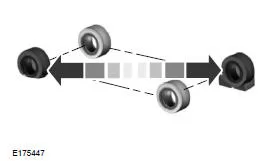
3. Block the front and rear of the wheel diagonally opposite the flat tire. For example, if the left front tire is flat, block the right rear wheel.
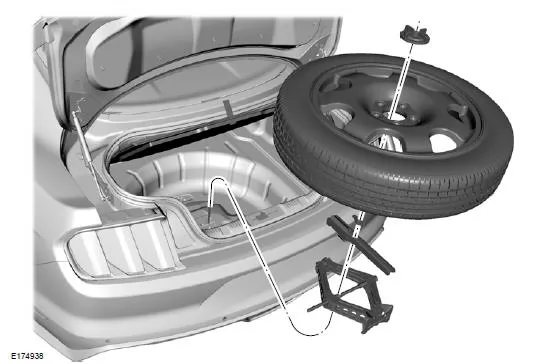
4. Remove the wheel wrench, spare wheel and jack.
5. If necessary, remove the wheel cover from the wheel if it is required to access the wheel nuts.

6. To release the wheel wrench from the jack, turn the hex nut on the jack counterclockwise.
This lowers the jack and releases the mechanical lock.
7. Loosen each wheel nut half a turn counterclockwise, but do not remove them until the wheel is off the ground.
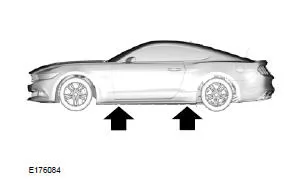
Note: Place the jack only at the specified lift points to avoid damaging the vehicle.
8. The lift points are shown here and marked by the triangle markings on the vehicle. Details are shown on the jack warning label.
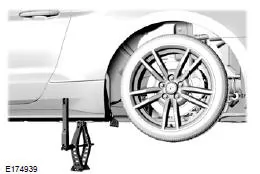
9. Position the jack at the lift point next to the tire to be changed. Turn the jack handle clockwise until the wheel is fully off the ground.
10. Remove the wheel nuts with the wheel nut wrench.
11. Replace the flat tire with the spare wheel, making sure the valve stem points outward. Thread the wheel nuts back on until the wheel sits flush against the wheel hub. Do not fully tighten the wheel nuts until the wheel has been lowered. When using the temporary spare tire, the wheel nut washers may not appear flush with the rim.
This is normal, but only when using the temporary spare tire.
12. Lower the wheel by turning the jack handle counterclockwise.
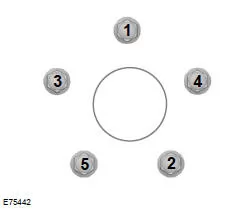
13. Remove the jack and fully tighten the wheel nuts in the specified sequence.
See Technical Data.
14. To attach the folded wheel nut wrench to the jack, hook the holder on the jack base into the wheel nut wrench as shown.
Fold the wheel nut wrench upward and adjust the jack height until the pin engages the intended opening. Hand-tighten the hex nut.
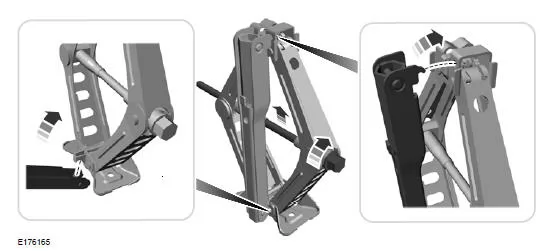
15. Stow the flat tire, wheel cover, jack, and wheel nut wrench.
Make sure the jack is secured so that it does not rattle while driving.
16. Remove the wheel chock.
The information on wheels with different specifications and on tire changes in the Ford Mustang (VI Gen, 2014–2023) helps ensure safety and handling. The Ford Mustang 2014–2023 provides clear instructions for using temporary spare tires and spare wheels with different specifications to prevent damage and risk.
Particular emphasis is placed on driving at the correct speed, avoiding snow chains on certain wheels, and quickly returning to standard wheels. The Ford Mustang VI Generation demonstrates its commitment to safety and precision in an emergency.
Frequently Asked Questions
Why must snow chains not be used on a spare wheel with different specifications?
Because this can damage the wheel and the vehicle and compromise safety.
What is the maximum speed when driving with a temporary spare tire?
A maximum of 80 km/h to ensure safety and prevent damage.
Test yourself
A quick Ford Mustang quiz: every answer comes with an explanation and a link to the manual page.