Tire care. Using summer tires. Using snow chains
Tire care on the Ford Mustang VI Gen includes not only tire rotation but also the correct use of summer and winter tires. This section explains the effects of temperature, wear and storage on tire quality. It also covers all important aspects of snow chains, from permitted tire sizes to safe fitting. Drivers who use the Mustang in wintry regions will find useful recommendations here. These instructions protect against vehicle damage and also improve handling in difficult weather conditions, helping the vehicle keep its performance in every season.
Tire care
Note: If uneven tire wear is found, contact an authorized dealer before rotating the tires. Have the wheel alignment, tire balance, or mechanical components checked and corrected as necessary.
Note: The vehicle may be equipped with a spare tire with different specifications. A spare tire with different specifications is a spare that differs from the road wheels in brand, size, or appearance. A spare tire with different specifications is intended for temporary use only and must not be used when rotating the tires.
Note: After rotating the tires, check the tire pressure and adjust it to the vehicle requirements.
Rotating the tires at the recommended intervals (as specified in the "Scheduled Maintenance" chapter) promotes more even tire wear, which improves tire performance and service life.
Rear-wheel drive vehicles (front wheels on the left in the illustration).
Non-directional tires
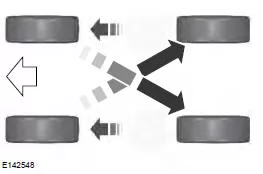
Staggered fitment with different tire sizes on the front and rear axles.
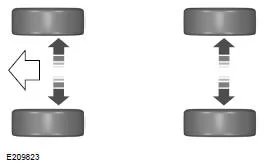
In some cases, uneven tire wear can be corrected by rotating the tires.
Using Summer Tires
Summer tires offer superior performance on wet and dry roads.
Summer tires do not have the M+S (mud and snow) symbol on the sidewall. Because summer tires do not provide the same traction as all-season or winter tires, it is recommended that summer tires not be used at temperatures below approximately 7 °C (depending on tire wear and environmental conditions), or in snow and ice. As with any tire, the performance of summer tires is affected by wear and environmental conditions. If driving under these conditions cannot be avoided, the use of M+S (mud and snow), all-season, or winter tires is recommended.
Store summer tires indoors at temperatures above -7°C. The rubber compound used in these tires loses its flexibility at temperatures below -7°C and may develop cracks in the tread area.
If the tires have been exposed to temperatures below -7°C, warm them in a heated room for at least 24 hours to at least 5 °C before mounting them on a vehicle, driving a vehicle with them, or checking the tire pressure. Do not store the tires near heaters or heating systems used to heat the storage area. Do not expose the tires to direct heat or hot air. Always inspect the tires after storage and before use.
Using Winter Tires
Winter tires use the same tire pressures as those listed in the tire pressure table. See Technical Specifications.
Using Snow Chains
WARNINGS
Driving at a speed that is too high for the conditions can cause loss of vehicle control. Driving at extremely high speeds for an extended period can damage vehicle components.
Winter tires must have the same size, load index, and speed rating specifications as the tires originally fitted by Ford. Using tires or wheels other than those recommended by Ford can affect vehicle safety and performance and increase the risk of losing control of the vehicle, which may result in a rollover and serious or fatal injury. In addition, using tires or wheels other than those recommended may cause failure of the steering, suspension, axles, transfer case housing, or electronic transfer case.
The tires fitted to the vehicle may have an all-weather tread pattern that provides traction in rain and snow. However, in some climates, winter tires and snow chains may be required. Chains should only be used on the tires in an emergency or when their use is required by law.
Note: The insulators and suspension bump stops prevent damage to the vehicle. Do not remove these components from the vehicle when using winter tires and snow chains.
Follow these guidelines when using winter tires and snow chains:
- Do not fully load the vehicle whenever possible.
- Snow chains can damage aluminum wheels.
- Only use extra-low-profile snow chains with a maximum dimension of 10 mm (measured on the tire sidewall) on 255/40R19 tires on the rear axle.
- Do not use snow chains on 275/40R19 tires.
- Not all SAE Class S snow chains meet these requirements. Snow chains that meet this size restriction have a tensioning device.
- Only buy snow chains from manufacturers that clearly state the body-to-tire clearance restrictions. Snow chains must be installed in pairs on the front or rear tires.
- With snow chains installed, do not exceed a speed of 50 km/h, as recommended by the chain manufacturer.
- Install the snow chains securely and make sure they do not contact wiring, brake lines, or fuel lines.
- Drive carefully. If the snow chains make noise by rubbing or striking the vehicle, stop and tighten the snow chains. If this does not correct the problem, remove the snow chains to avoid damage to the vehicle.
- Remove the snow chains when they are no longer needed.
For questions about snow chains, contact an authorized dealer.
The tire care information for the Ford Mustang (VI Gen, 2014–2023) helps you optimize tire life and performance. It gives clear recommendations on rotating the wheels and on using summer and winter tires correctly to improve safety and handling stability.
The information on storing summer tires and using snow chains is especially important for avoiding damage to the tires and the vehicle. It reflects the sixth-generation Ford Mustang's attention to detail and its high standards for operational safety.
This concept shows how the Ford Mustang (VI Gen, 2014–2023) combines sporty driving dynamics with everyday practicality and responsibility.
Test yourself
A quick Ford Mustang quiz: every answer comes with an explanation and a link to the manual page.