Front Seats
The Vehicle Safety Systems Section contains important information on safety and correct adjustment of the seats, seatbacks and head restraints.
Adjust the seat position before driving.
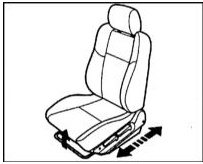
To adjust the seat position longitudinally, lift the release lever located at the front under the seat cushion. While holding the lever in the raised position, slide the seat assembly forward or rearward to a comfortable position, then release the lever. To check that the seat is securely locked, try to move it forward and rearward.
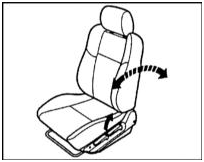
To adjust the seatback recline angle, lift the release lever located on the side of the seat cushion base on the door side. While holding the lever up, move the seatback to a comfortable position, then release the lever. The seatback locks automatically in the new position.
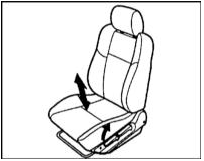
Some vehicle versions provide for seat cushion height adjustment. Adjustment is made using the release lever located on the left side of the seat cushion base. Pull the lever up, move the seat cushion to a comfortable position, then lower the lever. The cushion locks automatically in the new position.
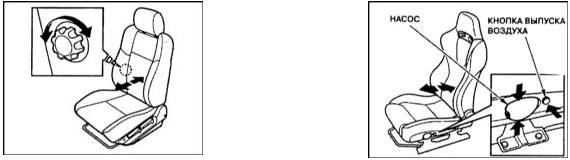
On some models, the driver's seatback design also allows adjustment of the lumbar support position. Adjustment is made using a rotary knob located on the inner side of the seatback side surface. On R-class models, driver's seatback lumbar support is adjusted by pumping. Pumping is performed by compressing the spring of a special air pump. To release the air, press the release button.
Models with Power Driver's Seat Adjustment
Some models are equipped with a power driver's seat adjustment. The power seat control panel with two switches is located on the left side of the seat cushion base. The combined long slide switch is used to adjust the seat position in the fore-aft and vertical directions. The smaller switch is used to adjust the seatback recline angle.
Seat adjustment can be performed with the ignition key in any position, but must be completed before driving.
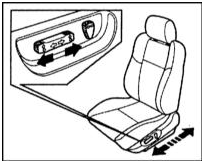
To adjust the seat position in the fore-aft direction, slide the long slide switch on the power seat control panel in the corresponding direction.
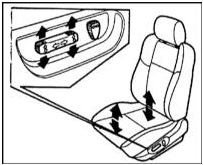
To adjust the height of the front and rear edges of the seat cushion, press the front or rear end of the slide switch in the corresponding direction.
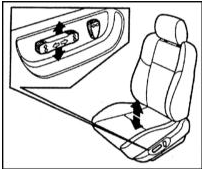
To adjust the height of the seat cushion assembly, move the entire slide switch up or down.

The seatback recline angle is adjusted using the smaller switch located behind the first long switch.
Head Restraints
Head restraints help prevent neck and head injuries in a rear-end collision. For head restraints to effectively perform their protective function, they must be properly adjusted.
Adjust the head restraint height so that the top of the head restraint cushion is level with the top of the ear. If tall occupants cannot achieve this, the head restraint must be set to its highest position.

On some vehicle versions, head restraints can be adjusted for height and tilt angle. Head restraint adjustment requires both hands, so do not attempt to adjust the head restraint while the vehicle is moving. To raise the head restraint, simply pull it up; to lower it, press it down. The tilt angle is changed by tilting the head restraint to the desired position.
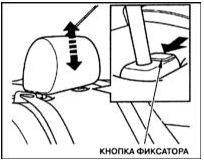
Some vehicle versions have a button-type head restraint lock. With this design, to raise the head restraint, simply pull it up; lowering it can only be done after pressing the lock button.
To remove the head restraint for cleaning or replacement, proceed as follows: raise the head restraint fully, then press the lock button and remove the head restraint from the seatback.
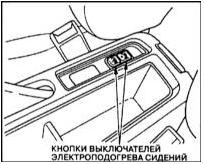
Seat Heaters
Some models provide front seat heating. Both front seats are equipped with electric heaters that operate only when the ignition is on (ignition key in the "ON" [II] position). To turn on the heater, press the corresponding push-button switch; the indicator lamp built into the button should illuminate. To turn off the heater, press the button again.
Do not turn on the seat heaters with the engine off, and avoid using them for extended periods with the engine idling to prevent battery discharge.
Test yourself
A quick Honda Accord quiz: every answer comes with an explanation and a link to the manual page.