Heating, Ventilation and Air Conditioning Systems
When the heating and ventilation system is used properly, comfortable conditions in the passenger compartment are ensured and fogging of the windows is prevented.
If the vehicle was not equipped with an air conditioning system at the time of purchase, it can be installed at any convenient time. To have this system installed on your vehicle, contact a Honda service station.
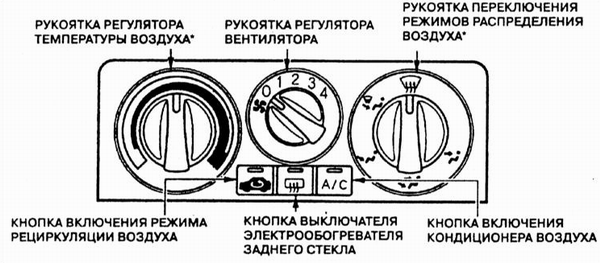
Heating, Ventilation and Air Conditioning Control Panel
Blower Speed Selector Knob
Turning the knob clockwise increases the blower speed and, consequently, the airflow into the passenger compartment. Turning the knob to the fully right position turns the blower off.
Temperature Control Knob
Turning the knob clockwise increases the temperature of the air entering the passenger compartment.
Air Conditioner Switch
The "A/C" button is used to turn the air conditioner on and off. When the air conditioner is on, the indicator lamp built into the button lights up.
Rear Window Defroster Switch
The switch button is also equipped with a built-in indicator lamp, which lights up when the defroster is on.
Recirculation Mode Switch
This button is used to turn on the recirculation mode of the passenger compartment air. The button is equipped with a built-in indicator lamp. When the mode is on, the passenger compartment is isolated from the outside atmosphere and the flow of fresh air into it stops. The blower circulates air in a closed loop. When the button is pressed again (the indicator lamp should go out), the supply of fresh air into the passenger compartment resumes.
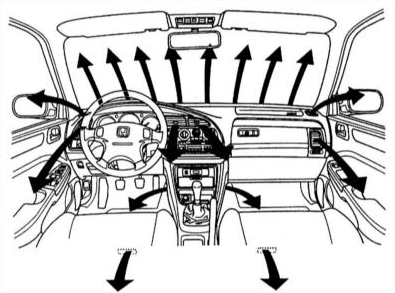
Airflow Distribution Selector Knob
The knob is used to select the air distribution mode in the passenger compartment.
Air is supplied through the side instrument panel vents in all modes. The general airflow distribution diagram is shown in the illustration.
 Outside air enters the passenger compartment through the center and side instrument panel vents.
 Outside air enters the passenger compartment simultaneously through the center and side vents in the control panel, as well as through the lower vent openings that supply air to the driver and passenger footwells.
 Outside air is supplied only to the driver and passenger footwells.
 Outside air enters the passenger compartment simultaneously through the windshield defroster nozzles, built into the control panel at the top near the lower edge of the glass, and through the lower vent openings of the footwells.
 Outside air is supplied to defrost the windshield through the nozzles built into the control panel at the top near the lower edge of the glass.
Vent Louver Control
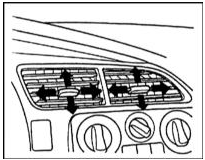
The center duct nozzles of the instrument panel are equipped with special louvered deflectors that allow adjusting the direction of the airflow both horizontally and vertically. The deflectors are controlled by levers built into the nozzle grille.

The grilles of the side instrument panel ducts have a similar design. In addition, it is possible to completely shut off the airflow through them.
Test yourself
A quick Honda Accord quiz: every answer comes with an explanation and a link to the manual page.