Range Selector Position Indicators, Range Selector Lever Positions
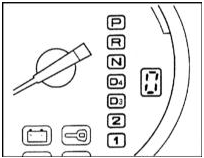
Range Selector Position Indicators
Additional indicator lamps are built into the tachometer assembly, allowing the driver to easily monitor the AT range selector position. To the right of the range indicators is the gear indicator, which operates when the transmission is in manual control mode.
The "D4" indicator automatically illuminates for several seconds when the ignition is switched on (key turned to the "ON" [II] position). Flashing of the "D4" indicator while the vehicle is moving (regardless of range selector position) indicates a possible AT malfunction. In this case, avoid sudden acceleration. Contact a Honda service station immediately for inspection and repair of the automatic transmission.

Gear Selector Lever Positions
The transmission gear selector lever can be placed in one of eight detent positions. When starting the engine, the lever must be in the "P" or "N" position only. If the vehicle is stopped with one of the automatic transmission ranges "D4", "D3", "2", "1", "R" or "N" engaged, fully release the accelerator pedal and depress the brake pedal to ensure the vehicle is held securely.
To switch to manual shift mode, move the selector lever from the "D4" position toward yourself. Manual shifting is available in this position.
When shifting automatic transmission ranges, move the lever along the guide slot. The gear selector lever is locked in the "P" position when the ignition key is turned to the "LOCK" (0) or "ACC" (I) position. In this case, the lever cannot be moved out of the "P" position even when the brake pedal is depressed.
"P" position. In this position, the selector lever mechanically locks the transmission output shaft. Always move the selector lever to the "P" position when turning off or starting the engine. To move the selector lever out of the "P" position, depress the brake pedal after releasing the accelerator pedal. Tilt the selector lever to the right and move it out of the "P" position.
If the lever still cannot be moved out of the "P" position after performing all the actions described above, release it by following the instructions below.
To prevent damage to the AT, move the lever to the "P" position only after the vehicle has come to a complete stop. Note: The ignition key can be removed only after the selector lever is moved to the "P" position.
"R" position. For the control procedure for moving the selector lever from the "P" position to the "R" (Reverse) position, refer to the instructions above. Move the lever from the "N" (Neutral) position to the "R" position only after the vehicle has come to a complete stop.
The automatic transmission is equipped with a special safety device that prevents the lever from being accidentally moved to the "R" position when the vehicle speed exceeds 10-12 km/h.
If reverse does not engage after the vehicle has come to a complete stop, depress the brake pedal and slowly move the gear selector lever first to the "N" position, then to the "R" position.
If the safety device is faulty, or if the battery is disconnected or discharged, reverse cannot be engaged. In this case, the reverse lock release must be performed.
"N" position. Use the "N" (Neutral) position when starting a stalled engine while the vehicle is rolling and during short stops with the engine running. If for any reason you need to leave the vehicle, first move the gear selector lever to the "P" (Park) position. When moving the lever out of the "N" position, depress the foot brake pedal.
"D4" position. The gear selector lever must remain in this position at all times when driving under normal road conditions. In the "D4" (Drive) range, forward gears are shifted automatically depending on vehicle speed and accelerator pedal position. While driving, you may notice that automatic upshifts occur later, that is, at higher vehicle speeds, if the engine has not yet warmed up to normal operating temperature. This ensures faster engine warm-up.
Manual shift mode. When the gear selector lever is in the "D4" position, manual shift mode can be engaged. In this mode, gears are shifted using the same lever as on models equipped with a manual transmission, but without using the clutch pedal. To engage manual shift mode, move the lever from the "D4" position to the left (toward the driver's seat). The transmission returns to automatic control when the lever is moved back to the right (toward the passenger's seat).
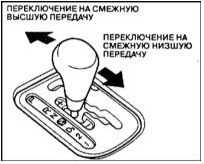
In manual shift mode, the transmission is controlled by sequential pushes of the selector lever forward or backward. Pushing the lever forward upshifts the transmission to the next higher gear. Conversely, pushing the lever backward downshifts the transmission to the adjacent lower gear. The engaged gear number is displayed on the instrument panel. The engaged gear indicator is located on the tachometer dial to the right of the "D4" indicator.
When the range selector lever is moved to the position corresponding to manual transmission control, the indicator of the currently engaged gear illuminates on the instrument panel. For example, if fourth gear is engaged, the number "4" will be displayed to the right of the "D4" indicator. During subsequent gear changes in manual mode, the indicator reading will change accordingly. If manual transmission control is engaged while the vehicle is stationary, first gear will engage automatically and the number "1" will be displayed in the indicator window.
Vehicle start-off and acceleration will take place in first gear; then second and higher gears must be engaged manually. In manual transmission control mode, monitor the tachometer to make sure the maximum permissible engine speed is not exceeded. During acceleration, upshift to the next higher gear in a timely manner, without allowing the tachometer needle to enter the red zone of the scale.
If the driver does not operate the range selector lever, the transmission will remain in the same gear (1st, 2nd, 3rd or 4th) without shifting. Gear shifts also do not occur when the accelerator pedal is fully depressed.
In manual transmission control mode, the transmission can automatically downshift from fourth to third gear in the following cases:
a) Vehicle speed drops below 27 km/h.
b) The vehicle is driving uphill at a speed of 27 to 60 km/h.
c) The foot brake pedal is depressed while the vehicle is moving downhill.
The automatic downshift to third gear provides increased traction when driving uphill and improves engine braking efficiency when driving down a steep grade.
In addition, in manual transmission control mode, the transmission automatically downshifts to first gear when the vehicle decelerates and stops. This downshift occurs when the vehicle speed drops to 10 km/h.
If an attempt is made to manually engage a lower gear while driving, in which the engine speed would exceed the maximum permissible value, this shift is automatically blocked.
If the vehicle is traveling in fourth gear and the driver's command to engage third gear is blocked, the number "3" on the instrument cluster will flash several times, then the "4" indicator will illuminate again. Similarly, if the vehicle is traveling in third gear and the driver's command to engage second gear is blocked, the "2" indicator on the instrument panel will flash several times, and then the "3" indicator will illuminate again.
If, during flashing of the blocked gear indicator, the vehicle speed decreases to the point where, after the gear shift, the engine crankshaft speed cannot exceed the maximum permissible value, the block is released and the adjacent lower gear engages in the transmission.
At low ambient temperatures, when the transmission temperature does not exceed -10°C, manual gear shifting may not operate.
The Specifications list the recommended gear shift speeds for the transmission.
"D3" position. When the range selector lever is set to the "D3" position, the automatic transmission operates similarly to the "D4" (Drive) range. The difference is that upshifting to fourth gear is excluded. The "D3" range is recommended when towing a trailer in hilly terrain or for engine braking on steep downhill grades. Engaging the "D3" range is also useful for eliminating unnecessary cyclic shifting of the automatic transmission between third and fourth gears. Such cyclic shifting may occur, for example, when driving in heavy traffic with frequent decelerations and stops.
For rapid acceleration when the transmission is operating in the "D4" or "D3" range, press the accelerator pedal fully to the floor.
The transmission will then automatically downshift to the adjacent lower gear. If the vehicle speed is low, the transmission may downshift by two gears at once.
"2" position. When the "2" range is selected, the automatic transmission will operate constantly in second gear. When the vehicle stops, the transmission does not downshift to first gear. Constant use of second gear provides good vehicle traction on uphill grades and the ability to apply intensive engine braking on steep downhill grades. The "2" range is recommended for starting off on slippery road surfaces and when driving in deep snow. This helps prevent excessive wheel spin.
When the "2" range is selected while the vehicle is moving, the engagement of second gear is automatically delayed and occurs only after the vehicle speed decreases to a safe level at which the crankshaft speed will not exceed the maximum permissible value.
"1" position. When the "1" range is selected, the automatic transmission will operate constantly in first gear. If the "1" range is selected at a speed above 50 km/h, the transmission will first shift to second gear. Engaging an intermediate gear prevents sudden and unexpected engine braking.
Maximum permissible vehicle speeds
The Specifications list the maximum permissible vehicle speeds when engaging the various automatic transmission ranges. If the values specified in the Specifications are exceeded, the tachometer needle enters the red zone of the scale, indicating that the permissible engine speed has been exceeded. The engine control module then begins limiting crankshaft speed by reducing fuel supply, which can be felt as a change in engine operation. Engine operation returns to normal as soon as the tachometer needle leaves the red zone of the scale.
To avoid engine damage, before shifting gears, make sure the tachometer needle does not exceed the maximum permissible vehicle speed for that gear and is not in the red zone of the scale.
Test yourself
A quick Honda Accord quiz: every answer comes with an explanation and a link to the manual page.