Anti-Corrosion Treatment
GENERAL INFORMATION

Locations for Sealant Application
1. FRONT PILLAR
2. VENTILATION DUCT WALL
3. SEALED AREAS
4. QUARTER PANEL (WHEEL HOUSE)

Example of sealing and corrosion protection of body panel joints
1. SEAL AROUND THE ENTIRE PERIMETER OF THE DOOR PANEL FLANGE JOINT.
2. CORROSION PROTECTION COMPOUND APPLIED TO THE INNER SIDES OF THE PANELS.

Example of applying sound deadening mastic
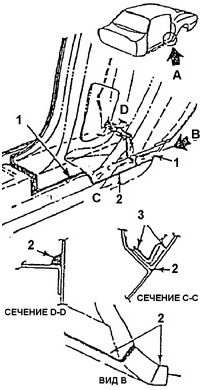
Example of applying sealer and corrosion protection compound
1. MEDIUM-CONSISTENCY SEALER APPLICATION AREA.
2. SEALER.
3. CORROSION PROTECTION COMPOUND
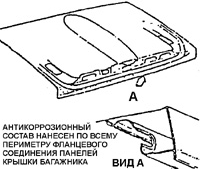
Corrosion protection of the inner side of the luggage compartment lid

Example of sealing the rear body joints
1. SIDE PANEL.
2. EDGE.
3. REAR PANEL.
4. FLOOR PANEL.
5. SEAM JOINT

Example of applying sealer and sound deadening mastic to the wheel house parts A. SOUND DEADENING MASTIC APPLICATION AREAS ON THE WHEEL HOUSE PARTS AND FLOOR PANEL EXTENSION.
B. SEALER (ALL SEAM JOINTS).
1. WHEEL HOUSE PART.
2. OUTER BODY SIDE PANEL
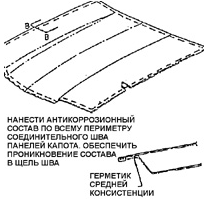
Applying sealer to the hood panel seam joint
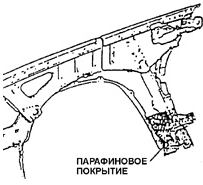
Example of applying corrosion protection coating to the fender
Warning.
When performing work involving the application of sound deadening mastics or
corrosion protection compounds, make sure these materials do not get into door locks, door glass guide channels, window regulator mechanisms, seat belt retractors, or any moving and rotating suspension components.
parts located underneath the vehicle body. After treating the body, make sure that all body drain holes are open. Incorrect application
of materials may reduce the service life of moving parts or
increase the likelihood of corrosion damage to the body. In addition, personal injury to the technician may occur.
To protect the body from corrosion, special anti-corrosion materials are applied to the inner and outer surfaces of metal panels. Some steel parts are protected on one or both sides.
with metallic galvanic plating or are galvanized. Steel sheet with a
protective coating is used for the fenders, doors, side panels, cowl panel in front of the windshield, luggage compartment lid and covers, floor panels,
wheel house splash guards and other body parts exposed to aggressive
media and subject to mechanical damage. In areas of the body where
moisture may accumulate, special pre-treatment technologies are used.
Special anti-corrosion pre-treatment is applied to bare metal surfaces.
A protective layer of paraffin-based
wax is applied to the inner surfaces of body parts.
mastic. Exposed body seam joints are sealed with sealer, and a layer of water-repellent and sound-absorbing mastic is applied to the wheel house splash guards, underbody and inner surfaces of the doors. Any repair work involving
damage to or removal of the anti-corrosion coating may lead to intensive subsequent corrosion of unprotected body areas. Therefore, after completing repair or replacement of body parts, it is very important to properly apply an
anti-corrosion protective layer using materials recommended for service station use.
During body manufacturing, all metal surfaces
undergo preliminary anti-corrosion treatment and are coated with
primer protective layers. After repair or replacement of body parts,
all unprotected metal body surfaces must be treated again. This treatment must be performed before applying sealing compounds, soundproofing mastic or the main layer of anti-corrosion coating.
During body manufacturing, the seam joints of parts are sealed
with sealer, which not only prevents water and dust from entering the body but also provides
corrosion protection. Sealer is applied to the mating surfaces of outer and inner door panels, luggage compartment lid, hood, wheel house parts, body side panels, floor panels, roof and other body parts. The condition
of sealed body panel joints can be easily assessed visually.
If damage to the seam joint seals is found, restore the sealing immediately. Mating surfaces of new panels with body parts must be treated with sealer before installation on the vehicle. New doors and luggage compartment lid installed in place of old ones must also be treated with sealer around the entire perimeter of the seam joint edge.
Welded seams, flange joints or lap joints of body parts
are sealed with medium-consistency plastic sealer. The sealer must
retain its elastic properties after application to the body and be paintable. For sealing open seams with large gaps, use semi-solid consistency sealer.
When applying the compound, follow the manufacturer's instructions on the package. After body repair, it may
be necessary to repaint some parts, such as the hood, fenders, doors, side panels, luggage compartment lid, roof, cowl panels, underbody panels or inner panels. In this case, use standard procedures, including surface preparation for painting/primer application and the
base coat of paint. Sound deadening mastics applied by spray to various metal panels provide, in addition to reducing
cabin noise, also corrosion protection and sealing of
body part joints. If the sound deadening coating is damaged as a result of an accident or repair work, it must be restored using materials recommended for service station use. When
installing a new body part (replacing the old one), apply a layer of sound deadening mastic to it. The application locations and layer thickness must match the part as supplied from the factory.
For corrosion protection of body parts, it is recommended to use the compound
3M Rust Fighter-1 or an equivalent substitute for corrosion protection.
For large parts (doors, side panels, floor pans, trunk lid,
hood, fenders, etc.), apply a layer of primer. Application
of the anti-corrosion coating is performed in the following sequence.
PROCEDURE.
1. Clean the metal surface of the body panel..
2. Apply the preparatory coat..
3. Apply a layer of sealer to all pre-sealed joints..
4. Apply a layer of paint to the required areas of the body on exposed flange
joints, outer seams and underbody parts..
5. Apply a layer of sound-deadening mastic (similar to factory treatment)..
6. Apply a layer of anti-corrosion compound..
7. Apply a layer of protective compound to the underbody.
Test yourself
A quick Daewoo Nexia quiz: every answer comes with an explanation and a link to the manual page.