Refrigerant
On-vehicle Inspection
ON-VEHICLE INSPECTION
PROCEDURE
1. INSPECT REFRIGERANT PRESSURE WITH MANIFOLD GAUGE SET
HINT:
The following examples show the readings of a manifold gauge set and the corresponding air conditioning system problems.
(a) Read the manifold gauge pressure when the following conditions are met:
- The doors are fully open.
- The engine is idling (for Gasoline Model) or power switch is on (READY) (for HV Model).
- The A/C switch is on.
- The temperature is set to max cold.
- The blower speed is set to high.
- The temperature at the air inlet with recirculate selected is 30 to 35 °C.
(1) Normal functioning air conditioning system Gauge Reading
|
|
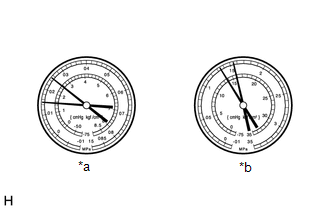
(2) Abnormally functioning air conditioning system
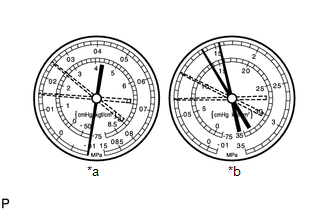
*a |
LO |
*b |
HI |
- During operation, pressure on low pressure side cycles between normal and vacuum
Symptom
Air conditioning system periodically cools and then fails to cool
Probable Cause
Moisture in air conditioning system freezes at expansion valve orifice, causing refrigerant to temporarily stop circulating
After system stops and warms up again, ice melts and normal operation is temporarily restored
Diagnosis
Cooler dryer (integrated into condenser tank) saturated with moisture
Moisture in air conditioning system is freezing at expansion valve orifice and blocking circulation of refrigerant
Corrective Actions
Replace cooler dryer
Remove moisture by repeatedly evacuating air from air conditioning system
Recharge air conditioning system with proper amount of new or purified refrigerant
HINT:
For the example above, moisture is present in the air conditioning system.
- Pressure is low on both low and high pressure side
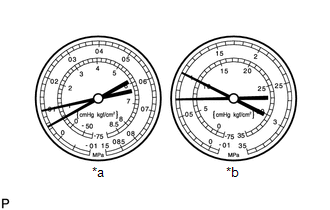
*a
LO
*b
HI
Symptom
Air conditioning system does not cool effectively
Insufficient cooling performance
Probable Cause
Refrigerant leaks from air conditioning system
Diagnosis
Insufficient refrigerant
Refrigerant leaking
Corrective Actions
Check for refrigerant leaks and repair if necessary
Recharge air conditioning system with proper amount of new or purified refrigerant
If gauges indicate pressure of close to 0, then it is necessary to evacuate air conditioning system after repairing leaks
HINT:
For the example above, there is insufficient refrigerant.
- Pressure is low on both low and high pressure side
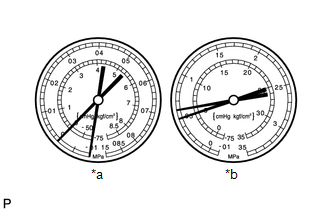
*a
LO
*b
HI
Symptom
Air conditioning system does not cool effectively
Frost exists on pipe from condenser to evaporator unit
Probable Cause
Refrigerant flow is obstructed by dirt inside pipes of condenser core
Diagnosis
Condenser is clogged
Corrective Actions
Replace condenser
HINT:
For the example above, there is poor circulation of refrigerant.
- Vacuum is indicated on low pressure side and very low pressure is indicated on high pressure side
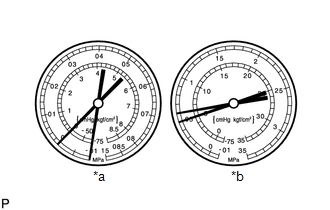
*a
LO
*b
HI
Symptom
Air conditioning system does not cool effectively (System may cool occasionally)
Frost or condensation is seen on piping on both sides of receiver/dryer or expansion valve
Probable Cause
Refrigerant flow is obstructed by moisture or dirt in air conditioning system
Expansion valve is stuck closed
Diagnosis
Refrigerant does not circulate
Corrective Actions
Replace expansion valve
Replace condenser
Evacuate air conditioning system and recharge with proper amount of new or purified refrigerant
HINT:
For the example above, the refrigerant does not circulate.
- Pressure is too high on both low and high pressure side
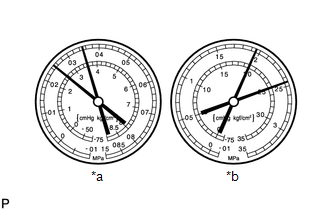
*a
LO
*b
HI
Symptom
Air conditioning system does not cool effectively
Probable Cause
Unable to provide sufficient performance due to excessive amount of refrigerant
Cooling effectiveness of condenser is insufficient
Diagnosis
Excessive amount of refrigerant in air conditioning system because excessive refrigerant was added during recharging
Cooling effectiveness of condenser is insufficient because condenser fins are clogged or cooling fan is faulty
Corrective Actions
Clean condenser
Check operation of condenser cooling fan
If condenser is clean and fan operation is normal, check amount of refrigerant and recharge air conditioning system with proper amount of new or purified refrigerant
HINT:
For the example above, the air conditioning system is overcharged or cooling effectiveness of condenser is insufficient.
- Pressure is too high on both low and high pressure side
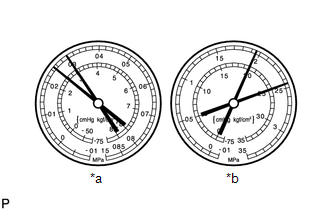
*a
LO
*b
HI
Symptom
Air conditioning system does not cool
The low pressure piping is too hot to touch
Probable Cause
Air in air conditioning system
Diagnosis
Air present in air conditioning system
Insufficient vacuum purging when evacuating air conditioning system
Corrective Actions
Replace cooler dryer
Check compressor oil to see if it is dirty or insufficient
Evacuate air conditioning system and recharge it with new or purified refrigerant
NOTICE:
These gauge indications occur when the air conditioning system has been left open and then recharged without evacuating the system.
HINT:
For the example above, air is present in the air conditioning system.
- Pressure is too high on both low and high pressure side
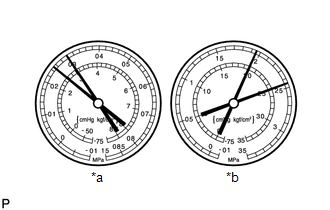
*a
LO
*b
HI
Symptom
Air conditioning system does not cool effectively
Frost or large amount of condensation on piping on low pressure side
Probable Cause
Expansion valve may be stuck open or metering refrigerant incorrectly
Diagnosis
Excessive refrigerant in low pressure piping
Expansion valve open too wide
Corrective Actions
Replace expansion valve
HINT:
For the example above, there is an expansion valve malfunction.
- Pressure is too high on both low and high pressure side or pressure is too low on high pressure side
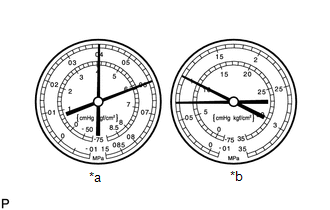
*a
LO
*b
HI
Symptom
Air conditioning system does not cool effectively
Probable Cause
Internal leak in compressor
Diagnosis
Low compression
Leak from damaged valve or other compressor component
Corrective Actions
Replace compressor
HINT:
For the example above, there is insufficient compressor compression.
(3) Gauge readings (Reference)
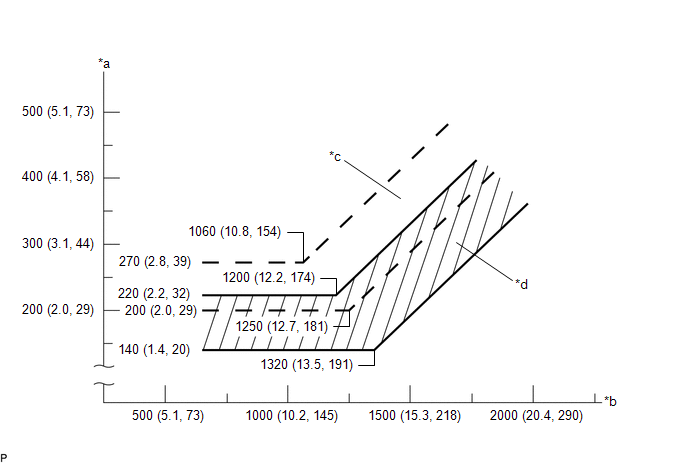
*a |
Pressure on Low Pressure Side kPa (kgf/cm2, psi) |
*b |
Pressure on High Pressure Side kPa (kgf/cm2, psi) |
*c |
Blower High Zone |
*d |
Blower Low Zone |
Precaution
PRECAUTION
PRECAUTIONS FOR REFRIGERANT HFO-1234yf (R1234yf)
(a) Compatibility
(1) The parts used in the refrigerant cycle, the compressor oil, etc. of an HFO-1234yf (R1234yf) system are not compatible with a conventional HFC-134a (R134a) system.
(b) HFO-1234yf (R1234yf) Refrigerant
(1) Always use HFO-1234yf (R1234yf) as the refrigerant.
NOTICE:
- Do not charge the system with refrigerant near open flame, as HFO-1234yf (R1234yf) is combustible.
- When charging the system with refrigerant, make sure that the area is well ventilated (especially be careful in areas where the gas can easily accumulate, such as under lifts and in garage pits, as the gas is heavier than air).
- Follow any local regulations regarding combustible gases.
- Be sure to use a refrigerant recovery unit that is compatible with HFO-1234yf (R1234yf) systems.
HINT:
The shape of the service port for refrigerant charging has an exclusive design conforming to international standards for HFO-1234yf (R1234yf) to prevent improper refrigerant charging.
(c) Compressor Oil (for Gasoline Model)
(1) Always use ND-OIL 12 as the compressor oil.
NOTICE:
The oil used for HFC-134a (R134a) systems (ND-OIL 8) does not work well in HFO-1234yf (R1234yf) systems. If the oil used for HFC-134a (R134a) systems (ND-OIL 8) is used in an HFO-1234yf (R1234yf) system, it will result in degradation of the refrigerant and deterioration of resin parts.
(2) When parts of the air conditioning system are removed, quickly block off any areas that are exposed to the outside air with plugs, vinyl tape, etc., as the oil used for HFO-1234yf (R1234yf) systems absorbs moisture easily.
(3) Do not allow the compressor oil to spray, as the oil used for HFO-1234yf (R1234yf) systems has harmful effects on acrylic resins.
(d) Compressor Oil (for HV Model)
(1) Always use ND-OIL 11 as the compressor oil.
NOTICE:
The oil used for HFC-134a (R134a) systems (ND-OIL 8) does not work well in HFO-1234yf (R1234yf) systems. If the oil used for HFC-134a (R134a) systems (ND-OIL 8) is used in an HFO-1234yf (R1234yf) system, it will result in degradation of the refrigerant and deterioration of resin parts.
(2) When parts of the air conditioning system are removed, quickly block off any areas that are exposed to the outside air with plugs, vinyl tape, etc., as the oil used for HFO-1234yf (R1234yf) systems absorbs moisture easily.
(3) Do not allow the compressor oil to spray, as the oil used for HFO-1234yf (R1234yf) systems has harmful effects on acrylic resins.
(e) Evacuation
(1) When evacuating the system, be sure to use a refrigerant recovery unit, refrigerant recycler and refrigerant charger that are compatible with HFO-1234yf (R1234yf) systems.
(f) Refrigerant Gas Leak Inspection
(1) Use a gas leak detector to check for refrigerant gas leaks.
HINT:
Be sure to use a gas leak detector that is compatible with HFO-1234yf (R1234yf) systems.
(2) Turn the engine switch (for Gasoline Model) or power switch (for HV Model) off when checking for refrigerant leaks.
HINT:
- If the engine is running when checking for leaks, the leaking gas will be diluted by the air from the fan and blower, making detection more difficult.
- If the air conditioning system is operating when checking for leaks, the refrigerant pressure in the system will decrease, making it harder for gas to leak.
- If the air conditioning system is operating when checking for leaks, the electronic gas leak detector may react to a sudden change in humidity due to the humid air coming from the drain cooler hose and a faulty judgment may be made.
PRECAUTIONS RELATED TO REMOVAL AND INSTALLATION OF PARTS
(a) If refrigerant gets in your eyes
(1) Do not rub your eyes with your hands or a cloth.
(2) Consult an eye doctor.
(b) Handling of Refrigerant (Container)
(1) Do not heat the container. If the container is directly heated or put into boiling water, the pressure inside the container will become abnormally high and the container may burst.
(2) Do not drop or strike the container.
(3) Do not bring the container anywhere near your face. Always wear eye protection.
(c) Pipe Installation (for Gasoline Model)
(1) Always use new O-rings.
HINT:
When removing an O-ring, use an object with a soft tip so as not to damage the piping.
(2) Apply a sufficient amount of compressor oil (ND-OIL 12) to the O-ring.
(3) Route the hoses in the way they are naturally shaped. Do not twist or forcibly bend the hoses.
(4) Do not use cloth gloves, etc. as fibers attached to O-rings can lead to refrigerant gas leaks.
(d) Pipe Installation (for HV Model)
(1) Always use new O-rings.
HINT:
When removing an O-ring, use an object with a soft tip so as not to damage the piping.
(2) Apply a sufficient amount of compressor oil (ND-OIL 11) to the O-ring.
(3) Route the hoses in the way they are naturally shaped. Do not twist or forcibly bend the hoses.
(4) Do not use cloth gloves, etc. as fibers attached to O-rings can lead to refrigerant gas leaks.
Replacement
REPLACEMENT
PROCEDURE
1. RECOVER REFRIGERANT FROM REFRIGERATION SYSTEM
(a) for Gasoline Model:
(1) Start the engine.
(b) for HV Model:
(1) Turn the power switch on (READY).
(c) Operate the compressor under the following conditions:
Item | Condition |
|---|---|
Operating Time |
3 minutes or more |
Temperature setting |
Max cold |
Blower speed |
High |
Engine (for Gasoline Model) |
Idling |
Power switch (for HV Model) |
On (READY) |
A/C switch |
On |
This causes most of the compressor oil from the various components of the A/C system to collect in the compressor.
HINT:
It is not necessary to operate the compressor if the A/C does not operate because of compressor lock, etc.
(d) for Gasoline Model:
(1) Stop the engine.
(e) for HV Model:
(1) Turn the power switch off.
(f) Recover the refrigerant from the A/C system using a refrigerant recovery unit.
HINT:
Use the refrigerant recovery unit in accordance with the manufacturer's instruction manual.
2. CHARGE AIR CONDITIONING SYSTEM WITH REFRIGERANT
HINT:
Charge the system with refrigerant in accordance with the manufacturer's instruction manual.
(a) Perform vacuum purging using a vacuum pump or appropriate equipment.
NOTICE:
Be sure to use a refrigerant recovery unit that is compatible with HFO-1234yf (R1234yf) systems.
(b) Charge the air conditioning system with refrigerant.
Refrigerant Type:
HFO-1234yf (R1234yf)
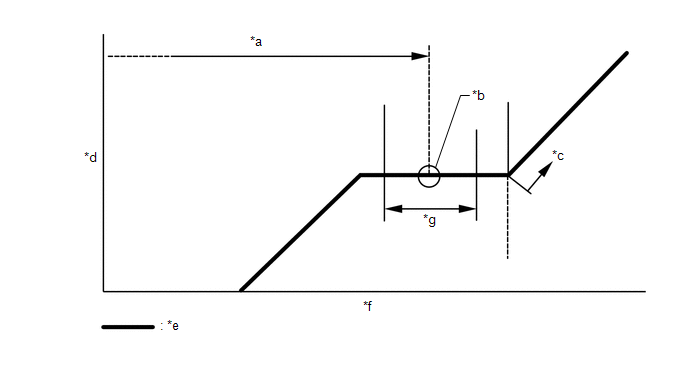
*a |
Standard Charge Amount |
*b |
Mean Value in Proper Range |
*c |
Overcharged |
*d |
High Pressure |
*e |
Sub-cool System |
*f |
Refrigerant Amount |
*g |
+/-30 g (+/-1.05 oz) |
- |
- |
Standard Charge Amount:
for Gasoline Model |
580 to 640 g (20.5 to 22.5 oz) |
for HV Model |
520 to 580 g (18.4 to 20.4 oz) |
NOTICE:
- Do not turn the A/C switch on before charging the air conditioning system with refrigerant. Doing so may cause the compressor to operate without refrigerant, resulting in overheating of the compressor.
- The refrigerant amount should be checked by quantity (weight).
- The graph above is shown for reference only.
HINT:
Ensure that sufficient refrigerant is available to recharge the system when using a refrigerant recovery unit. Refrigerant recovery units are not always able to recover 100% of the refrigerant from an air conditioning system.
3. WARM UP ENGINE (for Gasoline Model)
(a) Keep the A/C switch on for at least 2 minutes to warm up the compressor.
NOTICE:
To prevent damage to the compressor, be sure to warm up the compressor when turning the air conditioning on after removing and installing any air conditioning system lines (including the compressor).
4. WARM UP COMPRESSOR (for HV Model)
(a) Keep the A/C switch on for at least 2 minutes to warm up the compressor.
NOTICE:
To prevent damage to the compressor, be sure to warm up the compressor when turning the air conditioning on after removing and installing any air conditioning system lines (including the compressor).
5. INSPECT FOR REFRIGERANT LEAK
(a) After recharging the air conditioning system with refrigerant, inspect for refrigerant leaks using a halogen leak detector.
HINT:
Be sure to use a halogen leak detector that is compatible with HFO-1234yf (R1234yf) systems.
(b) Carry out the test under the following conditions:
- Turn the engine switch (for Gasoline Model) or power switch (for HV Model) off.
- Ensure good ventilation (the halogen leak detector may react to volatile gases which are not refrigerant, such as gasoline vapor and exhaust gas).
- Repeat the inspection 2 or 3 times.
- Measure the pressure to make sure that there is some refrigerant remaining in the air conditioning system.
Pressure when the compressor is off: approximately 392 to 588 kPa (3.9 to 5.9 kgf/cm2, 57 to 85 psi)
(c) Using a halogen leak detector, inspect for refrigerant leaks from the air conditioning system. |
|
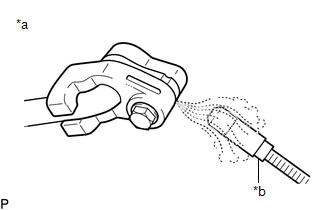
(d) Bring the halogen leak detector close to the drain cooler hose with the detector power off, and then turn the detector on. HINT:
|
|
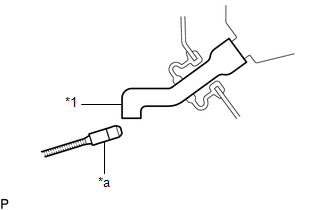
(e) If a refrigerant leak is not detected from the drain cooler hose, remove the blower motor control from the cooling unit. Insert the halogen leak detector sensor into the unit and check for leaks.
(f) Disconnect the pressure sensor connector and leave it for approximately 20 minutes. Bring the halogen leak detector close to the pressure sensor and check for leaks.
HINT:
When checking for leaks, the presence of oily dirt at a joint can indicate a leak.