Fuel Injection System
GENERAL INFORMATION
All vehicles with fuel-injected engines are equipped with a catalytic converter. The only adjustable parameter is the idle speed (see subsection 2.2.2).The fault code is indicated by a series of long (0.6 s) and short (0.3 s) flashes of the warning lamp and the red indicator on the control unit housing, separated by a 0.9 s interval. Long flashes indicate the first digit of the code, and short flashes indicate the second digit. After 2.1 s, the next stored fault code will be displayed. Diagnostics
PROCEDURE
1. Before concluding that the fuel injection system is faulty, check the filter for cleanliness, ignition timing, spark plug and valve clearances, and cylinder compression. Make sure the connectors are securely attached and free of corrosion.
2. If no faults are found, switch the control unit to self-diagnostic mode 2. The fault code is determined by the blinking of the red LED on the right side of the control unit.
3. Stored fault codes remain in the control unit memory until the 50th starter engagement.
4. If the fault does not reoccur during this period, it is erased automatically. The code can also be erased by switching the unit to mode 2 and then to mode 1, or by disconnecting the battery for more than 24 hours.
Entering self-diagnostic mode
PROCEDURE
1. Remove the fuse box cover that contains the control unit connector.
2. Turn the ignition on. This switches the control unit to mode 1.
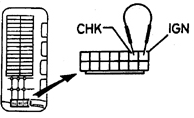
3. Connect the IGN and CHK terminals of the diagnostic connector with a jumper wire. After 2 seconds, the control unit switches to mode 2.
4. In mode 2, only the fault codes stored in the control unit memory are read. Warning: If codes 11 and 21 are displayed, check the crankshaft position sensor circuit before checking the ignition circuit.
5. On vehicles with a catalytic converter, when the control unit is switched to mode 2, the exhaust gas mixture monitoring mode is automatically activated during engine start.
6. If the indicators light up, the mixture is lean. If both indicators go out, the mixture is rich.
7. To check the oxygen sensor, start the engine, raise the speed to 2000 rpm, and observe either indicator for 2 minutes. With a normal sensor, the indicators will blink at least 5 times in 10 seconds.
8. To exit mode 2, connect the IGN and CHK terminals again for 2 seconds with the engine off, or turn the ignition off and disconnect the battery ground cable (with the engine running).
9. For a complete check of the fuel injection system, take the vehicle to a service station.
Code number/Faulty circuit: 11 crankshaft position sensor circuit; 12 air flow meter circuit; 13 coolant temperature sensor circuit; 21 ignition signal circuit; 34 knock sensor circuit; 43 throttle position sensor circuit; 55 all circuits operating normally
Test yourself
A quick Nissan Sunny quiz: every answer comes with an explanation and a link to the manual page.