Classifying high-voltage batteries
Fundamentals of classifying high-voltage batteries
The installed high-voltage batteries are highly complex components and systems that could be affected during their service life by defects, failure and partial failure.
The high-voltage battery could be damaged in a road traffic incident.
The substances contained in high-voltage batteries are hazardous materials.
The state of the high-voltage battery impacts the following service requirements and workshop processes:
- Special qualification requirements of service employees EIP, HVT and HVE.
- Repairability of high-voltage battery
- Packaging and transport process for high-voltage batteries
- Quarantine and reporting processes to be carried out
Important
- To assess the hazard potential of the high-voltage battery, classify the high-voltage battery.
The high-voltage battery can be assigned to 3 states:
- "NORMAL", not critical: no measures need to be taken.
- "WARNING", critical: failure to observe the recommended measures may lead to fatal/serious injury.
- "DANGER", dangerous: failure to observe the recommended measures will lead to fatal/serious injury.
Carry out assessment based on classification matrix.
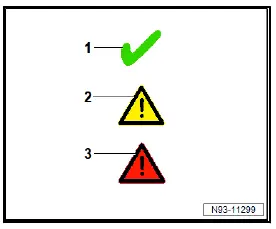
Classification matrix
Assessment criteria:
Visual, sensory:
- No relevant mechanical damage.
- No fluid leaks.
Functional, electric:
- High-voltage battery can be diagnosed.
- No relevant entries in event memory.
Thermal:
- Temperature within tolerance.
Classification:
- NORMAL
Not critical: No measures have to be taken.
Fulfilment of ALL criteria results in classification "NORMAL".
Visual, sensory:
- Relevant mechanical damage, e.g. dent, crack, opening, defective seal.
- Corrosion damage.
- Pungent smell.
Functional, electric:
- High-voltage battery cannot be diagnosed.
- Relevant entries in event memory.
Thermal:
- Temperature outside tolerance
Classification:
WARNING
Critical: Failure to observe the recommended measures may lead to fatal/ serious injury.
Fulfilment of ONE criterion results in classification "WARNING"
Assessment criteria:
Visual, sensory:
- Fluid leak, suspected fluid in high-voltage battery system.
- Sparks, smoke or vapour.
- Signs of fire.
- Unusual noises inside the high-voltage battery, e.g.
crackling or hissing.
- Mechanical damage with exposed, accessible contacts/ conductors.
- Accessibility of highvoltage battery for temperature measurements, e.g. due to missing or damaged body parts, surface temperature of high-voltage battery higher than 80ºC
Thermal:
- Temperature ≥ 80ºC.
Classification:
DANGER
Dangerous: Failure to observe the recommended measures will lead to fatal/ serious injury.
Fulfilment of ONE criterion results in classification "DANGER".
Matrix of measures
Classification:
NORMAL
Immediate measure:
- Not necessary.
Other measures and processes:
Repair according to Workshop Manual:
- Repair if necessary.
Intermediate storage/ quarantine:
- Original packaging
- Not stacked, flat on ground.
- Stored undercover outside and protected against rain.
Packaging and transport:
- Original packaging
Classification:
WARNING
Immediate measure:
- Quarantine
- Bring outside or into quarantine area/ quarantine cabinet.
- Use PPE.
Other measures and processes:
Repair according to Workshop Manual:
- Implement disposal measures if repair not possible.
- Transfer to not critical status possible through repair.
Intermediate storage/ quarantine:
- Inform responsible party in accordance with reporting procedure.
- Move highvoltage vehicle/ highvoltage battery to suitable outside area/ space.
- Protect removed highvoltage battery against moisture.
Packaging and transport:
- Special transport crate required (may need to be dismantled).
- May only be packaged by trained personnel.
Carry out additional actions as instructed by HVE.
Classification:
DANGER
Immediate measure:
- Keep a safe distance.
- Observe highvoltage vehicle/ highvoltage battery.
- Have fire extinguishing equipment ready and at the first sign of fire immediately notify the fire service and evacuate the building.
- Do not inhale smoke/ gas.
Wear mask.
- If the highvoltage battery has suffered mechanical damage with exposed, accessible contacts or conductors, do not touch the vehicle or the highvoltage battery.
- Quarantine highvoltage vehicle/ highvoltage battery if possible.
- Cordon off a large area and inform responsible party as per reporting procedure.
- Use PPE.
Other measures and processes:
Repair according to Workshop Manual:
- Not relevant.
Intermediate storage/ quarantine:
- Quarantine vehicle/ battery and call fire service if necessary.
- Observe highvoltage vehicle/ highvoltage battery.
Packaging and transport:
- Do not package.
- Do not transport.
Classification procedure
- The classification is software-based and carried out with the aid of "Guided Functions" via ODIS.
- Measured values of cell voltages and temperature sensors are collected, the event memory is interrogated, communication with the battery regulation control unit is checked.
- Classification can be carried out with the high-voltage battery fitted in the vehicle or removed.
- Only an HVE may reclassify the battery based on an assessment specific to the case.
Procedural diagram
Visual, sensory, function, electric and thermal assessment.
Criteria:
- Signs of fire?
- Sparks, smoke, vapour noticeable?
- Noise from high-voltage battery, e.g. crackling?
- Pungent smell?
- Fluid leak or suspected fluid in high-voltage battery system?
- Severe mechanical damage to high-voltage battery?
- Temperature and cell voltage measurement?
- Functional check of highvoltage battery?
Classification
- NORMAL (not critical)
- WARNING (critical)
- DANGER (dangerous)
Classification of high-voltage batteries with aid of ODIS
Special tools and workshop equipment required
- Diagnosis interface VAS 6154A - VAS 6154A-
- High-voltage diagnostics box -CN- - VAS 5581A
Assessing condition
With high-voltage battery installed:
- ⇒ Vehicle diagnostic tester Connect.
- Carry out classification with ⇒ Vehicle diagnostic tester.
Continued
With high-voltage battery removed:
- Connect high-voltage diagnostics box -CN- - VAS 5581Ausing vehicle-specific test adapters to communication connector of high-voltage battery.
- Switch on high-voltage diagnostics box -CN- - VAS 5581A- .
- Connect to ⇒ Vehicle diagnostic tester via diagnostics interface - VAS 6154A- or USB cable.
- Carry out classification with ⇒ Vehicle diagnostic tester.