Distinction of types of plastic

In this manual: Distinction of types of plastic
Basic information on body repairs — 1Explanation of symbols — 1Overview of materials used — 1Joining and separating techniques — 1Surface repair — 1Corrosion protection — 1Noise insulation — 1Plastic repair — 1General notes - windows — 1Self-adhesive components — 1Noises — 1Resistance spot welding — 1Solid rivet — 1Pop rivet — 1Incorrect riveting — 1Overview of riveting attachments — 1Making a flow-drill screw connection, pre-drilled hole in upper part — 1Distinction of types of plastic — 1Processing instructions - original products — 1Preparing plastic repair — 1Repairing deformations — 1Bonding plastic attachments — 1Welding plastic attachments — 1Glass repair- Introduction — 1Carrying out glass repair — 1General notes on the use of adhesives — 1Preparing old undamaged windows for installing — 1Preparing new windows for installation — 1Installation instructions for bonded windows — 1Bonding log — 1Preparing gas strut for disposal — 1Preparing rear lid drive unit VX69/rear lid drive unit 2 VX77 for disposal — 1Causes of water ingress — 1Locating water ingress — 1Interior equipment — 1Compartments/covers — 1Equipment — 1Centre console — 1Front centre armrest — 1Interior mirror — 1Passenger protection — 1Seat belts — 1Child seat anchors — 1Airbag system — 1Airbag control unit — 1Front airbag, driver side — 1Front passenger airbag — 1Side airbags — 1Curtain airbags — 1Airbag crash sensors — 1Seat belt verification — 1Seat occupied recognition — 1Trim, insulation — 1Front door trims — 1Rear door trims — 1Dash panel — 1Central tube for dash panel — 1Interior trims — 1Luggage compartment trims — 1Roof trims — 1Seat frames — 1Overview of seat variants — 1Front seats — 1Rear seats — 1Seat - padding, covers — 1Front seat covers and padding — 1Rear seat covers and padding — 1Technical data — 1Body - front — 1Lock carrier — 1Wings — 1Technical data — 1Air conditioning system — 1Overview of fitting locations - air conditioning system, R134a/R1234yf — 1Overview of fitting locations - air conditioning system, R744 — 1Refrigerant circuit, R134a/R1234yf — 1Refrigerant circuit, R744 — 1Valve unit of heat pump, R744 — 1Air conditioner compressor, R134a/R1234yf — 1Air conditioner compressor, R744 — 1Control motors, vehicles without air conditioner operating unit at rear — 1Control motors, vehicles with air conditioner operating unit at rear — 1Front heater and air conditioning unit, R134a/R1234yf — 1Front heater and air conditioning unit, R744 — 1Air duct — 1Coolant circuit, rear-wheel drive — 1Coolant circuit, all-wheel drive — 1Operating and display unit — 1Other controlling and regulating components — 1Air quality improvement system — 1Technical data — 1Brake test — 1Electrical components — 1Anti-lock brake system — 1Control unit and hydraulic unit — 1Separating control unit from and connecting to hydraulic unit — 1Connecting brake lines to hydraulic unit — 1Sensors — 1Brakes - mechanism — 1Front brake — 1Rear brake — 1Parking brake — 1Brake pedal — 1Brakes - hydraulics — 1Brake servo and brake master cylinder — 1Hydraulic system — 1Technical data — 1Fitting locations — 1Senders/sensors/control units — 1Adaptive cruise control — 1Reversing camera system — 1Front camera for driver assist systems — 1Overhead view camera — 1Electric drive systems- Safety information and repair notes — 1Classifying high-voltage batteries — 1Packaging high-voltage batteries — 1Packaging critical high-voltage batteries with "Warning" status — 1Bulkhead — 1Bonnet, rear lid — 1Bonnet — 1Rear lid — 1Charging flap unit — 1Front doors, door components, central locking — 1Door — 1Door components — 1Central locking — 1Rear doors, door components — 1Door — 1Door components — 1Sunroof — 1Sliding sunroof — 1Water drain hoses — 1Bumpers — 1Bumper, front — 1Bumper, rear — 1Glazing — 1Windscreen — 1Rear windscreen — 1Side windows — 1Door windows — 1Exterior equipment — 1Spoiler — 1Mouldings, trims, extensions — 1Underbody cladding — 1Roof moulding and roof railing — 1Exterior mirror — 1Wheel housing liner — 1Lettering and emblems — 1Towing bracket — 1Technical data — 1Vehicle identification data — 1Safety information — 1Body parts and materials — 1Technical data — 1Alignment jig — 1Body - front — 1Overview of fitting locations — 1Longitudinal member cross panel — 1Longitudinal member — 1Assembly overview - front right longitudinal member, part section — 1Battery tray — 1Front wheel housing — 1Body - centre — 1Overview of fitting locations — 1Roof — 1A-pillar — 1B-pillar — 1Side member — 1Body - rear — 1Rear cross member — 1Rear cross panel — 1Luggage compartment floor — 1Rear longitudinal member — 1Side panel — 1Rear wheel housing — 1Technical data — 1Controls, housing — 1Removing and installing gearbox — 1Gearbox housing, clutch housing — 1Final drive - differential — 1Technical data — 1Controls, housing — 1Gearbox housing, clutch housing — 1Gear oil — 1Final drive - differential — 1Explanation of symbols — 1Paintwork structure — 1Areas exposed to stone chipping — 1Seam seals, front body — 1Seam seals, bonnet, inner side — 1Seam seals, doors — 1Seam seals, underbody — 1Underseal — 1Cavity sealing — 1Technical data — 1Overview of fitting locations - components/control units in centre section of vehicle — 1Overview of fitting locations - components/control units in rear section of vehicle — 1Overview of fitting locations - components/control units in centre section of vehicle — 1Overview of fitting locations - components/control units in rear section of vehicle — 1Components/control units — 1Multifunction steering wheel — 1Technical data — 1Identification — 1Electrical components — 1Hazard classification of high-voltage system — 1Removing and installing engine — 1Removing and installing front motor — 1Removing and installing rear motor — 1Removing and installing rear motor — 1Front assembly mountings — 1Cooling — 1Cooling system/coolant — 1Coolant pump/coolant regulation — 1Radiator, radiator fan — 1Electric drive systems — 1High-voltage components, charging unit for high-voltage battery and voltage converter — 1High-voltage components, charging unit for high-voltage battery with integrated voltage converter — 1Warning stickers — 1High-voltage battery unit, edge of upper part of battery housing without wax — 1High-voltage battery components, edge of upper part of battery housing without wax — 1High-voltage battery unit, edge of upper part of battery housing with wax — 1High-voltage battery components, edge of upper part of battery housing with wax — 1Power and control electronics for electric drive — 1Electric drive motor — 1Electric drive motor — 1Motor control unit — 1De-energising high-voltage system — 1Potential equalisation lines — 1Charging socket, with charging cable — 1Charging socket, with separate charging cable — 1Charging unit for high-voltage battery — 1Charging unit for high-voltage battery, with integrated voltage converter — 1Vehicle noise/engine sound — 1Accelerator pedal — 1Voltage converter — 1High-voltage cables, all-wheel drive — 1High-voltage cables, rear-wheel drive — 1Technical data — 1Starter, current supply, CCS — 1Assembly overview - battery — 1Removing and installing battery [A] — 1Disconnecting and connecting battery — 1Removing and installing earth wire with battery monitor control unit [J367] — 1Gauges, instruments — 1Dash panel insert — 1Horn — 1Windscreen wash/wipe system — 1Windscreen wiper system — 1Windscreen washer system — 1Rear window wiper system ID4 — 1Rear window washer system — 1Lights, bulbs, switches - exterior — 1Headlights — 1Lights in exterior mirror — 1Tail lights — 1High-level brake light — 1Number plate light — 1Entry and start authorisation system — 1Steering column switch module — 1Towing bracket — 1Lights, bulbs, switches - interior — 1Lights — 1Controls — 1Anti-theft alarm system — 1Cigarette lighter, socket — 1Wiring — 1Relay carriers, fuse holders, electronics boxes — 1Control units — 1Technical data — 1Front suspension — 1Front axle — 1Subframe — 1Suspension strut, upper suspension link — 1Lower suspension link, swivel joint — 1Wheel bearing — 1Drive shaft — 1Anti-roll bar — 1Rear suspension — 1Rear axle — 1Subframe — 1Anti-roll bar — 1Suspension link, track rod — 1Suspension strut, shock absorber, spring — 1Wheel bearing assembly, trailing arm — 1Drive shaft — 1Self-levelling suspension — 1Electronic damping control — 1Vehicle level sender — 1Wheels, tyres, vehicle geometry — 1Wheel alignment — 1Wheels, tyres — 1Steering — 1Steering wheel — 1Steering column — 1Steering rack — 1
2steps
~12min
1/5difficulty
Done 0 of 2

Plastics are classified into thermoplastics, thermosets and elastomers based on their chemical structure and behaviour when heated.

Thermoplastics and thermosets are often used in the automotive industry.

Elastomers are currently used to a limited extent in the automotive industry.

In addition, composite materials are used in the automotive industry.

Identification

Most plastic attachments are marked with a standard code -5-.

The standard code -5- indicates the composition and is located on the inside of the plastic attachment.

Important

  • To view the standard code -5-, it may be necessary to remove the plastic attachment.

The standard code -5- indicates the type of plastic, additives or strengtheners. The standard code -5- consists of the symbol ">", an abbreviation for the type of plastic and ends with the symbol "<". The abbreviations stand for:

  • Base polymer
  • Special characteristics
  • Type, properties and strengthener content
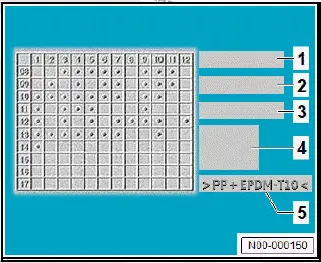
Volkswagen ID.4. Distinction of types of plastic

Base polymer

Designates the polymer or polymer blend from which the plastic attachment was manufactured.

For polymer blends, the individual polymers are separated by the symbol "+" and are indicated in descending order by their mass fraction.

Example >PP+EPDM<: A blend consisting of polypropylene (PP) and ethylene propylene diene rubber (EPDM). The main component is polypropylene.

All vehicles (continued)

Special characteristics

Special characteristics of a base polymer, such as foamed, chlorinated, high strength or low density, are indicated after the base polymer separated by a hyphen ("-").

Example: >PE-HD<: A high-density (HD) polyethylene. Abbreviations of the special characteristics can also be indicated after the actual polymer, e.g. >HDPE<.

All vehicles (continued)

Type, properties and strengthener content

Strengthener additives are indicated with 1 or 2 letters after the polymer. The letters are separated from the base polymer by a hyphen "-". The first letter refers to the type of additive and the second letter refers to the properties of the additive.

Abbreviations of additives, strengtheners and properties:

Volkswagen ID.4. Type, properties and strengthener content

Plastic reinforced with glass fibres is marked with the letters "GF" and the mass fraction of the additive.

Example >UPGF30<: Unsaturated polyester (UP) containing 30 % of glass fibres as a strengthener.

All vehicles (continued) Talcum is another additive. Talcum is marked with the letter "T" or "TD", talcum in powder form.

Example >PP-T10<: Polypropylene (PP) containing 10 % of talcum as a strengthener.

All vehicles (continued)

Thermoplastic

Thermoplastics are a brittle or viscoplastic plastics at normal temperature that can soften and be deformed when heated.

After cooling, thermoplastics solidify and regain their original properties.

When thermoplastics come into contact with solvents, they can dissolve or swell.

Important

  • When thermoplastics are welded, the material must be determined to identify the appropriate welding rod material and the welding temperature.

When welding, a higher mechanical strength can be achieved compared to bonding. It is recommended to weld fractures and cracks in thermoplastics.

Properties and areas of application:

Designation/ Abbreviation:

Polyethylene/ PE

Properties:

  • excellent electrical properties
  • high resistance to water and humidity
  • low temperature resistance

Areas of application:

Fuel tank, wheel housing trims, bumper cover, air ducts

Designation/ Abbreviation:

Polypropylene/ PP

Properties:

  • high chemical resistance
  • good mechanical and electrical properties
  • higher thermal stability compared to polyethylene

Areas of application:

Bumper cover, headlight housing, wheel housing liners, battery housing, housing of heater and air conditioning unit

Designation/ Abbreviation:

Acrylonitrilebutadiene styrene/ ABS

Properties:

  • high stiffness, surface hardness and toughness
  • addition of metal coating and glass fibres possible

Areas of application:

Air ducts, wheel trims, sun visors, exterior mirror housing

Designation/ Abbreviation:

Polyamide/ PA

Properties:

  • high resistance against material fatigue
  • high impact and abrasion resistance
  • good mechanical characteristics
  • reinforcement with glass fibres possible

Areas of application:

Air ducts, wheel trims, exterior mirror housing

Designation/ Abbreviation

Polycarbonate / PC

Properties:

  • high stiffness, toughness and impact resistance
  • transparent in its original state

Areas of application:

Bumper cover, spoiler, air ducts, headlight

Designation Abbreviation:

PP and PE copolymer/ P/E

Properties:

  • by adding ethyl, polypropylene achieves a significantly higher impact resistance

Areas of application:

Bumper cover

Designation / Abbreviation

Acrylic-styrene- acrylonitrile/ ASA

Properties:

  • high strength and surface hardness

Important

  • acrylic-styrene- acrylonitrile must not be welded

Areas of application:

Air ducts, exterior mirror housing

Thermosetting plastics

Thermosetting plastics are brittle and viscoplastic plastics that do not soften or melt when heated. After exceeding the decomposition temperature, thermosetting plastics decompose and carbonise without changing shape.

When thermosetting plastics are subjected to a sufficiently high external force, their higher stiffness results in immediate material fracture without prior deformation.

Thermosetting plastics have a high resistance to chemicals, so they hardly swell and do not dissolve in solvents.

Important

  • Due to their properties, thermosetting plastics may only be bonded for repairs.

Properties and areas of application:

Designation /Abbreviation:

Epoxy resin / EP

Properties:

  • excellent adhesion to plastics
  • addition of strengtheners possible

Areas of application:

Adhesives for plastic repairs

Designation /Abbreviation:

Unsaturated polyester2)/ UP

Properties:

  • excellent mechanical characteristics
  • high resistance to chemicals
  • often reinforced with glass fibres

Areas of application:

Bumper cover, grille, flaps, exterior attachments of commercial vehicles

Elastomers

Elastomers are characterised by a high elasticity over a wide temperature range.

Elastomers deform when pressure is applied from the outside.

Without pressure, elastomers return to their original shape.

When elastomers are heated, they become soft but do not melt.

When the decomposition temperature of elastomers is exceeded, they decompose or carbonise.

Important

  • Due to their properties, elastomers may only be bonded for repairs

Polyurethane and ethylene propylene diene rubber are the elastomers most commonly used in the automotive industry.

Polyurethane

Polyurethane (PUR or PU) can have different chain structures depending on the manufacturing process and can be a thermoplastic, thermosetting plastic or elastomer.

Elastomers can be produced as a foam and are suitable as a reinforcement in bumper covers, dash panels or steering wheels.

Ethylene propylene diene rubber:

Ethylene propylene diene rubber s(EPDM) is often used in the production of bumper covers in combination with polypropylene or polypropylene copolymer and polyethylene to achieve a higher elasticity and impact resistance.

  1. Not assigned
  2. Unsaturated polyester, generally reinforced with glass fibres, is rarely used in the automotive industry.