Evse Inspection
- 120v/240v Evse
- 120v Evse
120v/240v Evse Nissan Ariya 2026
Symptom Table
Charge by EVSE is composed of three factors, which are vehicle, EVSE and power supply outlet and it is necessary to determine which factor is causing the concerns.
For shape, refer to Component Description.
TYPE A
 |
Power outlet for normal charge |  |
Genuine NISSAN adapter |  |
EVSE |
 |
Nissan Ariya Vehicle |
TYPE B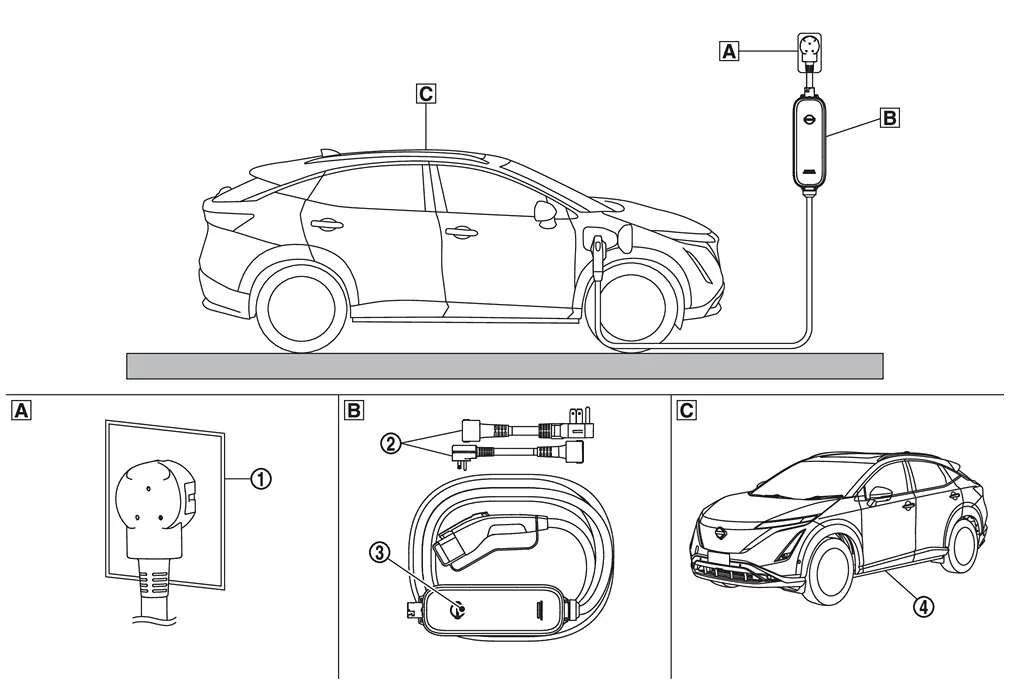
|
Power outlet for normal charge | |
Exchangeable plug | |
EVSE |
|
Nissan Ariya Vehicle |
CONFIRMATION OF USAGE EVSE
Confirm the usage EVSE when symptoms occurred.
For shape, refer to Component Description.
Which EVSE is used?
>>TYPE A: GO TO 2.
>>TYPE B: GO TO 4.
CONFIRMATION OF USAGE AC POWER SOURCE
Confirm the usage AC power source when symptoms occurred.
Which AC power source is used?
>>Only 240 V is used: GO TO 5.
>>Only 120 V is used: GO TO 3.
>>Both 120 V and 240 V are used: GO TO 3.
CHECK GENUINE NISSAN ADAPTER
Confirm that symptom is occurred with the following combination.
Customer's Genuine NISSAN adapter
Outlet that is confirmed to operate normally (120 V power outlet)
EVSE that is confirmed to operate normally
Nissan Ariya Vehicle that is confirmed to operate normally
Does the symptom occur?
YES>>Replace Genuine NISSAN adapter.
NO>>GO TO 5.
CHECK EXCHANGEABLE PLUG
Confirm that symptom is occurred with the following combination.
Customer's exchangeable plug
Outlet that is confirmed to operate normally (120 V or 240 V power outlet)
EVSE that is confirmed to operate normally
Nissan Ariya Vehicle that is confirmed to operate normally
Does the symptom occur?
YES>>Replace exchangeable plug.
NO>>GO TO 5.
SYMPTOM CONFIRMATION PROCEDURE
Perform the following procedure with each combination of patterns to check the status of the indicator lamp (LED) on the control box (EVSE) and the DTC.
| Pattern 1 |
|
| Pattern 2 |
|
| Pattern 3 |
|
| Pattern 1 |
|
| Pattern 2 |
|
| Pattern 3 |
|
Turn power switch ON.
Erase "self-diagnostic result." using CONSULT.
Turn OFF the charging timer.
Turn power switch OFF.
Connect the EVSE side plug to the power outlet and confirm the illumination of the control box indicator lamp (LED). (Charge connector is not connected to normal charge port.)
Connect the charge connector to the normal charge port and confirm the illumination of the control box indicator lamp (LED).
Disconnect the charge connector.
Turn power switch ON.
Perform "all self-diagnostics" using CONSULT. When DTC is detected, perform diagnosis of the corresponding DTC.
Turn power switch OFF.
Disconnect the EVSE side plug from the power outlet.
GO TO 6.
CONTROL BOX INDICATOR LAMP (LED) ILLUMINATING STATUS CHECK RESULT
Charge connector is not connected to normal charge port.
X: Potential possibility
<Control box indicator lamp (LED) illuminating status: TYPE A> Combination pattern Control box indicator lamp status Possible cause Content Occurrence pattern Correspondence 1 2 3 Nissan Ariya Vehicle EVSE Power outlet □ □ □ READY: ON (Green)
POWER: OFF
FAULT: OFF
ー ー ー ― ― Connect the charge connector to the normal charging port and check the illuminating status of the control box indicator lamp (LED). □ □ □ All LED lamps OFF ー X X No AC voltage input.
Possibility of cable disconnection or concerns inside the control box or EVSE plug line.
When symptoms occurred in pattern 1 and 3. Replace EVSE. When symptoms do not occur with Pattern 1 to 3. Since it is estimated that there is an abnormality on the customer's outlet side, Whether it is dedicated wiring work according to NISSAN recommended work, Request confirmation to installation site. □ □ □ READY: Blink (Green)
POWER: OFF
FAULT: OFF
ー X X Outlet 'Earth' insufficient (Ground contact resistance large).
There is a possibility that outlet earth is not connected.
When symptoms occurred in pattern 1 and 3. Replace EVSE. When symptoms do not occur with Pattern 1 to 3. Since it is estimated that there is an abnormality on the customer's outlet side, Whether it is dedicated wiring work according to NISSAN recommended work, Request confirmation to installation site. □ □ □ READY: Blink (Green)
POWER: OFF
FAULT: OFF
ー X X Outlet 'ground' insufficient (Ground contact resistance large).
There is a possibility that outlet ground is not connected.
When symptoms occurred in pattern 1 and 3. Replace EVSE. When symptoms do not occur with Pattern 1 to 3. Since it is estimated that there is an abnormality on the customer's outlet side, Whether it is dedicated wiring work according to NISSAN recommended work, Request confirmation to installation site. □ □ □ READY: ON (Green)
POWER: OFF
FAULT: ON (Red)
ー X ー EVSE electric leak detection function is abnormal.
Possibility of concerns inside the control box
When symptoms occurred in pattern 1 and 3. Replace EVSE. □ □ □ READY: ON (Green)
POWER: Blink (Orange)
FAULT: ON (Red)
ー X ー Relay abnormality.
Possibility of concerns inside the control box
When symptoms occurred in pattern 1 and 3. Replace EVSE. □ □ □ READY: ON (Green)
POWER: OFF
FAULT: Blink (Red)
ー X ー Signal line voltage concerns or electric leakage is occurred inside in the control box.
Possibility of concerns inside the control box
When symptoms occurred in pattern 1 and 3. Replace EVSE. □ □ □ READY: Blink (Green)
POWER: OFF
FAULT: Blink (Red)
ー X ー Operation of EVSE plug overheat protection (High temperature)
Insufficient connection between the plug (include NISSAN genuine adapter) and the outlet.
Concerns on thermistor inside the EVSE plug.
When symptoms occurred in pattern 1 and 3. Replace EVSE. □ □ □ READY: Blink (Green)
POWER: OFF
FAULT: ON (Red)
ー X ー EVSE temperature detection function is abnormal (Short circuit, Disconnection).
Concerns on thermistor inside the EVSE plug.
When symptoms occurred in pattern 1 and 3. Replace EVSE. X: Potential possibility
<Control box indicator lamp (LED) illuminating status: TYPE B> Combination pattern Control box indicator lamp status Possible cause Content Occurrence pattern Correspondence 1 2 3 Nissan Ariya Vehicle EVSE Power outlet □ □ □ READY: ON (Green)
POWER: OFF
FAULT: OFF
ー ー ー ― ― Connect the charge connector to the normal charging port and check the illuminating status of the control box indicator lamp (LED). □ □ □ All LED lamps OFF ー X X No AC voltage input.
Possibility of cable disconnection or concerns inside the control box.
When symptoms occurred in pattern 1 and 3. Replace EVSE. When symptoms do not occur with Pattern 1 to 3. Since it is estimated that there is an abnormality on the customer's outlet side, Whether it is dedicated wiring work according to NISSAN recommended work, Request confirmation to installation site. □ □ □ READY: Blink (Green)
POWER: OFF
FAULT: OFF
ー X X Outlet 'Earth' insufficient (Ground contact resistance large).
There is a possibility that outlet earth is not connected.
When symptoms occurred in pattern 1 and 3. Replace EVSE. When symptoms do not occur with Pattern 1 to 3. Since it is estimated that there is an abnormality on the customer's outlet side, Whether it is dedicated wiring work according to NISSAN recommended work, Request confirmation to installation site. □ □ □ READY: Blink (Green)
POWER: OFF
FAULT: OFF
ー X X Outlet 'ground' insufficient (Ground contact resistance large).
There is a possibility that outlet ground is not connected.
When symptoms occurred in pattern 1 and 3. Replace EVSE. When symptoms do not occur with Pattern 1 to 3. Since it is estimated that there is an abnormality on the customer's outlet side, Whether it is dedicated wiring work according to NISSAN recommended work, Request confirmation to installation site. □ □ □ READY: ON (Green)
POWER: OFF
FAULT: ON (Red)
ー X ー EVSE electric leak detection function is abnormal.
Possibility of concerns inside the control box
When symptoms occurred in pattern 1 and 3. Replace EVSE. □ □ □ READY: ON (Green)
POWER: Blink (Orange)
FAULT: ON (Red)
ー X ー Relay abnormality.
Possibility of concerns inside the control box
When symptoms occurred in pattern 1 and 3. Replace EVSE. □ □ □ READY: ON (Green)
POWER: OFF
FAULT: Blink (Red)
ー X ー Signal line voltage concerns or electric leakage is occurred inside in the control box.
Possibility of concerns inside the control box
When symptoms occurred in pattern 1 and 3. Replace EVSE. □ □ □ READY: Blink (Green)
POWER: OFF
FAULT: Blink (Red)
ー X ー Operation of EVSE plug overheat protection (High temperature)
Insufficient connection between the plug (exchangeable plug) and the outlet.
Concerns on thermistor inside the EVSE.
When symptoms occurred in pattern 1 and 3. Replace EVSE. □ □ □ READY: Blink (Green)
POWER: OFF
FAULT: ON (Red)
ー X ー EVSE temperature detection function is abnormal (Short circuit, Disconnection).
Concerns on thermistor inside the EVSE plug.
When symptoms occurred in pattern 1 and 3. Replace EVSE. Charge connector is connected to normal charge port.
X: Potential possibility
<Control box indicator lamp (LED) illuminating status: TYPE A> Combination pattern Control box indicator lamp status Possible cause Content Occurrence pattern Correspondence 1 2 3 Nissan Ariya Vehicle EVSE Power outlet □ □ □ READY: ON (Green)
POWER: ON (Orange)
FAULT: OFF
ー ー ー ー ー The Nissan Ariya vehicle, EVSE and power outlet are normal. □ □ □ READY: ON (Green)
POWER: OFF
FAULT: OFF
X X ー Charging does not start.
There is a possibility that cable has been disconnected between the charge connector and the control box.
There is a possibility that connection between charge connector and Nissan Ariya vehicle normal charge port was insufficient. (Concerns on EVSE or normal charge port)
There is a possibility that the Nissan Ariya vehicle has concerns and charging prohibited.
When symptoms occurred in pattern 1 and 3. Replace EVSE. When symptoms occurred in pattern 1 and 2. Check whether the EV system warning lamp is on turn on the power supply position and the EV system warning lamp is lit If it is, please check according to the detected DTC.
Check the normal charging port. Refer to Component Inspection .
□ □ □ READY: Blink (Green)
POWER: OFF (Orange)
FAULT: OFF
ー X X Outlet 'ground' insufficient (Ground contact resistance large).
There is a possibility that outlet ground is not connected.
Disconnection of earth line of EVSE
When symptoms occurred in pattern 1 and 3. Replace EVSE. When symptoms do not occur with Pattern 1 to 3. Since it is estimated that there is an abnormality on the customer's outlet side, Whether it is dedicated wiring work according to NISSAN recommended work, Request confirmation to installation site. □ □ □ READY: ON (Green)
POWER: OFF
FAULT: ON (Red)
ー X ー EVSE electric leak detection function is abnormal.
Possibility of concerns inside the control box.
When symptoms occurred in pattern 1 and 3. Replace EVSE. □ □ □ READY: ON (Green)
POWER: Blink (Orange)
FAULT: ON (Red)
ー X X Relay abnormality , relay welding detection function is abnormal or outlet power supply is abnormal.
Possibility of concerns inside the control box.
Possibility of outlet wired to the wrong power supply.
When symptoms occurred in pattern 1 and 3. Replace EVSE. When symptoms do not occur with pattern 1 to 3. Since it is estimated that there is an abnormality on the customer's outlet side, whether it is dedicated wiring work according to regulations and standards, Request confirmation to installation site.
When used with a 240 V outlet, the outlet must be connected to a single phase power supply obtained from delta connection. If connected to other power supply, EVSE does not work normally. Refer to Component Description (120V/240V EVSE) or Component Description (120V EVSE).□ □ □ READY: ON (Green)
POWER: OFF
FAULT: Blink (Red)
X X ー Electric leak between EVSE control box and on-board charger or signal line voltage concerns.
Possibility of concerns inside the control box.
Possibility that Nissan Ariya vehicle has concerns. (Between charge port and on-board charger)
When symptoms occurred in pattern 1 and 3. Replace EVSE. When symptoms occurred in pattern 1 and 2. Perform AC leakage check. Refer to Insulation Resistance Check . □ □ □ READY: Blink (Green)
POWER: Blink (Orange)
FAULT: ON (Red)
ー X ー EVSE temperature detection function is abnormal (Short circuit, Disconnection) and Charge current limit.
Insufficient connection between plug and the outlet.
Concerns on thermistor inside the EVSE plug.
When symptoms occurred in pattern 1 and 3. Replace EVSE. □ □ □ READY: Blink (Green)
POWER: Blink (Orange)
FAULT: Blink (Red)
ー X X Operation of EVSE plug overheat protection (High temperature) and Charge current limit.
Insufficient connection between plug and the outlet.
When symptoms occurred in pattern 1 and 3. Replace EVSE. When symptoms do not occur with Pattern 1 to 3. Since it is estimated that there is an abnormality on the customer's outlet side, Whether it is dedicated wiring work according to NISSAN recommended work, Request confirmation to installation site. □ □ □ All LED lamps OFF
(After connecting the charge connector)X X X Power outlet side breaker shut down immediately after connecting the charging connector to the Nissan Ariya vehicle.
Electric leak and/or short on vehicle side.
Electric leak and/or short on EVSE.
Insufficient power outlet.
When symptoms occurred in pattern 1 and 3. Replace EVSE. When symptoms occurred in pattern 1 and 2. Perform AC leakage check. Refer to Insulation Resistance Check . When symptoms do not occur with Pattern 1 to 3. Since it is estimated that there is an abnormality on the customer's outlet side, Whether it is dedicated wiring work according to NISSAN recommended work, Request confirmation to installation site. X: Potential possibility
<Control box indicator lamp (LED) illuminating status: TYPE B> Combination pattern Control box indicator lamp status Possible cause Content Occurrence pattern Correspondence 1 2 3 Nissan Ariya Vehicle EVSE Power outlet □ □ □ READY: ON (Green)
POWER: ON (Orange)
FAULT: OFF
ー ー ー ー ー The Nissan Ariya vehicle, EVSE and power outlet are normal. □ □ □ READY: ON (Green)
POWER: OFF
FAULT: OFF
X X ー Charging does not start.
There is a possibility that cable has been disconnected between the charge connector and the control box.
There is a possibility that connection between charge connector and Nissan Ariya vehicle normal charge port was insufficient. (Concerns on EVSE or normal charge port)
There is a possibility that the Nissan Ariya vehicle has concerns and charging prohibited.
When symptoms occurred in pattern 1 and 3. Replace EVSE. When symptoms occurred in pattern 1 and 2. Check whether the EV system warning lamp is on turn on the power supply position and the EV system warning lamp is lit If it is, please check according to the detected DTC.
Check the normal charging port. Refer to Component Inspection .
□ □ □ READY: Blink (Green)
POWER: OFF (Orange)
FAULT: OFF
ー X X Outlet 'ground' insufficient (Ground contact resistance large).
There is a possibility that outlet ground is not connected.
Disconnection of earth line of EVSE
When symptoms occurred in pattern 1 and 3. Replace EVSE. When symptoms do not occur with Pattern 1 to 3. Since it is estimated that there is an abnormality on the customer's outlet side, Whether it is dedicated wiring work according to NISSAN recommended work, Request confirmation to installation site. □ □ □ READY: ON (Green)
POWER: OFF
FAULT: ON (Red)
ー X ー EVSE electric leak detection function is abnormal.
Possibility of concerns inside the control box.
When symptoms occurred in pattern 1 and 3. Replace EVSE. □ □ □ READY: ON (Green)
POWER: Blink (Orange)
FAULT: ON (Red)
ー X X Relay abnormality , relay welding detection function is abnormal or outlet power supply is abnormal.
Possibility of concerns inside the control box.
Possibility of outlet wired to the wrong power supply.
When symptoms occurred in pattern 1 and 3. Replace EVSE. When symptoms do not occur with pattern 1 to 3. Since it is estimated that there is an abnormality on the customer's outlet side, whether it is dedicated wiring work according to regulations and standards, Request confirmation to installation site.
When used with a 240 V outlet, the outlet must be connected to a single phase power supply obtained from delta connection. If connected to other power supply, EVSE does not work normally. Refer to Component Description (120V/240V EVSE) or Component Description (120V EVSE).□ □ □ READY: ON (Green)
POWER: OFF
FAULT: Blink (Red)
X X ー Electric leak between EVSE control box and on-board charger or signal line voltage concerns.
Possibility of concerns inside the control box.
Possibility that Nissan Ariya vehicle has concerns. (Between charge port and on-board charger)
When symptoms occurred in pattern 1 and 3. Replace EVSE. When symptoms occurred in pattern 1 and 2. Perform AC leakage check. Refer to Insulation Resistance Check . □ □ □ READY: Blink (Green)
POWER: Blink (Orange)
FAULT: ON (Red)
ー X ー EVSE temperature detection function is abnormal (Short circuit, Disconnection) and Charge current limit.
Insufficient connection between plug and the outlet.
Concerns on thermistor inside the EVSE.
When symptoms occurred in pattern 1 and 3. Replace EVSE. □ □ □ READY: Blink (Green)
POWER: Blink (Orange)
FAULT: Blink (Red)
ー X X Operation of EVSE plug overheat protection (High temperature) and Charge current limit.
Insufficient connection between plug and the outlet.
When symptoms occurred in pattern 1 and 3. Replace EVSE. When symptoms do not occur with Pattern 1 to 3. Since it is estimated that there is an abnormality on the customer's outlet side, Whether it is dedicated wiring work according to NISSAN recommended work, Request confirmation to installation site. □ □ □ All LED lamps OFF
(After connecting the charge connector)X X X Power outlet side breaker shut down immediately after connecting the charging connector to the Nissan Ariya vehicle.
Electric leak and/or short on vehicle side.
Electric leak and/or short on EVSE.
Insufficient power outlet.
When symptoms occurred in pattern 1 and 3. Replace EVSE. When symptoms occurred in pattern 1 and 2. Perform AC leakage check. Refer to Insulation Resistance Check . When symptoms do not occur with Pattern 1 to 3. Since it is estimated that there is an abnormality on the customer's outlet side, Whether it is dedicated wiring work according to NISSAN recommended work, Request confirmation to installation site.
If there is no problem with the combination of patterns 1 to 3, since it is presumed that there is an abnormality on the side of the customer outlet, make a confirmation to the installation work source as to whether it is dedicated wiring work according to Nissan recommended work.
120v Evse Nissan Ariya first Gen
Symptom Table
Charge by EVSE is composed of three factors, which are vehicle, EVSE and power supply outlet and it is necessary to determine which factor is causing the concerns.
For shape, refer to Component Description.
TYPE A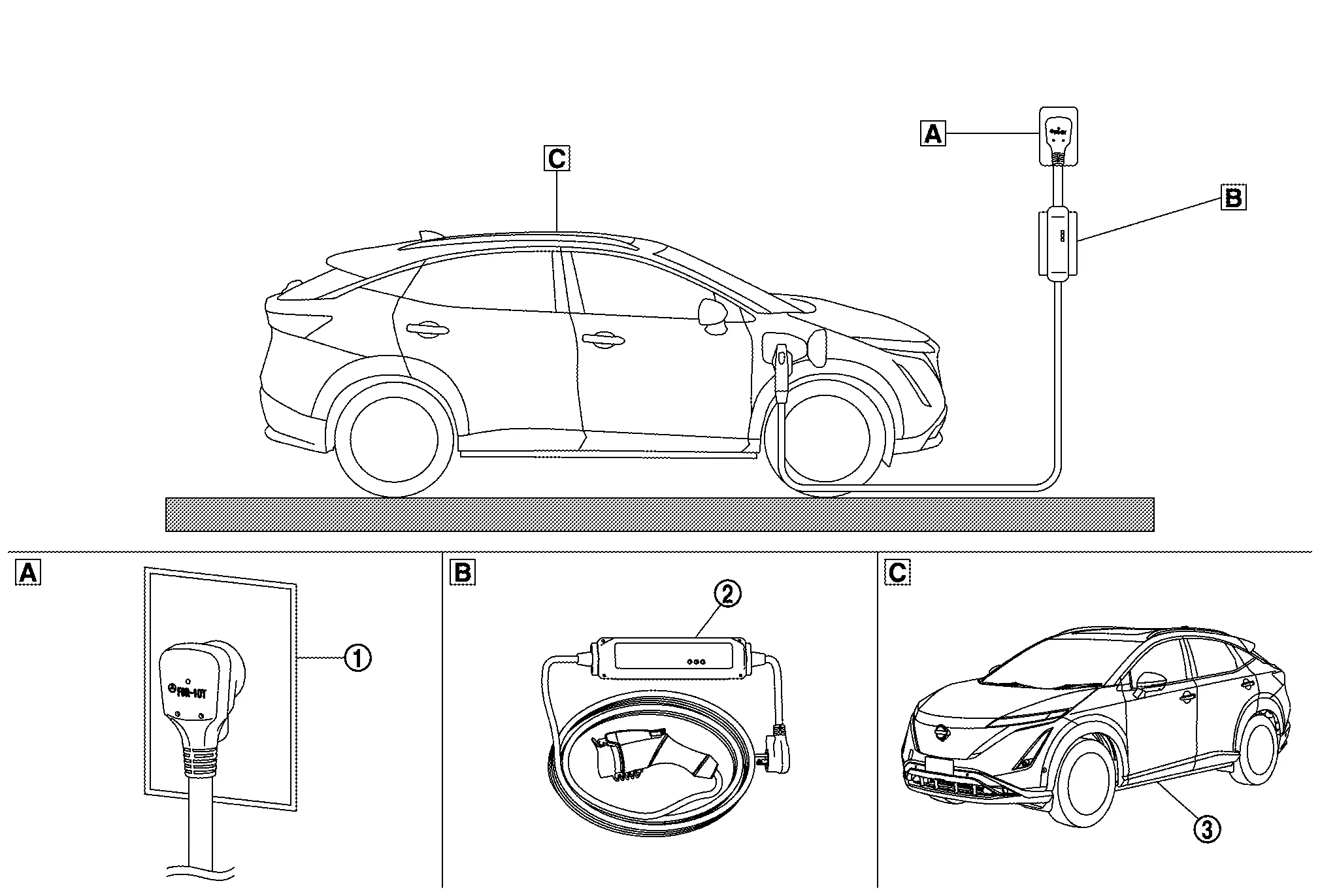
|
Power outlet for normal charge | |
EVSE | |
Nissan Ariya Vehicle |
TYPE B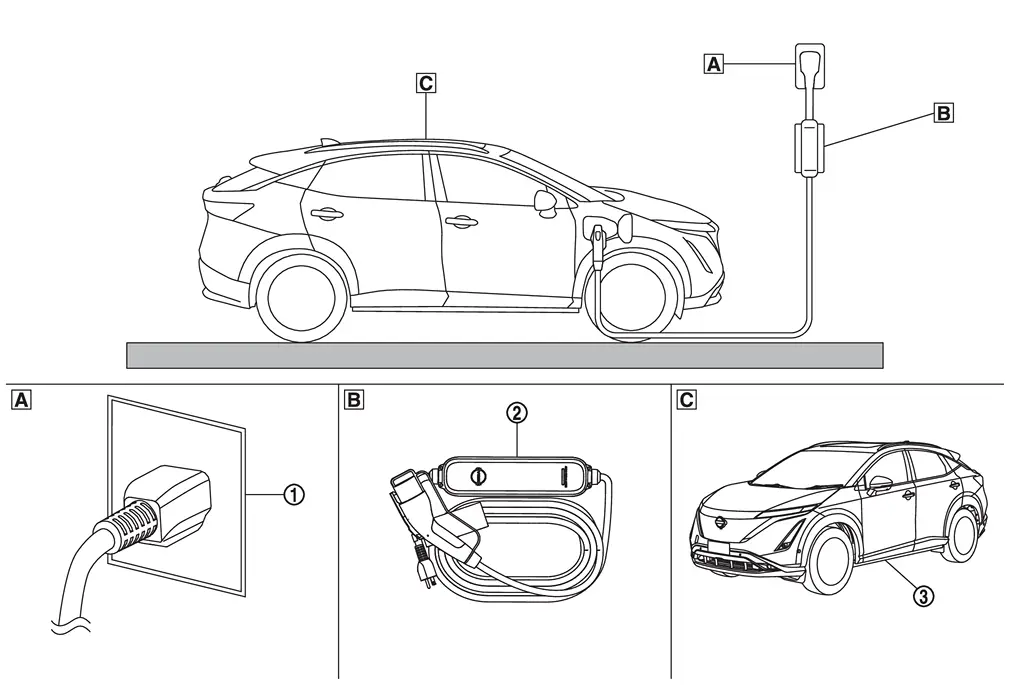
|
Power outlet for normal charge | |
EVSE | |
Nissan Ariya Vehicle |
Symptom confirmation procedure
Perform the following procedure with each combination of patterns to check the status of the indicator lamp (LED) on the control box (EVSE) and the DTC.
| Pattern 1 |
|
| Pattern 2 |
|
| Pattern 3 |
|
Turn power switch ON.
Erase "self-diagnostic result." using CONSULT.
Turn OFF the charging timer.
Turn power switch OFF.
Connect the EVSE plug to the power outlet and confirm the illumination of the control box indicator lamp (LED). (Charge connector is not connected to normal charge port.)
Connect the charge connector to the normal charge port and confirm the illumination of the control box indicator lamp (LED).
Disconnect the charge connector.
Turn power switch ON.
Perform "all self-diagnostics" using CONSULT. When DTC is detected, perform diagnosis of the corresponding DTC.
Turn power switch OFF.
Disconnect the EVSE plug from the power outlet.
GO TO 2.
Control box indicator lamp (LED) illuminating status check result
Charge connector is not connected to normal charge port.
X: Potential possibility
<Control box indicator lamp (LED) illuminating status> Combination pattern Control box indicator lamp status Possible cause Content Occurrence pattern Correspondence 1 2 3 Nissan Ariya Vehicle EVSE Power outlet □ □ □ READY: ON (Green)
CHARGE: OFF
FAULT: OFF
ー ー ー ― ― Connect the charge connector to the normal charging port and check the illuminating status of the control box indicator lamp (LED). □ □ □ READY: Blink (Green)
CHARGE: OFF
FAULT: OFF
ー X X Outlet 'Earth' insufficient (Ground contact resistance large).
There is a possibility that outlet earth is not connected.
When symptoms occurred in pattern 1 and 3. Replace EVSE. When symptoms do not occur with Pattern 1 to 3. Since it is estimated that there is an abnormality on the customer's outlet side, Whether it is dedicated wiring work according to NISSAN recommended work, Request confirmation to installation site. □ □ □ READY: Blink (Green)
CHARGE: OFF
FAULT: OFF
ー X X Outlet 'ground' insufficient (Ground contact resistance large).
There is a possibility that outlet ground is not connected.
When symptoms occurred in pattern 1 and 3. Replace EVSE. When symptoms do not occur with Pattern 1 to 3. Since it is estimated that there is an abnormality on the customer's outlet side, Whether it is dedicated wiring work according to NISSAN recommended work, Request confirmation to installation site. □ □ □ All LED lamps OFF ー X X No AC voltage input.
Possibility of cable disconnection or concerns inside the control box or EVSE plug line.
When symptoms occurred in pattern 1 and 3. Replace EVSE. When symptoms do not occur with Pattern 1 to 3. Since it is estimated that there is an abnormality on the customer's outlet side, Whether it is dedicated wiring work according to NISSAN recommended work, Request confirmation to installation site. □ □ □ READY: ON (Green)
CHARGE: OFF
FAULT: ON (Red)
ー X ー Relay abnormality
Possibility of concerns inside the control box
When symptoms occurred in pattern 1 and 3. Replace EVSE. □ □ □ READY: ON (Green)
CHARGE: OFF
FAULT: Blink (Red)
ー X ー Signal line voltage concerns.
Possibility of concerns inside the control box
When symptoms occurred in pattern 1 and 3. Replace EVSE. □ □ □ READY: Blink (Green)
CHARGE: OFF
FAULT: Blink (Red)
ー X ー Operation of EVSE plug overheat protection (High temperature)
EVSE temperature detection function is abnormal (Short circuit, Disconnection).
Insufficient connection between the plug and the outlet.
Concerns on thermistor inside the EVSE plug.
When symptoms occurred in pattern 1 and 3. Replace EVSE. Charge connector is connected to normal charge port.
X: Potential possibility
<Control box indicator lamp (LED) illuminating status> Combination pattern Control box indicator lamp status Possible cause Content Occurrence pattern Correspondence 1 2 3 Nissan Ariya Vehicle EVSE Power outlet □ □ □ READY: ON (Green)
CHARGE: ON (Orange)
FAULT: OFF
ー ー ー ー ー The Nissan Ariya vehicle, EVSE and power outlet are normal. □ □ □ READY: ON (Green)
CHARGE: OFF
FAULT: OFF
X X ー Charging does not start.
There is a possibility that cable has been disconnected between the charge connector and the control box.
There is a possibility that connection between charge connector and Nissan Ariya vehicle normal charge port was insufficient. (Concerns on EVSE or normal charge port)
There is a possibility that the Nissan Ariya vehicle has concerns and charging prohibited.
When symptoms occurred in pattern 1 and 3. Replace EVSE. When symptoms occurred in pattern 1 and 2. Check whether the EV system warning lamp is on turn on the power supply position and the EV system warning lamp is lit If it is, please check according to the detected DTC.
Check the normal charging port. Refer to Component Inspection.
□ □ □ READY: Blink (Green)
CHARGE: OFF (Orange)
FAULT: OFF
ー X X Outlet 'ground' insufficient (Ground contact resistance large).
There is a possibility that outlet ground is not connected.
Disconnection of earth line of EVSE
When symptoms occurred in pattern 1 and 3. Replace EVSE. When symptoms do not occur with Pattern 1 to 3. Since it is estimated that there is an abnormality on the customer's outlet side, Whether it is dedicated wiring work according to NISSAN recommended work, Request confirmation to installation site. □ □ □ READY: ON (Green)
CHARGE: OFF
FAULT: ON (Red)
ー X ー EVSE electric leak detection function is abnormal or relay abnormality .
Possibility of concerns inside the control box.
When symptoms occurred in pattern 1 and 3. Replace EVSE. □ □ □ READY: ON (Green)
CHARGE: OFF
FAULT: Blink (Red)
X X ー Electric leak between EVSE control box and on-board charger or signal line voltage concerns.
Possibility of concerns inside the control box.
Possibility that Nissan Ariya vehicle has concerns. (Between charge port and on-board charger)
When symptoms occurred in pattern 1 and 3. Replace EVSE. When symptoms occurred in pattern 1 and 2. Perform AC leakage check. Refer to Insulation Resistance Check. □ □ □ READY: Blink (Green)
CHARGE: Blink (Orange)
FAULT: Blink (Red)
ー X X EVSE temperature detection function is abnormal (Short circuit, Disconnection) and Charge current limit or Operation of EVSE plug overheat protection (High temperature) and Charge current limit.
Insufficient connection between plug and the outlet.
Concerns on thermistor inside the EVSE plug.
When symptoms occurred in pattern 1 and 3. Replace EVSE. When symptoms do not occur with Pattern 1 to 3. Since it is estimated that there is an abnormality on the customer's outlet side, Whether it is dedicated wiring work according to NISSAN recommended work, Request confirmation to installation site. □ □ □ All LED lamps OFF
(After connecting the charge connector)X X X Power outlet side breaker shut down immediately after connecting the charging connector to the Nissan Ariya vehicle.
Electric leak and/or short on vehicle side.
Electric leak and/or short on EVSE.
Insufficient power outlet.
When symptoms occurred in pattern 1 and 3. Replace EVSE. When symptoms occurred in pattern 1 and 2. Perform AC leakage check. Refer to Insulation Resistance Check. When symptoms do not occur with Pattern 1 to 3. Since it is estimated that there is an abnormality on the customer's outlet side, Whether it is dedicated wiring work according to NISSAN recommended work, Request confirmation to installation site.
If there is no problem with the combination of patterns 1 to 3, since it is presumed that there is an abnormality on the side of the customer outlet, make a confirmation to the installation work source as to whether it is dedicated wiring work according to NISSAN recommended work.