EVAP leak check
In this manual: EVAP leak check
10steps
~60min
3/5difficulty
Done 0 of 10
Inspection
CAUTION:
- Do not use compressed air or a high pressure pump.
- Do not exceed 4.12 kPa (0.042 kg/cm2, 0.6 psi) of pressure in EVAP system.
NOTE:
- Do not start engine.
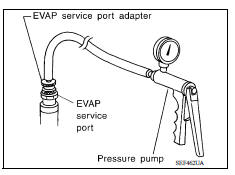
- Improper installation of EVAP service port adapter [commercial service tool: (J-41413-OBD)] to the EVAP service port may cause a leak.
1.EVAP LEAK CHECK
With CONSULT
- Install EVAP service port adapter [commercial service tool: (J- 41413-OBD)] and pressure pump to EVAP service port.
- Turn ignition switch ON.
- Select the "EVAP SYSTEM CLOSE" in "WORK SUPPORT" mode of "ENGINE" using CONSULT.
- Touch "START". A bar graph (Pressure indicating display) will appear on the screen.
- Apply positive pressure to the EVAP system until the pressure indicator reaches the middle of the bar graph.
- Remove EVAP service port adapter [commercial service tool: (J- 41413-OBD)] and hose with pressure pump.
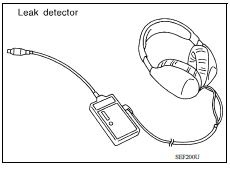
7. Locate the leak using a leak detector [commercial service tool: (J-41416)]. Refer to EC, "EVAPORATIVE EMISSION SYSTEM : System Description".

Without CONSULT
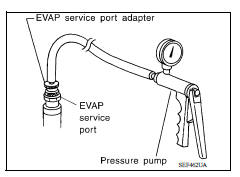
- Install EVAP service port adapter [commercial service tool: (J- 41413-OBD)] and pressure pump to EVAP service port.
- Apply battery voltage between the terminals of EVAP canister vent control valve to make a closed EVAP system.
- To locate the leak, deliver positive pressure to the EVAP system until pressure gauge points reach 1.38 to 2.76 kPa (0.014 to 0.028 kg/cm2, 0.2 to 0.4 psi).
- Remove EVAP service port adapter [commercial service tool: (J- 41413-OBD)] and hose with pressure pump.
5. Locate the leak using a leak detector [commercial service tool: (J-41416)]. Refer to EC, "EVAPORATIVE EMISSION SYSTEM : System Description".
>> INSPECTION END
Was this page helpful?